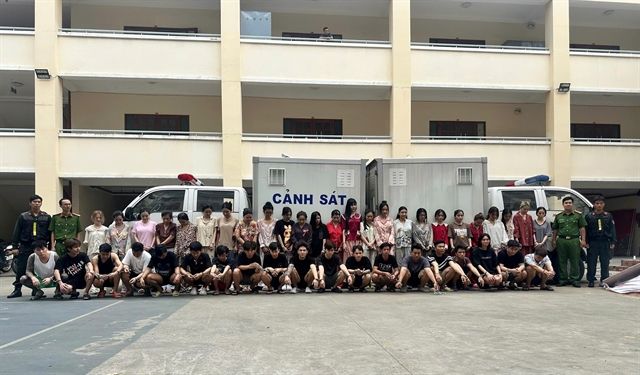
In a significant crackdown on an emerging drug threat, law enforcement in Ho Chi Minh City has taken 49 people into custody on suspicion of trafficking a lethal synthetic drug hidden inside electronic cigarettes. Among those detained are four foreign nationals from South Korea, China and Cambodia, according to an announcement from the city's narcotics investigation unit on Wednesday. The operation represents one of the most elaborate schemes yet uncovered in Vietnam involving the misuse of pharmaceutical substances through vaping devices, signalling a troubling adaptation by criminal networks to evade traditional drug detection.
The seized contraband included 1,670 vape cartridges containing etomidate, a potent surgical anaesthetic normally reserved for hospital operating theatres and controlled administration by medical professionals. Investigators also recovered hundreds of grams of ketamine and methamphetamine, indicating that the dismantled syndicate operated across multiple illicit substances simultaneously. Etomidate's addition to Vietnam's government-controlled substances list only five months earlier in January underscores how rapidly criminal organisations identify and exploit regulatory gaps in emerging technologies and chemical alternatives.
Police records show that the network deliberately disguised the nature of their product through deceptive marketing. Etomidate-laced pods were packaged and sold under appealing brand names deliberately calculated to attract young consumers—labels such as "chill pod", "relaxation pod", "sleep-well pod" and "fly pod" created a false impression of benign stress relief products. This rebranding strategy parallels how illegal operators worldwide adapt mainstream consumer language to mask dangerous substances. The pods were then distributed through venues with high concentrations of young people, including bars, karaoke establishments, and private rental accommodations, greatly expanding their reach.
The investigation originated from intelligence about an individual operating under the alias Ba Giá, subsequently identified as Nguyen Huu Huan, a 28-year-old from Dong Thap Province in southern Vietnam. Officers tracked his activities on An Duong Vuong Street in Ho Chi Minh City's An Lac Ward, where he conducted transactions in electronic cigarettes. His arrest on June 25 alongside his wife, Ngo Thi Kim Chi, 30, following a sale to a local resident named Tran Phuc, 31, provided the critical breakthrough that unravelled the broader operation. This initial intervention proved instrumental in exposing two separate supply chains feeding the retail distribution network.
The first upstream supplier network was operated by Huynh Ngoc Thuy Nhu, 26, with assistance from Hua Tuong Vy, 20, both based in Ho Chi Minh City itself. The second, and more geographically significant, pipeline was controlled by Le Quoc Duy, 40, from An Giang Province along Vietnam's southwestern border with Cambodia. Duy's operation represents a critical vulnerability in regional border security, as he systematised smuggling routes through minor border crossings to transport contraband directly from Cambodia into Vietnam before redistributing supplies to the capital. From his operations alone, authorities seized 37 vape pods plus 200 grams each of ketamine and methamphetamine, demonstrating the scale and diversity of his trafficking.
A third supplier faction headed by Han Kiat, a Cambodian national, and three other foreign collaborators operated a parallel distribution channel targeting the expatriate community residing in Ho Chi Minh City. This specialisation within the criminal enterprise highlights how sophisticated modern drug trafficking has become, with different groups targeting distinct demographic and socioeconomic segments. The involvement of multiple foreign nationals suggests a transnational dimension to the operation, likely reflecting broader Southeast Asian organised crime networks capitalising on Vietnam's position as a crucial hub for regional smuggling routes.
The pharmacological danger posed by etomidate creates particular concern for public health authorities across the region. Unlike nicotine, which primarily affects the nervous system through well-understood mechanisms, etomidate when inhaled penetrates lung tissue and enters the bloodstream almost instantaneously, reaching the brain within seconds. Initial symptoms may appear deceptively mild—light-headedness and slight hallucinations—potentially encouraging continued use. However, acute complications can rapidly develop, including severe neurotoxicity, extreme drowsiness, involuntary muscle contractions and complete loss of consciousness. Most alarmingly, high doses or concurrent consumption with alcohol or other central nervous system depressants can precipitate sudden respiratory failure and death, a risk profile particularly acute given that young users are unlikely to understand drug interactions or dosing protocols.
The market appeal of these vapes stems partly from a critical gap in consumer detection capabilities. Standard rapid drug testing kits available commercially can identify conventional narcotics including heroin, cannabis and methamphetamine through established chemical markers. Etomidate's distinct molecular structure falls outside the detection parameters of these commonplace tests, making users vulnerable to unwittingly consuming the substance while believing they possess ordinary products. Only sophisticated laboratory analysis equipment operated by official police and forensic agencies can accurately identify etomidate, placing ordinary consumers at significant disadvantage and creating an illusion of safety through false-negative test results.
For Malaysia and other Southeast Asian nations, the Ho Chi Minh City case provides urgent lessons about emerging drug trafficking methodologies. The exploitation of vaping technology represents a fundamental evolution in how criminal networks distribute controlled substances, leveraging the legitimacy of legal e-cigarette commerce to obscure their illegal operations. The cross-border smuggling component—particularly the Cambodia-Vietnam-Ho Chi Minh City pipeline—demonstrates how porous regional borders facilitate rapid redistribution of contraband. Similar vulnerabilities almost certainly exist across Malaysia's own borders, particularly in Sabah and Sarawak, where synthetic drug smuggling from neighbouring countries remains persistent.
The operation also illustrates how chemical innovation—whether through synthetic analogues of controlled drugs or pharmaceutical substances repurposed for recreational use—consistently outpaces regulatory frameworks. Vietnam's January listing of etomidate came only after the substance was already circulating illicitly, suggesting reactive rather than anticipatory policy approaches. Malaysian authorities should consider more proactive chemical surveillance mechanisms, enhanced coordination with regional counterparts, and investment in forensic capabilities that match the sophistication of evolving criminal methodologies.
Beyond enforcement, public education represents an equally critical intervention point. Young consumers' vulnerability to trendy packaging and misleading marketing reflects gaps in drug awareness programming, particularly regarding pharmaceutical substances and their dangers outside medical contexts. The police warning that criminals deliberately misrepresent etomidate as "undetectable" or "100 percent negative" exploits exactly this knowledge deficit. Educational campaigns across Malaysia should emphasise that appearance, packaging claims and even negative rapid tests provide no reliable guarantee of product safety, particularly with emerging substances deliberately engineered to evade conventional detection.
The international composition of the arrested network—involving South Korean, Chinese and Cambodian nationals—underscores how modern drug trafficking transcends national boundaries, requiring enhanced regional intelligence sharing and law enforcement coordination. ASEAN nations collectively face pressure from diversifying criminal networks exploiting the region's geographic position, porous borders and youthful population demographics. Malaysia's own recent experiences with synthetic drug epidemics demonstrate the severe societal costs when such networks establish distribution infrastructure unchecked. The Ho Chi Minh City dismantling, while significant, likely represents only one component of a much larger regional problem.

