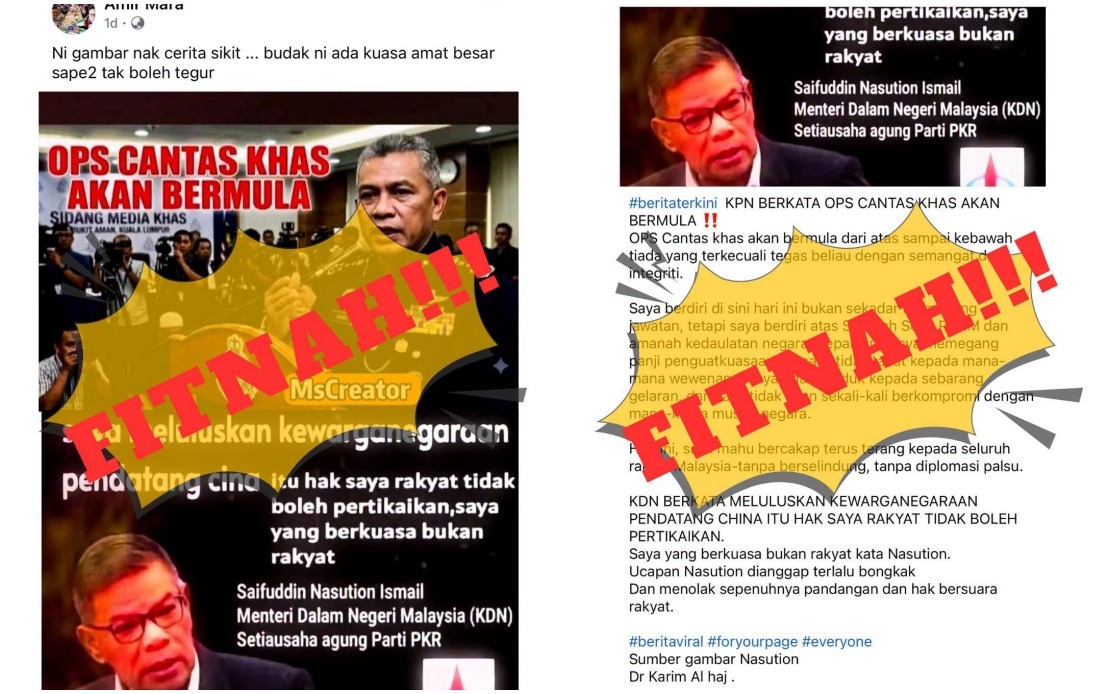
Home Minister Datuk Seri Saifuddin Nasution Ismail has categorically dismissed persistent allegations that the Home Ministry (KDN) conducted mass citizenship grants to foreign nationals, including claims involving 1.2 million Chinese nationals remaining unlawfully in Malaysia. Speaking from Putrajaya on August 19, Saifuddin Nasution characterised these narratives as deliberate misinformation campaigns that continue to circulate despite his repeated public denials and factual rebuttals.
The minister expressed frustration at the durability of these claims in the public discourse, noting that he has addressed them multiple times with documentation and official data. Despite these efforts, Saifuddin Nasution observed that certain actors persistently recycle discredited videos, posters and narratives through social media platforms, suggesting a coordinated strategy to undermine public trust rather than good-faith questioning of government policy.
Saifuddin Nasution stressed that the government has already provided comprehensive official explanations on this matter, with facts and evidence documented in previous ministerial statements and media coverage. He emphasised that these corrections represent the definitive position of the KDN, yet their repetition appears necessary given the persistence of misleading claims. This pattern reflects a broader challenge facing government institutions across Southeast Asia in combating false information that gains traction on social media despite official clarification.
The minister warned of the broader implications of spreading such allegations, moving beyond simple factual disputes to address systemic risks. He argued that defamatory claims of this nature damage not only individual and institutional reputations but, more critically, corrode public confidence in state institutions themselves. Such erosion of institutional credibility can have cascading effects on governance effectiveness and citizen cooperation with legitimate policy initiatives.
Beyond institutional concerns, Saifuddin Nasution highlighted the acute social and security dimensions of the misinformation campaign. He cautioned that these narratives possess considerable potential to incite racial hatred, disrupt public order and ultimately threaten national security by exploiting demographic sensitivities. Malaysia's multiethnic composition and history of communal tensions make such warnings particularly pertinent, as unfounded claims about citizenship and demographic change can rapidly mobilise anxiety across community lines.
The minister called upon all stakeholders to cease circulation of these claims, explicitly urging political actors and interest groups to refrain from weaponising sensitive issues for partisan advantage or social media engagement. This appeal represents an acknowledgment that such misinformation often serves specific political or commercial interests, incentivising its continued circulation even after official refutation. The problem extends beyond occasional sharing to systematic amplification by organised networks.
Saifuddin Nasution directed citizens to verify information directly through official government channels before accepting or disseminating claims. He emphasised the individual responsibility of social media users to engage in basic fact-checking before amplifying messages, particularly on matters involving sensitive national issues. This appeal to personal accountability reflects recognition that combating misinformation ultimately requires shifts in user behaviour rather than institutional fact-checking alone.
The minister's statement underscored a fundamental principle in information governance: the distinction between facts and interpretations. He asserted plainly that "facts are facts, and data is data," implying that government possesses the definitive quantitative and documentary evidence necessary to settle these questions conclusively. This framing positions the dispute not as a matter of differing political perspectives but as a conflict between verifiable reality and fabrication.
The persistence of citizenship-related claims reflects particular anxieties within Malaysia regarding immigration policy and demographic change. These allegations tap into longstanding concerns about border security and national identity, making them particularly resonant despite official denials. The willingness of some segments of society to credit these narratives despite government refutation suggests deeper underlying concerns about immigration transparency and citizenship procedures that may warrant broader policy communication efforts.
Saifuddin Nasution's response also implicitly acknowledges the challenge of information asymmetry in the digital age. Official statements, however detailed and factual, often struggle to compete with the emotional resonance and shareability of sensational claims. The viral nature of false narratives—particularly those evoking demographic or security concerns—creates situations where repetition by authorities themselves may inadvertently amplify reach, a dilemma facing communications strategies across government ministries in Malaysia and the region.
The statement carries implications for broader governance issues in Malaysia around institutional transparency and public engagement. While Saifuddin Nasution asserted that explanations have been provided, the continued circulation of these claims suggests possible gaps in how government reaches citizens, particularly those primarily consuming information through social media rather than official statements. This points toward the necessity of more sophisticated public communication strategies beyond traditional media.
For Malaysian policymakers and regional observers, this incident illustrates the vulnerability of even authoritative government institutions to coordinated misinformation campaigns. As Southeast Asia grapples with increasingly complex information environments, the experience with these citizenship allegations offers lessons about the importance of proactive transparency, rapid fact-checking capacity and community engagement strategies. The challenge extends beyond individual refutations to developing systemic resilience against misinformation targeting government institutions and sensitive national issues.

