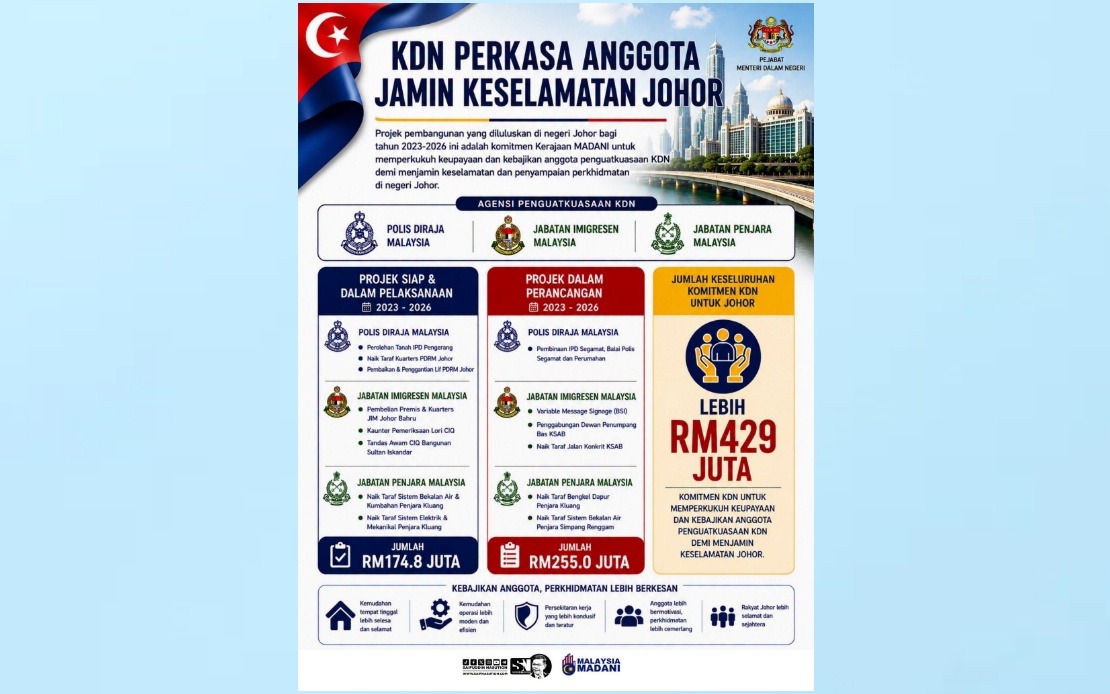
The Home Ministry has directed over RM429 million towards Johor's enforcement infrastructure and personnel development since 2023, marking a substantial commitment to the state's security apparatus. According to Home Minister Datuk Seri Saifuddin Nasution Ismail, this investment encompasses three critical agencies responsible for maintaining public order and national security: the Royal Malaysia Police (PDRM), the Malaysian Immigration Department (JIM), and the Malaysian Prisons Department. The scale of this allocation underscores the federal government's recognition of Johor's strategic importance as Malaysia's second-largest state by population and a vital economic zone adjacent to Singapore.
The minister articulated a comprehensive philosophy underpinning the spending strategy, framing personnel welfare not merely as an administrative benefit but as a cornerstone of operational effectiveness. When enforcement officers work in environments equipped with modern facilities, secure accommodation, and contemporary equipment, the resulting improvements in morale and efficiency translate directly into enhanced public safety outcomes. This approach reflects growing international recognition that security sector productivity depends fundamentally on the wellbeing of frontline personnel, a principle increasingly adopted across Southeast Asian law enforcement agencies.
The RM429 million commitment divides into two distinct implementation phases. RM174.8 million has been earmarked for projects either completed or actively progressing through construction and procurement stages, while RM255 million remains allocated for initiatives still in preliminary planning and design phases. This bifurcated structure suggests a realistic, phased approach to capital expenditure, ensuring manageable budgetary flows while maintaining momentum toward long-term infrastructure objectives. The allocation methodology reflects prudent financial management, avoiding the pitfall of over-committing resources that could strain operational budgets in other critical areas.
Current implementation projects reveal the practical dimensions of this investment strategy across Johor's enforcement landscape. The Pengerang District Police Headquarters project is acquiring land to establish a facility that will serve one of Johor's fastest-developing regions, while the Johor Bahru Immigration Department is securing office and residential premises to accommodate personnel managing one of Malaysia's busiest international border crossings. Simultaneously, Kluang Prison is receiving essential upgrades to fundamental facilities, addressing infrastructure deficiencies that directly impact both inmate conditions and staff working environments. These concurrent initiatives demonstrate coordinated planning across multiple agencies rather than siloed, competitive funding requests.
The pipeline of planned projects extends the vision beyond immediate needs into medium-term modernisation. The proposed Segamat District Police Headquarters will integrate operational police facilities with residential quarters in a consolidated complex, addressing persistent challenges of officer recruitment and retention in smaller towns where accommodation options remain limited. The consolidation of the bus passenger terminal at Sultan Abu Bakar Complex represents a pragmatic infrastructure optimisation that enhances security oversight at a major transportation hub. Kitchen workshop and water supply system upgrades at Kluang and Simpang Renggam prisons, while seemingly mundane, address fundamental operational requirements essential for maintaining facility standards and staff morale.
Saifuddin Nasution positioned this investment within the broader framework of the MADANI Government's commitment to equitable state development. He emphasised that resource allocation decisions reflect deliberate prioritisation of each state's specific requirements and developmental aspirations, rejecting any notion of arbitrary or politically-motivated distribution. This framing carries particular significance in Malaysia's federalist context, where state development allocations frequently become subjects of political scrutiny and intercommunal debate.
The minister's reference to Prime Minister Datuk Seri Anwar Ibrahim's recent parliamentary statement regarding Johor's enhanced budget allocation—now approximately RM14.6 billion compared to the previous RM10.2 billion—provides essential context for understanding this enforcement investment within Johor's broader fiscal picture. The substantial increase in overall state development funding suggests this RM429 million allocation reflects a coherent strategy of reinvestment in state institutions and public services rather than an isolated initiative. For Malaysian readers, particularly those in Johor, this represents tangible evidence of increased federal resources flowing toward their state's infrastructure and administrative capacity.
The emphasis on personnel welfare carries particular resonance across Southeast Asia, where enforcement agencies frequently struggle with recruitment, retention, and morale challenges. Malaysia's initiative to invest in officer accommodation, facility improvements, and workplace conditions demonstrates awareness that regional law enforcement effectiveness depends fundamentally on attracting and retaining quality personnel. As neighbouring countries face similar challenges in building professional security forces, Malaysia's proactive approach may establish benchmarks for regional best practice in personnel-focused budgeting.
For Johor specifically, these investments carry implications extending beyond immediate security considerations into broader economic and social development. The Pengerang police headquarters supports infrastructure development in the energy corridor, while immigration facility improvements enhance border management capacity relevant to cross-border commerce and tourism. Prisons upgrades contribute to rehabilitation programme delivery affecting reintegration outcomes across Johor's communities. The interconnected nature of these investments reflects sophisticated understanding that security, infrastructure, and social development advance together rather than in isolation.
The RM255 million allocated to planning-stage projects indicates sustained commitment extending beyond current fiscal cycles, suggesting these initiatives will progress regardless of future political transitions. This multi-year perspective proves crucial for major infrastructure development, allowing completion of complex projects without disruption from budgetary uncertainty. For Johor residents and businesses, it provides reasonable confidence in the continuity of these development initiatives across electoral cycles.
The strategic messaging around enforcement personnel welfare also resonates with workforce challenges across Malaysia's public service sector. As private sector opportunities increasingly compete for talented individuals, government commitment to improving working conditions in security agencies demonstrates recognition that attracting professional standards requires tangible investment in officer wellbeing. This principle applies equally to other public sector domains, suggesting the government's enforcement investment may catalyse broader public service modernisation.
Looking forward, successful implementation of these Johor initiatives will provide valuable evidence regarding the effectiveness of personnel-focused enforcement investment. The phased approach permits monitoring and adjustment as projects progress, while the geographic spread across Pengerang, Johor Bahru, Segamat, Kluang, and Simpang Renggam ensures no region feels neglected. For Malaysia's security architecture and for Johor's development trajectory, these investments represent meaningful reinforcement of state institutions serving 3.7 million citizens in a strategically vital region.

