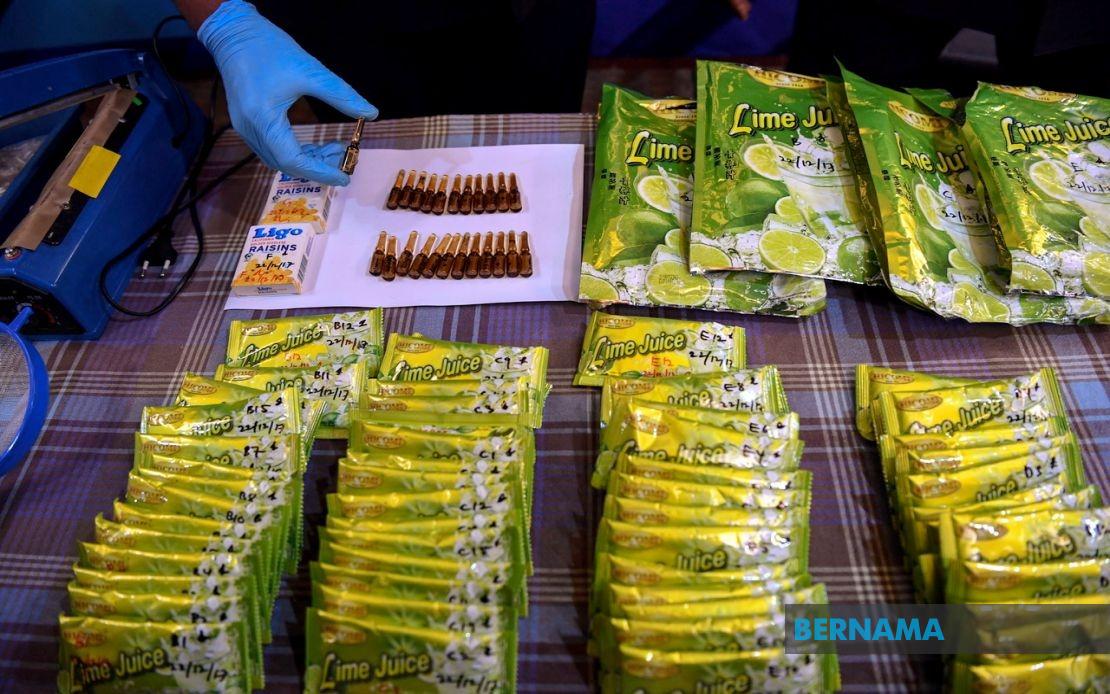
The Malaysian Home Ministry is mounting an aggressive nationwide campaign to stem the rising tide of synthetic drug trafficking and consumption, acknowledging that substances such as methamphetamine, fentanyl, and psychoactive pills locally known as "piu-piu" now constitute a critical security and public health threat. Home Minister Datuk Seri Saifuddin Nasution Ismail has cited the dangerous nature of these compounds, emphasizing their potency, addiction potential, and lethal overdose risk, alongside their documented connection to organised crime and community deterioration.
The scale of the synthetic drug problem has become increasingly evident through enforcement statistics. Between 2023 and June 2026, the Royal Malaysia Police recorded 238,704 arrests nationally across various synthetic drug-related offences, a figure that underscores the prevalence of these substances throughout the country. These numbers reflect not merely isolated cases but a systemic infiltration of drug networks across multiple population centres and demographic groups. The sheer volume of arrests suggests that authorities are contending with highly organised distribution networks rather than scattered opportunistic trafficking.
Central to the government's response is Operation Tapis and Operation Tapis Khas, comprehensive enforcement initiatives deployed across urban, semi-rural, and remote geographical zones. These operations represent a coordinated inter-agency effort involving the Royal Malaysia Police, the National Anti-Drugs Agency (AADK), and the Royal Malaysian Customs Department (JKDM), reflecting recognition that combating drug trafficking requires institutional coordination beyond any single enforcement body. The partnership acknowledges that synthetic drugs represent a cross-border challenge requiring customs vigilance, border intelligence, and community-level enforcement simultaneously.
Technology has become integral to the enforcement strategy. Authorities are deploying drones and surveillance camera networks to detect trafficking movements and identify distribution chokepoints, moving beyond traditional foot patrols and reactive investigations. This technological shift allows law enforcement to establish persistent monitoring of high-risk zones and trafficking corridors, potentially disrupting supply chains before drugs reach street-level markets. The investment in technological infrastructure also suggests recognition that traditional enforcement methods alone cannot match the sophistication of criminal networks profiting from synthetic drug distribution.
The legislative framework is undergoing refinement to address the speed at which criminal chemists develop new variants. The government is considering amendments to the Dangerous Drugs Act 1952 to explicitly schedule newly emerging synthetic drugs and New Psychoactive Substances (NPS) under the Act's controlled substances list. This legislative adaptation is crucial because synthetic drug manufacturers continuously modify molecular structures to circumvent existing prohibitions, creating legal loopholes. By updating legislation to capture chemical families rather than individual compounds, authorities aim to close the regulatory gap that currently allows novel synthetic variants to circulate temporarily before being formally scheduled.
Sarawak's drug situation illustrates the challenge facing Malaysian law enforcement in reaching peripheral territories. Between January and June this year, authorities arrested 7,097 individuals across the state, comprising 342 traffickers, 1,314 drug possessors, and 5,441 drug users. The state's geography—characterised by limited road infrastructure, river transportation, and remoteness—creates enforcement complications absent in urban centres. Sarawak's borders with Kalimantan also introduce cross-border smuggling dynamics, as traffickers exploit less-monitored frontier zones. The arrest figures indicate substantial enforcement activity, yet the persistent user population suggests that supply disruption remains incomplete.
Material seizures in Sarawak during the same six-month period—418.01 kilogrammes valued at RM53.73 million—demonstrate substantial interception capacity yet simultaneously reveal the immense quantity trafficked. The high monetary valuation reflects the profitability driving continued trafficking despite enforcement risks. Additionally, authorities detained thirteen individuals under the Dangerous Drugs (Special Preventive Measures) Act 1985, a provision allowing preventive detention of individuals deemed likely to commit drug offences. Such provisions represent a substantial enforcement tool but also raise considerations about civil liberties in the pursuit of public safety.
Asset confiscation has recovered RM1.95 million in syndicate assets in Sarawak, disrupting the financial infrastructure supporting trafficking operations. When combined nationally, such forfeitures create financial pressure on criminal networks, though their ultimate impact depends on whether asset recovery exceeds criminal profits from drug sales. Against this backdrop, criminal networks continue recruiting operators, suggesting that enforcement costs remain manageable relative to trafficking revenues. The 131 hardcore drug addicts subjected to action under Section 39C of the Dangerous Drugs Act 1952 reflect a harm-minimisation approach alongside enforcement, though the effectiveness of such interventions depends on rehabilitation quality.
Prevention programmes have expanded substantially, with 1,144 community awareness initiatives conducted nationwide between 2023 and June 2026. These programmes aim to build community resilience against drug use through education and early intervention. However, the scale of prevention activities relative to national population suggests coverage limitations—particularly in rural and remote areas where transportation barriers and resource constraints limit programme reach. The prevention approach acknowledges that enforcement alone cannot resolve demand-side drivers of drug consumption, yet quantifying prevention programme impact remains methodologically challenging.
Forensic laboratory capabilities are being enhanced to identify emerging synthetic drug variants and profile consumption trends. This intelligence function feeds operational planning, enabling authorities to anticipate trafficking patterns rather than merely reacting to detected substances. The focus on fentanyl analogues and synthetic opioids reflects global trends, as pharmaceutical precursor diversion and illicit synthesis of potent opioids represent growing transnational challenges. Malaysia's forensic enhancement aligns it with regional and international law enforcement standards, facilitating intelligence sharing with neighbours and international partners.
The government's multifaceted approach—combining enforcement intensity, legislative adaptation, inter-agency coordination, technology deployment, asset recovery, and prevention programming—represents recognition that synthetic drug trafficking constitutes a complex criminal enterprise rather than a simple law-and-order problem. Yet success depends ultimately on whether enforcement pressure, legislative closure of loopholes, and prevention efforts combine to reduce both supply and demand faster than criminal networks adapt and exploit new opportunities. The challenge is particularly acute for peripheral states like Sarawak, where geographical factors advantage traffickers and resource constraints limit enforcement capacity.

