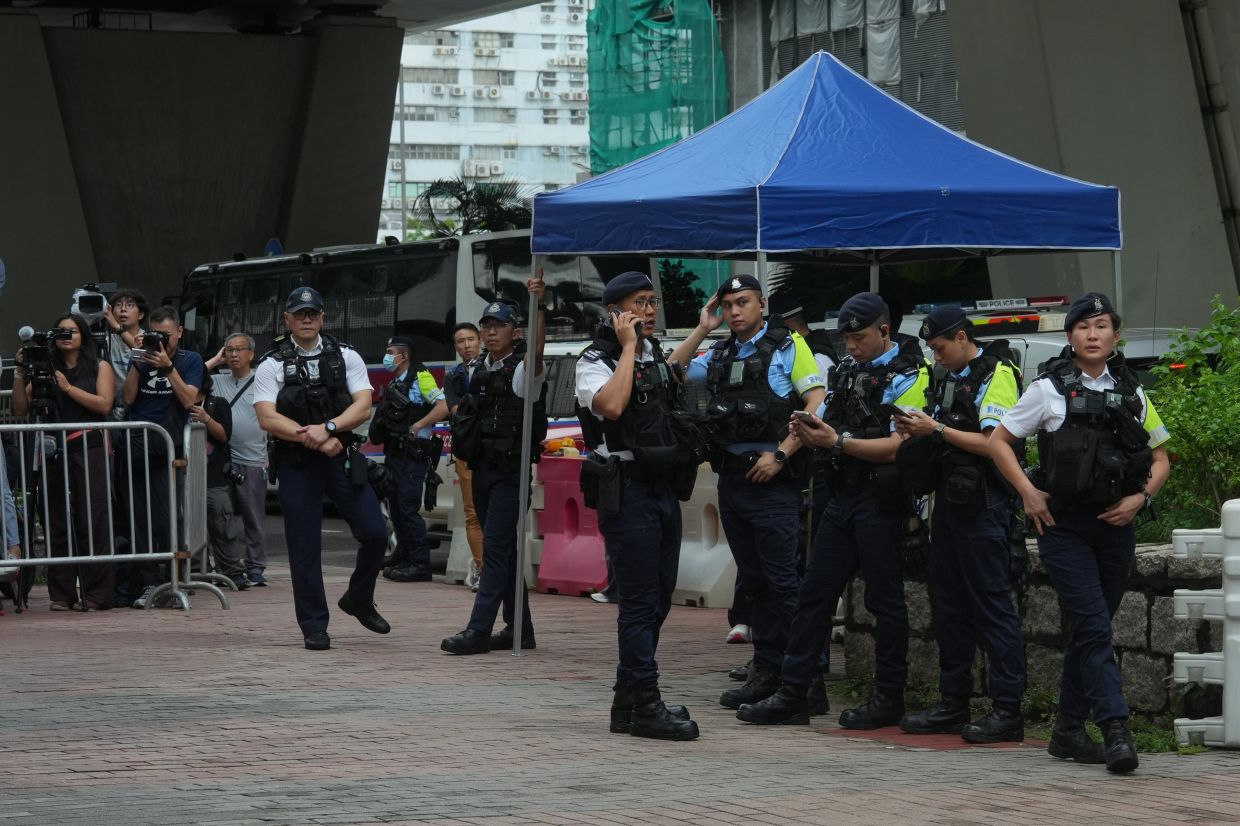
Hong Kong police have arrested a woman on suspicion of wearing a T-shirt carrying seditious messaging outside West Kowloon Court, in an incident that underscores the intensifying enforcement of national security legislation in the territory. The detention, announced by authorities on Monday evening, came as the woman was allegedly apprehended for disorder in a public place, obstructing police, and acting with seditious intention. According to a police statement, the security operation was conducted to "ensure public safety and order," though the force declined to provide specifics about its scope or methodology, citing operational sensitivity.
The arrest occurred in the early hours of Friday morning, mere hours before the court delivered verdicts in one of Hong Kong's most significant national security trials to date. More than fifty individuals had begun gathering outside the courthouse from before dawn, hoping to witness or observe proceedings against Lee Cheuk‑yan, the former chairman of the Hong Kong Alliance in Support of Patriotic Democratic Movements of China, and Chow Hang‑tung, the alliance's former vice‑chairwoman. The timing of the arrest—strategically positioned just as public attention focused on the courthouse—raised questions among observers about whether the operation was designed to deter civic participation or suppress visible dissent during a politically sensitive moment.
According to witness accounts relayed to media outlets, plainclothes officers targeted a woman in the gathering crowd, identifying her black T-shirt as potentially bearing seditious content printed in Japanese characters. The apprehension was captured on camera by journalists present at the scene, with footage showing police personnel instructing reporters to stand back as the woman was led away into a police vehicle. The incident reflects a broader pattern in which Hong Kong authorities have expanded interpretations of what constitutes seditious material or behaviour under the territory's national security framework, now extending enforcement beyond traditional mediums to include clothing and visual symbols in public spaces.
The arrested woman's detention represents a significant escalation in how authorities apply sedition provisions. Under Hong Kong's evolving legal landscape, acts previously considered marginal or symbolic expressions have increasingly fallen under scrutiny. The vague characterisation of the T-shirt's messaging—disclosed only as bearing Japanese characters—underscores concerns raised by civil liberties advocates about the breadth and ambiguity of sedition charges, which critics argue lack sufficient clarity to guide public conduct or distinguish legitimate expression from unlawful activity.
Hours after the woman's arrest, the three-judge panel at the High Court delivered its verdict against Lee, Chow, and the alliance, finding all defendants guilty of inciting subversion under Hong Kong's National Security Law. The 216-page ruling established a sweeping legal precedent, declaring that any attempt to challenge or weaken the Communist Party of China's authority over the mainland constitutes subversion, as the country's constitution fundamentally rejects Western-style democratic governance. This interpretation significantly expands the scope of what authorities may prosecute, moving beyond traditional subversion offences focused on overthrowing governments to encompassing ideological opposition to single-party rule itself.
Lee and Chow have now spent nearly five years in custody awaiting this verdict, their prolonged detention reflecting the gravity with which authorities treat national security matters. Chow, a practising barrister, and Lee, a former legislator, were prosecuted for their roles in organising and maintaining the annual Tiananmen Square vigil—a commemorative gathering marking the 1989 crackdown that has become an increasingly fraught symbol in Hong Kong's political landscape. The alliance, which coordinated this remembrance for decades, was formally disbanded following the imposition of national security legislation in 2020.
A fourth defendant, Albert Ho Chun‑yan, the alliance's former vice‑chairman, remains in custody having pleaded guilty to charges in January and awaiting sentencing. His case suggests that cooperation with authorities may not substantially reduce custodial periods, as Ho has already been detained for more than four years despite his guilty plea. The prolonged pre-trial and post-conviction detention periods across all defendants reflect a judicial approach that treats national security offences with exceptional gravity, prioritising preventive custody over traditional bail considerations.
For Malaysian readers and observers across Southeast Asia, this trial and the concurrent arrest outside the courthouse illustrate the practical consequences of expansive national security legislation. The Hong Kong case demonstrates how broadly drafted security laws—typically justified as protecting state stability—can be applied to suppress lawful civic expression, commemoration, and peaceful assembly. The inclusion of Japanese characters on a T-shirt as potential grounds for sedition charges exemplifies how enforcement discretion, combined with vague statutory language, creates a chilling effect on public participation and political expression.
The convergence of the arrest with the verdict announcement suggests a coordinated approach to managing public perception and suppressing visible dissent during politically sensitive moments. Such tactics raise concerns about whether security frameworks serve genuinely protective functions or function primarily as tools for political management. The incident also highlights the vulnerability of public spaces and civic participation to state surveillance and intervention when national security provisions remain broadly construed and loosely applied.
Regionally, the Hong Kong precedent carries implications for how other jurisdictions might interpret and enforce their own national security legislation. Malaysia, like several Southeast Asian nations, has security laws that observers have noted share structural similarities with Hong Kong's framework. As courts in various territories establish precedents expanding sedition and subversion provisions, the threshold for prosecutable conduct consistently lowers, potentially affecting freedom of expression and assembly across the region. The Hong Kong Alliance case and this woman's arrest exemplify how security legislation, once enacted, tends to expand in scope and application over time, often outpacing public understanding or legislative intent.

