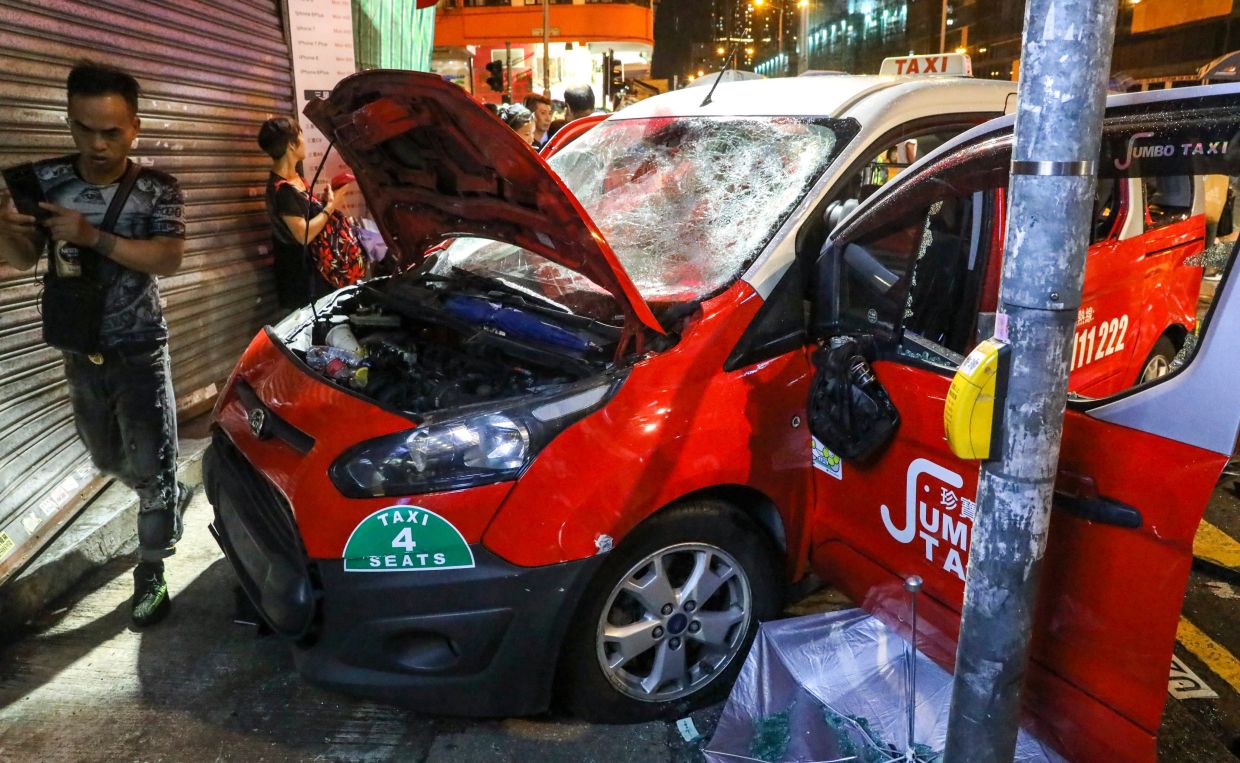
A Hong Kong kindergarten clerk has launched a major personal injury lawsuit seeking HK$8.4 million in compensation after a taxi mounted a pavement and struck her during a demonstration in Sham Shui Po on October 6, 2019, with her legal team arguing the collision demonstrates clear negligence on the driver's part.
Park Hoi-lam, now working as a clerk at a kindergarten near her residence in Tuen Mun, has testified that taxi driver Henry Cheng Kwok-chuen never sounded his horn or attempted to brake before his vehicle hit her and another woman on Yen Chow Street. In her account to the court, Park recalled that she and friends were travelling by bus toward Tsim Sha Tsui when blocked roads forced them to exit in Sham Shui Po, and upon discovering that railway services had also been suspended, the group opted to walk toward Mong Kok.
During that journey, Park became separated from her companions after walking ahead of them through what she described as a peaceful gathering of people. When she heard commotion near the taxi, she attempted to flee but found herself struck by the vehicle moving at what she characterized as very high speed. The collision inflicted severe damage to her lower limbs, necessitating seven surgical operations over a three-month period following the October 2019 incident. She was eventually discharged on January 18, 2020, though she required ongoing outpatient rehabilitation to address her injuries.
Plaintiff's counsel Susanna Leong has emphasized during proceedings before Justice Simon Leung Chun-man that the accident itself constitutes evidence of Cheng's negligence and failure to exercise reasonable care while operating his vehicle. The legal team representing Park has stressed that the subsequent attack on the driver by protesters is entirely irrelevant to understanding how and why the collision occurred in the first place, maintaining that responsibility for the incident rests solely with the motorist's actions preceding impact.
However, the defence has adopted a markedly different position, with Cheng's lawyers arguing that their client was himself a victim of the violence surrounding the 2019 demonstrations. Defence counsel Ashok Sakhrani and his team have contended that Cheng was subjected to a vicious assault involving metal rods and hard objects while performing his job, and that seeking compensation from another victim of the protest-related violence does not constitute genuine justice, no matter how serious the plaintiff's injuries may be. This framing represents a significant challenge to Park's claim, positioning the dispute as one between two individuals damaged by the broader social upheaval rather than a straightforward negligence matter.
The physical toll on Park's life has proven substantial and enduring. Although her condition has gradually improved, she continues to experience knee pain that restricts her mobility to roughly one hour of walking before requiring rest. Her current employment at a kindergarten near Tuen Mun involves limitations that would be unthinkable in her previous work: she cannot lift heavy objects and struggles with the expectation that childcare workers physically comfort crying toddlers by carrying them in their arms, a fundamental aspect of the role. Her cosmetic physician has recommended reconstructive surgery to address scarring on her legs from the accident, but Park indicated to the court that financial constraints prevent her from pursuing this procedure.
Medical assessments have delivered sobering prognoses regarding Park's future prospects. Doctors informed her that despite undergoing two additional surgeries after her initial discharge from hospital, her condition will likely not improve further, and she faces the realistic possibility of requiring knee replacement surgery at some point down the line. These predictions underscore the permanent nature of her injuries and their potential to worsen as she ages, adding a dimension of long-term vulnerability to her compensation claim.
During cross-examination, the defence sought to undermine Park's narrative by questioning why she had engaged legal representation when providing her police statement in March 2020, implying that her involvement with lawyers suggested involvement in the protest or concern about potential legal consequences. Park rejected this characterisation, stating she was simply protecting her own interests and denying any active participation in the demonstration itself. The defence further presented surveillance footage obtained through a private detective agency, arguing that video evidence showed Park capable of leading a normal life and walking without substantial difficulty.
Park's response to the surveillance evidence proved revealing about the distinction between performing ordinary activities and achieving meaningful quality of life. She acknowledged that the footage captured her shopping and dining after work, activities that normal people undertake routinely. However, she posed a pointed question to the court: whether such routine tasks alone could legitimately be characterised as leading a meaningful life. Her response highlights the gap between superficial functionality and the deeper erosion of life quality that severe, permanent injury can inflict, particularly for someone in her mid-career years with decades of working life ahead.
The litigation commenced in 2022, more than two years after the October 2019 collision, reflecting both the time required for Park's medical situation to stabilise and the complex legal processes involved in personal injury claims within Hong Kong's court system. The case is expected to proceed for six days before Justice Simon Leung, with the outcome potentially setting precedent for how Hong Kong courts assess liability and compensation in incidents that occurred amid the broader context of the 2019 social unrest, a period that saw numerous confrontations between vehicles and pedestrians in urban protest settings.
For Malaysian readers and Southeast Asian observers, this case illustrates the lingering consequences of the 2019 Hong Kong demonstrations, which created situations where ordinary citizens—whether protesters or workers simply attempting to move through their city—became vulnerable to sudden, life-altering injury. The tensions visible in this lawsuit, between Park's documented physical injuries and the defence's framing of the taxi driver as another victim of protest violence, reflect broader questions about accountability and compensation when civil unrest creates multiple casualties across different groups within society.

