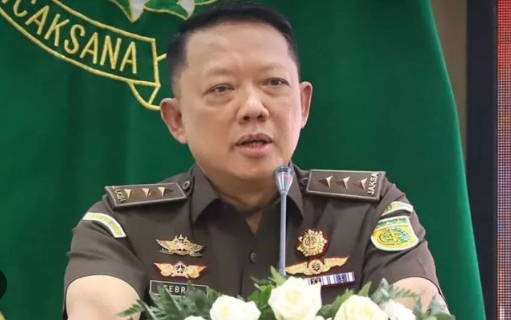
When Indonesian President Prabowo Subianto took office, he made fighting corruption a centrepiece of his agenda, directing officials to clean up their conduct before authorities intervened. Yet less than two years into his presidency, that commitment faces a critical test: an investigation into Febrie Adriansyah, until recently the nation's most powerful anti-corruption prosecutor and deputy attorney general for special crimes, has exposed fundamental questions about whether Indonesia's law-enforcement institutions can credibly investigate their own members.
The case began dramatically when police seized approximately US$26 million in cash and gold bars from a property owned by Febrie and designated him a suspect in money-laundering investigations. However, despite these serious allegations, Febrie has remained free—a decision that police have not publicly justified. When another suspect in the same matter was arrested shortly after, observers began questioning why a high-ranking former prosecutor received apparently different treatment, fuelling speculation about institutional protection.
What has proven most contentious, though, is the decision by police to transfer three related investigations to the Attorney General's Office, the very institution where Febrie spent much of his distinguished career. This move has drawn sharp criticism from legal scholars, constitutional experts, and lawmakers who argue it creates an obvious conflict of interest and may lack proper legal foundation. Former Constitutional Court Chief Justice Mahfud MD has warned that Indonesia's criminal procedure code does not clearly authorise transferring an active police investigation to prosecutors, raising the possibility that any case built through this process could face devastating pretrial challenges.
The transfer ostensibly aimed to improve coordination between police and prosecutors, yet it fundamentally altered the nature of the investigation. Police continue involvement in evidence verification and the staged handover of materials, including the authentication of seized currency through the Federal Bureau of Investigation, the US Secret Service, and embassies in Washington and Singapore. This hybrid approach—where two agencies share responsibility for investigating one of their own—exemplifies the institutional fragmentation that plagues Indonesia's anti-corruption apparatus.
Zaenur Rohman, an anti-corruption scholar at Gadjah Mada University, has characterised the transfer as a political settlement designed to defuse tensions between police and prosecutors, but one devoid of legal grounding. He and other analysts argue that the Corruption Eradication Commission, a separate state agency operating within the executive branch, would be far better positioned to handle such a politically sensitive and institutionally fraught case. The commission's structural independence from both police and prosecutors would theoretically reduce perceptions of institutional self-protection.
Lawmakers have responded by establishing a working group to monitor the investigation's progress, with some calling for the Attorney General's Office to establish an independent internal team. Coordinating Minister Yusril Ihza Mahendra defended the transfer as promoting investigative efficiency but acknowledged the risk of what Indonesians call "oranges eating oranges"—an expression capturing the concern that institutions protect their own. He subsequently disclosed that Prabowo had personally met with both the police chief and attorney general to direct their approach, suggesting presidential intervention to manage institutional tensions.
Febrie's prominence intensifies the case's sensitivity. As head of the Attorney General's Office's Special Crimes Division, he oversaw some of Indonesia's largest corruption investigations, including probes targeting major state enterprises such as Pertamina and Timah, as well as inquiries into Prabowo's signature free-meals programme and former Education Minister Nadiem Makarim. His stature means that any perception of institutional bias could undermine confidence in multiple high-profile investigations he oversaw. Meanwhile, Febrie's whereabouts remain undisclosed, though immigration authorities have barred him from leaving Indonesia for twenty days at police request. Before resigning, he acknowledged owning the raided property but denied that the seized assets belonged to him.
The handling of this investigation illuminates deeper structural problems within Indonesia's fragmented law-enforcement ecosystem. The police, Attorney General's Office, and Corruption Eradication Commission all possess overlapping investigative authority over corruption cases, creating periodic competition for jurisdictional control and political influence. This redundancy periodically generates the institutional friction visible in the Febrie case. Additionally, a 2025 revision to Indonesia's military law added the Attorney General's Office to institutions where active-duty military officers can serve without retiring, while simultaneously broadening the legal basis for prosecutors to seek military protection. These changes have shifted power dynamics and created new avenues for institutional entanglement.
Aditya Perdana, a political lecturer at the University of Indonesia, observes that while recent events do not explicitly demonstrate institutional conflict, their sequence suggests an underlying narrative. The dramatic raids, complete with armed soldiers deployed around Febrie's South Jakarta residence, contrasted sharply with his continued freedom and the subsequent transfer of cases to his former workplace. Prabowo's public call for "introspection" from all parties, followed by the police chief and attorney general appearing jointly to deny friction, indicates attempts to manage perceptions of institutional discord.
The Attorney General's Office subsequently ordered regional prosecutors to cease collecting data on the US$15 billion free-meals programme, citing the end of an initial collection period and warning against abuse of authority. This directive followed the office's own investigation naming an active police brigadier general as a suspect, suggesting an effort to prevent further jurisdictional competition between agencies. Such moves hint at backroom negotiations to compartmentalise investigations and reduce public manifestations of institutional tension.
According to Jacqui Baker, a senior lecturer in Southeast Asian politics at Murdoch University, the distribution of criminal investigation powers, particularly over high-stakes corruption cases, remains jealously contested because these authorities sit at the intersection of political and economic power. Successive Indonesian presidents have sought to maintain equilibrium among the police, prosecutors, and military rather than allowing any single institution to achieve dominance. Prabowo's administration has continued this balancing act, though with modifications that increasingly integrate military elements into civilian law enforcement.
The Febrie investigation, therefore, represents more than a single corruption probe. It exemplifies the structural vulnerabilities that emerge when overlapping institutions must investigate their peers without clear legal procedures or adequate independence mechanisms. For Malaysia and the broader Southeast Asian region, Indonesia's experience underscores the institutional prerequisites for credible anti-corruption work—namely, the necessity of investigative independence, transparent legal frameworks, and mechanisms insulating inquiry into senior officials from the influence of their former colleagues and institutional peers. Whether Prabowo's administration can navigate these tensions whilst maintaining public faith in anti-corruption efforts remains an open question that will define the credibility of his broader governance agenda.

