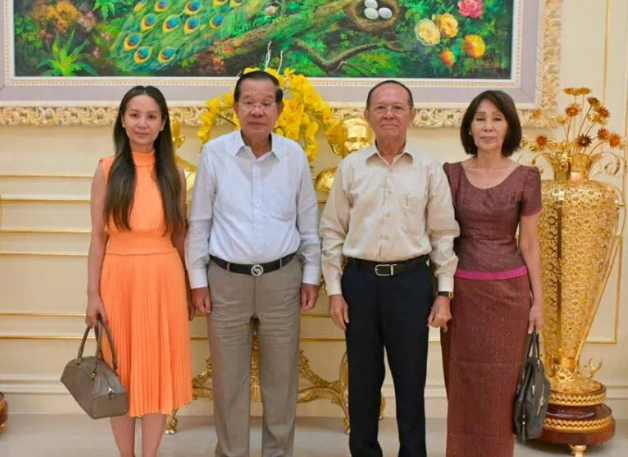
Cambodia's political landscape is showing signs of realignment as Senate president Hun Sen welcomes former opposition leader Kem Sokha into his home, marking a dramatic reversal in their decades-long antagonistic relationship. The two met on a Sunday morning in August for an extended three-hour conversation that Hun Sen publicly highlighted on social media, describing it as a candid family discussion that included Sokha's wife and daughter. The encounter, which Hun Sen indicated was a return visit following an earlier meeting at his residence, underscores a notable softening in Cambodia's rigid political divisions.
The most striking element of Hun Sen's public remarks centred on his effusive praise for Kem Monovithya, Sokha's daughter, whom he termed "an excellent human resource for the nation" after having spent considerable time speaking with her during the meeting. This characterisation carries considerable weight given Monovithya's historical prominence within the Cambodia National Rescue Party, the opposition movement her father led before its judicial dissolution in 2017. Hun Sen's willingness to publicly commend someone so closely associated with his former rival suggests a deliberate messaging about shifting political boundaries, though he has provided no explicit indication of what role, if any, Monovithya might assume in Cambodia's future political or public life.
Sokha's journey from political adversary to house guest reflects the dramatic transformation of his circumstances over recent months. The former CNRP co-founder spent years navigating severe legal and political constraints following his 2023 conviction on treason charges related to allegations of conspiracy with foreign powers—charges he received a 27-year prison sentence for. An appellate court upheld this conviction in April 2026, while simultaneously maintaining restrictions on his political participation and international travel. However, a royal pardon issued on May 25 terminated his prison sentence and house arrest, fundamentally altering his legal position and opening pathways for renewed public engagement.
The acceleration of Sokha's rehabilitation became evident through successive policy reversals. A royal decree issued on July 24 lifted his five-year overseas travel restriction, further loosening the constraints that had defined his existence since his detention. These incremental legal changes suggest coordinated decision-making at Cambodia's highest levels, creating space for Sokha to re-emerge into public consciousness as a private citizen rather than a prohibited political actor. His subsequent journey to Banteay Meanchey province on July 28 to meet displaced families affected by the Cambodia-Thailand border conflict marked one of his most significant public appearances, during which he explicitly characterised his activities as those of a private individual rather than any political representative.
The historical context of Hun Sen and Sokha's opposition makes their current rapprochement particularly noteworthy for observers of Cambodian politics. Throughout the 2010s, the CNRP emerged as Cambodia's most credible opposition force, achieving substantial electoral gains in both the 2013 national elections and 2017 commune elections. The party's judicial dissolution in November 2017, occurring merely weeks after Sokha's arrest, effectively eliminated the organised political challenge to Hun Sen's dominance. That the two men are now conducting extended private discussions and publicly acknowledging mutual respect represents a fundamental shift in Cambodia's polarised political dynamics that may reshape how power operates in the kingdom.
The significance of these meetings extends beyond personal reconciliation between two aging politicians. Hun Sen's decision to publicly highlight his conversations with Sokha and to specifically commend Monovithya appears designed to send signals about Cambodia's political future. By framing Monovithya as valuable national human capital, Hun Sen may be subtly indicating willingness to incorporate elements of the former opposition into Cambodia's political ecosystem, whether through advisory roles, non-partisan public service positions, or other institutional arrangements that fall short of explicit political rehabilitation. The absence of any formal announcement regarding political agreements or reconciliation processes does not diminish the apparent intentionality behind these increasingly visible interactions.
For Malaysian observers, the Cambodia developments offer insights into how authoritarian political systems manage internal opposition and consolidate long-term governance models. Unlike Malaysia's more institutionalised political competition and electoral cycles, Cambodia's approach to opposition management has historically been more absolute and exclusionary. Sokha's gradual reintegration into public life suggests Cambodia may be moving towards a model where former political opponents can be managed through conditional rehabilitation rather than permanent exclusion, provided they accept constraints on formal political activity. This represents pragmatic governance evolution in a region where political systems frequently struggle to balance legitimacy with stability.
The relationship between Hun Sen's actions and broader Southeast Asian patterns of political development also merits consideration. Across the region, ageing strongmen increasingly face questions about succession and institutional continuity. Hun Sen's cultivation of relationships with figures like Sokha may reflect calculations about how to maintain regime stability as his direct control eventually transitions. By demonstrating willingness to accommodate former opponents within circumscribed roles, he may be establishing precedent for a post-Hun Sen political architecture that preserves core power structures while accommodating some opposition participation. This approach differs markedly from zero-sum exclusion historically practiced.
Sokha's position remains complicated by the statutory prohibition on political activity that persists despite his pardon and travel restrictions being lifted. This bifurcated status—free from detention and travel restrictions but barred from political engagement—creates a unique category of political figure in Cambodia's system. Whether this restriction is intended as permanent or merely a transitional measure designed to manage his re-emergence gradually remains unclear. The trajectory of his legal status over coming months will reveal whether Hun Sen's apparent warming towards Sokha signals genuine reconciliation and possible eventual restoration of political rights, or whether it represents merely a more sophisticated management strategy for a politically neutralised former opponent.
The international dimensions of these meetings warrant attention given the treason charges against Sokha centred on alleged foreign conspiracy. Hun Sen's public engagement with Sokha, coupled with Sokha's stated interactions with international community members regarding displaced Cambodians, suggests Cambodia's government may be recalibrating its approach to managing external pressure and perceptions. By allowing Sokha measured public visibility and appearing to endorse his humanitarian activities, Hun Sen may be addressing both international criticism of his treatment of opposition figures and domestic concerns about the legitimacy of restrictions imposed on popular political leaders. This represents sophisticated image management rather than substantive democratic opening, yet it acknowledges that sustained international opprobrium carries costs even for authoritarian systems.
The undefined nature of what transpired during the three-hour discussion between Hun Sen and Sokha's family invites speculation about substantive negotiations. Hun Sen's deliberate silence on the conversation's subjects could indicate either genuinely apolitical family-level interaction or strategic opacity about sensitive political discussions. The fact that neither side has publicly announced any formal agreement or reconciliation framework suggests either that no significant political arrangement emerged, or that any such arrangement is being handled through private channels rather than public declaration. In either case, the willingness to be seen together represents meaningful symbolic change in Cambodia's political theatre.
Moving forward, the interactions between Hun Sen and Sokha will likely continue to generate scrutiny regarding Cambodia's political direction. Kem Monovithya's positioning is particularly significant; whether she eventually assumes any public or advisory role would substantially indicate whether Cambodia is genuinely moving towards incorporating former opposition elements or whether these meetings represent tactical positioning by Hun Sen. For Southeast Asian democracy observers, Cambodia's experience demonstrates how authoritarian systems can manage legitimacy challenges through selective accommodation of opposition figures, a pattern increasingly visible across the region as governance models adapt to changing domestic and international pressures.

