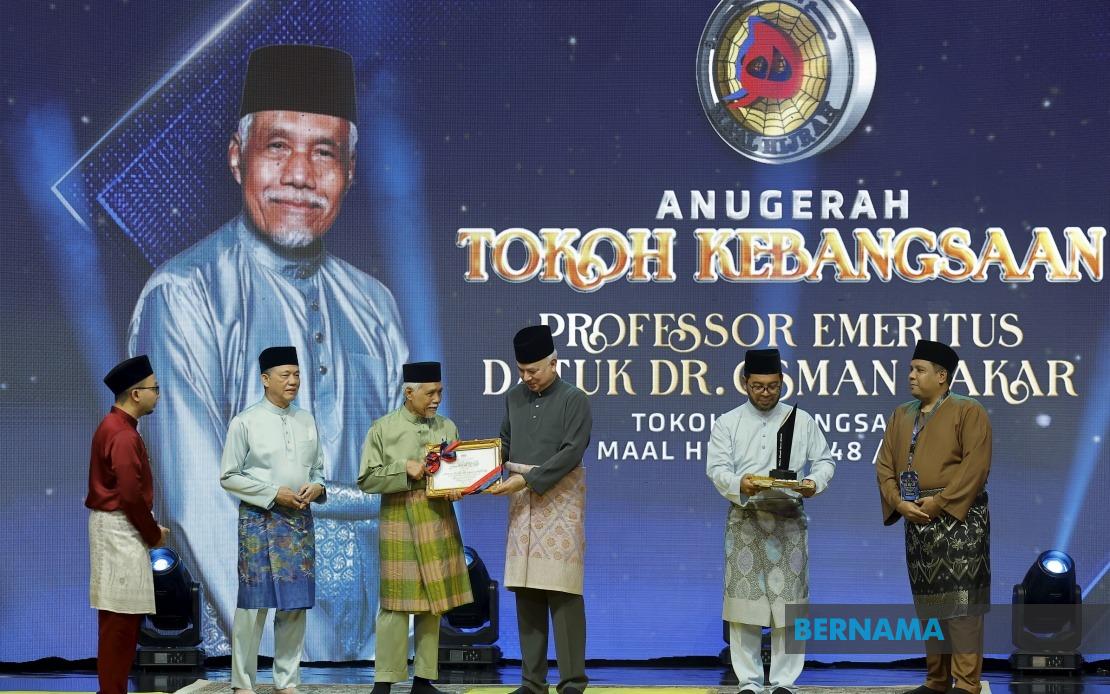
The International Islamic University Malaysia's rector, Prof Emeritus Datuk Dr Osman Bakar, has been named the National Tokoh Maal Hijrah for 1448H/2026 in recognition of his significant contributions to Islamic scholarship and education in Malaysia. The honour was bestowed at a national-level Maal Hijrah celebration held at Putra Mosque in Putrajaya on June 17, with the award presented by Sultan Nazrin Shah, the Sultan of Perak, who presided over the ceremony.
The Tokoh Maal Hijrah award, which recognises outstanding individuals who embody Islamic values and contribute meaningfully to society, underscores Osman Bakar's decades-long tenure at IIUM and his work in advancing Islamic higher education across the region. His recognition reflects the institution's central role in shaping Islamic thought and academic discourse within Malaysia and beyond, positioning IIUM as a leading centre for Islamic learning in Southeast Asia.
Parallel to the national honour, the ceremony recognised Dr Ahmad Al-Raysuni, a respected Islamic scholar from Morocco, as the International Tokoh Maal Hijrah. Al-Raysuni's selection highlights the transnational dimension of Islamic scholarship and the increasing cross-border collaboration among Muslim intellectuals and educators. His eminence in Islamic jurisprudence and philosophy has contributed to broader conversations about contemporary Islam and its application in modern societies, making the dual awards significant in acknowledging both local and international perspectives on Islamic values.
Recipients of the Tokoh Maal Hijrah distinction receive cash prizes alongside trophies and certificates of appreciation, reflecting the government's commitment to honouring individuals who advance Islamic principles and community development. These material recognitions serve not merely as tokens but as substantive acknowledgements of the recipients' contributions to Malaysia's spiritual and intellectual landscape.
The 2026 Maal Hijrah celebration operated under the theme "MADANI Dihayati, Ummah Diberkati"—a framework emphasizing the living practice of Islamic values within the context of Malaysia's broader MADANI governance vision. This thematic choice underscores how the government seeks to integrate Islamic principles with contemporary governance priorities, particularly regarding compassion, interfaith unity, and collective societal welfare. The emphasis on these values reflects ongoing efforts to frame Islam not as a static doctrine but as a dynamic ethical and social force relevant to modern Malaysian life.
The ceremony drew prominent government officials, including Deputy Prime Minister Datuk Seri Fadillah Yusof and his wife Datin Ruziah Mohd Tahir, as well as Dr Zulkifli Hasan, the Minister in the Prime Minister's Department responsible for Religious Affairs. Their attendance signalled the high-level political importance accorded to Maal Hijrah observance and to the recognition of individuals advancing Islamic education and values—a clear indication that such honours form part of Malaysia's official recognition of Islamic contributions to national development.
Osman Bakar's elevation to this national honour comes at a pivotal moment for Malaysia's higher education sector, where universities are increasingly expected to integrate Islamic values with academic excellence. IIUM, as a flagship institution combining Islamic scholarship with contemporary professional training, sits at the intersection of these expectations. Bakar's career has exemplified this integration, particularly in his promotion of interfaith dialogue and the application of Islamic knowledge to contemporary challenges ranging from environmental sustainability to biomedical ethics.
The recognition of both a Malaysian academic and a Moroccan scholar reflects broader patterns within the Islamic world, where knowledge and intellectual leadership increasingly transcend national boundaries. Morocco's prominence in contemporary Islamic scholarship, coupled with its role as a bridge between North African and Middle Eastern Islamic traditions, makes Al-Raysuni's honour meaningful for regional academic networks. His selection alongside Osman Bakar suggests that the award framework seeks to acknowledge excellence wherever it emerges while maintaining focus on Malaysia's indigenous scholarly contributions.
Maal Hijrah itself, commemorating the Islamic calendar's new year and the Prophet Muhammad's migration to Medina, has evolved beyond its strictly religious significance in Malaysia. It now functions as an occasion for national reflection on Islamic values and their role in advancing societal goals—a shift that acknowledges Islam's pervasive influence on Malaysian identity and governance structures. By honouring exemplary individuals during these celebrations, the government reinforces the connection between Islamic principles and national aspirations.
For IIUM specifically, Osman Bakar's recognition amplifies the institution's profile as a generator of Islamic thought capable of engaging with global scholarly conversations. As Malaysian universities compete for regional leadership in Islamic studies, such acknowledgements of their leaders strengthen their standing within both academic and political spheres. The honour also potentially influences how younger scholars and students within IIUM perceive the value of integrating Islamic learning with rigorous academic inquiry.
The ceremony's proceedings, set within the symbolic venue of Putra Mosque—itself an architectural and spiritual landmark in Malaysia's political capital—added ceremonial weight to the occasion. Putrajaya's selection as the venue for national Maal Hijrah celebrations positions the event as a central moment in Malaysia's official Islamic calendar, elevating the stature of award recipients and signalling government endorsement of their intellectual and moral leadership.
Looking forward, the recognition of scholars like Osman Bakar and Al-Raysuni may influence how Islamic higher education institutions throughout Southeast Asia position themselves within regional and global networks. The dual honouring of Malaysian and Moroccan scholars suggests openness to diverse Islamic intellectual traditions, potentially encouraging greater scholarly exchange across geographical regions and allowing Southeast Asian Islamic institutions to benefit from North African and Middle Eastern expertise while contributing their own contextual insights to broader Islamic discourse.