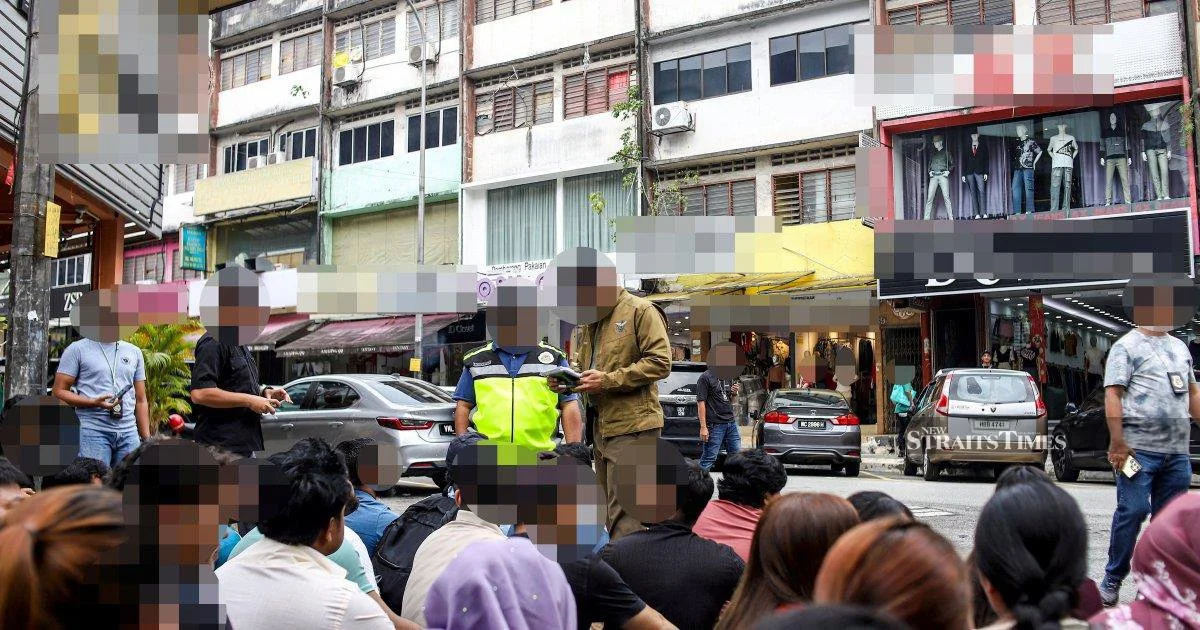
Immigration enforcement officers executed a comprehensive raid across Jalan Kenanga's wholesale clothing establishments in Kuala Lumpur today, resulting in the apprehension of 111 undocumented workers unable to produce valid travel or work documentation. The operation represents a significant crackdown on labour irregularities within the district, one of the country's most prominent commercial hubs for textile and apparel trading.
The timing and scale of the enforcement action underscore the Malaysian immigration authorities' renewed focus on controlling irregular migration patterns within high-concentration employment zones. Jalan Kenanga has long functioned as a crucial logistics and distribution epicentre for Southeast Asia's garment industry, drawing thousands of workers—both documented and undocumented—who sustain the rapid inventory turnover that characterises the wholesale sector.
Undocumented migration remains a persistent challenge across Malaysia's labour-intensive industries. The construction, agriculture, hospitality, and manufacturing sectors have historically absorbed significant numbers of irregular workers, but the wholesale and retail trade increasingly presents enforcement priorities. Workers without proper immigration status often accept lower wages, operate under informal arrangements, and remain vulnerable to exploitation by unscrupulous employers who exploit their precarious position.
The concentration of undocumented individuals within specific commercial precincts like Jalan Kenanga reflects broader regional migration patterns. Malaysia's geographic proximity to lower-income neighbouring countries, combined with persistent wage differentials and labour demand, creates sustained pull factors for irregular migration. Many workers enter legally on tourist or short-term visas, then remain after expiry or transition into undocumented status following visa cancellation or employment disputes.
Enforcement operations of this magnitude typically involve coordination between the Immigration Department's enforcement division and local municipal authorities. The wholesale clothing sector's dense commercial configuration—with multiple businesses operating within shared premises and high worker turnover—creates both opportunities and challenges for compliance monitoring. Building access controls remain minimal, and employment relationships often remain informal despite the organised nature of the merchandise trade.
The detained individuals now face processing procedures that may include identity verification, documentation assessment, and eventual repatriation or deportation depending on their countries of origin and immigration violation severity. Malaysia maintains bilateral agreements with key labour-source nations that facilitate structured return processes, though administrative capacity constraints occasionally create backlogs. Workers without identity documents face particular complications, as establishing nationality requires consular cooperation and can extend detention periods substantially.
These enforcement sweeps carry significant economic implications for affected businesses, many of which operate with razor-thin margins dependent on minimised labour costs. Some established traders within the district employ documented workers exclusively and maintain rigorous employment compliance, while others operate through subcontracted arrangements that distance them from direct liability. The operation may prompt selective labour-practice reforms among larger wholesale operators seeking to avoid future regulatory attention.
Regional economic integration and Malaysia's aspirations toward becoming a developed nation increasingly demand labour formalisation. Government initiatives promoting the regularisation of migrant workers provide pathways for workers and employers to transition toward legal status, offering amnesty periods when undocumented individuals can apply for proper work permits without automatic deportation. However, uptake remains inconsistent due to documentation barriers, employer reluctance, and migrant uncertainty regarding legal process outcomes.
The enforcement action reflects Malaysia's commitment to international labour standards and human trafficking prevention frameworks. Undocumented workers frequently occupy precarious situations conducive to exploitation—excessive working hours, wage deduction, unsafe conditions, and restricted mobility. Immigration enforcement, when complemented by labour inspections and worker protection initiatives, addresses vulnerability dimensions beyond irregular status considerations alone.
Jalan Kenanga's enforcement intensity may trigger broader industry self-regulation as wholesale merchants recognise reputational and operational risks associated with labour irregularities. Industry associations could intensify guidance regarding employment verification, while some businesses may accelerate formalisation investments. The raid's visibility through media coverage serves deterrent functions for both prospective undocumented migrant arrivals and employers considering hiring without documentation verification.
Moving forward, stakeholder engagement involving immigration authorities, labour departments, industry associations, and international organisations working on migrant protection remains crucial for addressing underlying drivers of irregular employment. While enforcement operations manage immediate compliance, structural solutions require coordinated investment in labour market formalisation infrastructure, employer education, and worker support systems that recognise both national security imperatives and humanitarian dimensions of migrant protection.
The 111 detainees represent only a fraction of estimated undocumented migrants operating across Malaysia's various economic sectors. Today's operation demonstrates continued enforcement commitment but also highlights the scale of ongoing challenges in achieving comprehensive labour market regulation across all employment zones.

