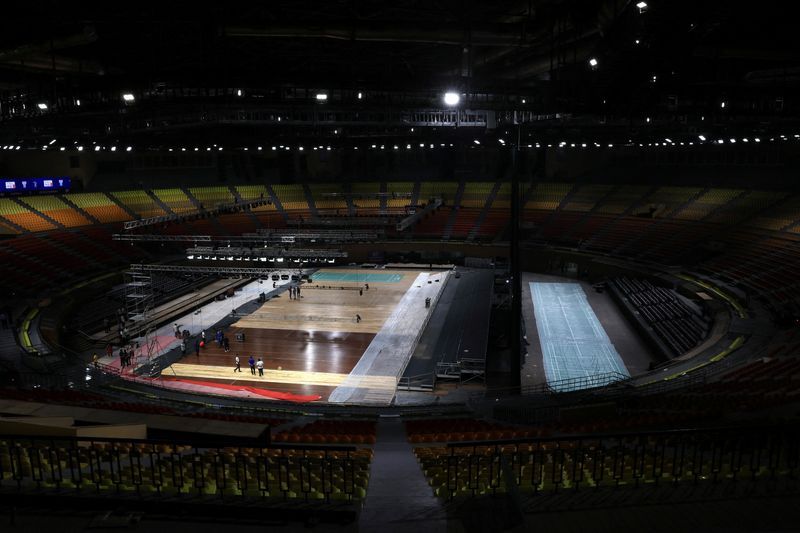
The Badminton World Federation's annual showcase will descend on New Delhi next week with an unconventional addition to the organizing crew: trained specialists whose job is to produce the distinctive hooting calls of langur monkeys. The Badminton Association of India has enlisted these vocal mimics as part of a comprehensive strategy to prevent the recurring wildlife disturbances that have plagued previous tournaments at the Indira Gandhi Indoor Stadium, a facility that will be central to India's bid to demonstrate world-class event management capabilities.
The problem these workers are tasked with solving is straightforward but persistent. Rhesus monkeys roam Delhi's streets with relative impunity, frequently breaching the boundaries of buildings and public spaces. These primates have earned a reputation for aggressive encounters with residents and pedestrians, making them an ongoing urban management challenge across India's capital. Unlike smaller monkey species, rhesus monkeys are notably difficult to deter through conventional means, which is why organizers have turned to an alternative predator to manage their behavior. Langurs, larger primates distinguished by their black facial markings, have proven effective as a natural deterrent. Indian government offices routinely deploy langurs or their representatives as a non-violent solution to rhesus monkey intrusions.
Zafar, one of the hired mimics brought in for the championships, represents a specialized profession passed down through generations within his family. During a media demonstration at the stadium on Monday, he showcased the distinctive vocalizations that render rhesus monkeys fearful enough to avoid the area. His explanation was straightforward: the animals are terrified of langurs, and reproducing their calls triggers an instinctive avoidance response. Zafar emphasized that the approach prioritizes animal welfare over confrontation, seeking to exclude monkeys through intimidation rather than harm. His involvement in multiple government office placements has given him considerable experience in applying this technique across diverse indoor settings.
The need for such measures became embarrassingly apparent during India's flagship badminton tournament, the Indian Open, held at the same stadium earlier this year. A rhesus monkey was observed wandering through the spectator gallery during play, a breach of venue security and decorum that reflected poorly on the hosts. This incident prompted the Badminton Association of India to take the situation seriously, recognizing that international tournaments demand pristine conditions and professional management. The incident served as a wake-up call that India's aspirations to host major international sporting events would require addressing even unconventional challenges.
Yet the animal-related challenges facing the Badminton World Federation championships extend well beyond primates. Delhi's pigeon population has become another significant nuisance for sports facilities in the city. During the aforementioned Indian Open, play was interrupted on two separate occasions when pigeons fouled the court surface, creating both hygienic concerns and procedural delays. Players objected to the conditions, citing sanitation issues that compromised the competitive experience. The repeated stoppages underscored how wildlife problems, if left unaddressed, can disrupt the professional conduct of major sporting events and damage India's international reputation.
Addressing the pigeon problem required a different tactical approach than the langur mimicry solution employed for monkeys. Stadium organizers have applied a specially formulated non-toxic gel across the roof structure and ventilation ducts of the Indira Gandhi Indoor Stadium. This substance, commonly deployed on railway infrastructure to discourage bird roosting, creates an inhospitable surface that prevents pigeons from settling and nesting. The application is designed to be humane while being sufficiently effective to keep birds away from competition areas. This proactive measure distinguishes the current preparation from the reactive chaos that characterized earlier tournaments.
The comprehensive approach to these issues reflects India's broader strategic positioning. As host of the 2030 Commonwealth Games and an active bidder for the 2036 Olympic Games, New Delhi cannot afford high-profile mishaps at international sporting events. Each tournament serves as a trial run, an opportunity for organizers to demonstrate their capacity to manage world-class venues and resolve unforeseen logistical challenges. The Badminton World Federation championships function as a relatively lower-profile dress rehearsal for the larger Olympics and Commonwealth Games hosting aspirations. Success here builds confidence among international sporting federations that India possesses the institutional competence and problem-solving capability to manage even unusual circumstances.
Badminton Association of India secretary general Sanjay Mishra provided public assurance that the organization had thoroughly evaluated previous shortcomings and implemented corrective measures. He stated that concerns identified during the Indian Open had been systematically addressed through facility improvements and enhanced management protocols. Mishra further claimed that the Badminton World Federation had expressed complete satisfaction with the current arrangements, suggesting that international organizers view the preparations as adequate and professional. The statement serves to reassure both international participants and India's domestic sporting community that this iteration of the championship will avoid the operational embarrassments of its predecessor.
For Malaysian and broader Southeast Asian observers, India's approach to the badminton championships offers instructive lessons about hosting international sporting events in the region. Many Southeast Asian cities face similar wildlife management challenges, from stray animals to bird populations, particularly in tropical urban environments. India's willingness to employ creative, culturally-rooted solutions—such as leveraging indigenous knowledge about animal behavior and utilizing traditional expertise—demonstrates that international standards can be met through locally-adapted strategies rather than wholesale importation of foreign practices. The langur mimic represents indigenous problem-solving scaled to serve modern sporting infrastructure needs.
The incident also highlights the often-overlooked dimensions of hosting major sporting events that go beyond athletic competition and infrastructure. Tournament organizers must manage environmental variables, animal populations, and public health concerns that can easily derail proceedings if poorly anticipated. India's evolution from reactive crisis management during the Indian Open to proactive prevention for the Badminton World Federation championships shows institutional learning and adaptive capacity. These competencies matter significantly for regional reputations in international sporting circles, particularly as Southeast Asian nations increasingly bid for and host major championships.
The langur mimics and anti-pigeon measures represent more than mere wildlife management; they symbolize India's determination to present a polished international image at critical junctures. In a competitive global environment where multiple nations vie for hosting privileges, such details accumulate into comprehensive assessments of organizational reliability. For Malaysia and other regional competitors in the international sporting events marketplace, India's experience underscores that meticulous attention to every operational detail, no matter how unusual, contributes to successful championships and enhanced standing for future bidding rounds.

