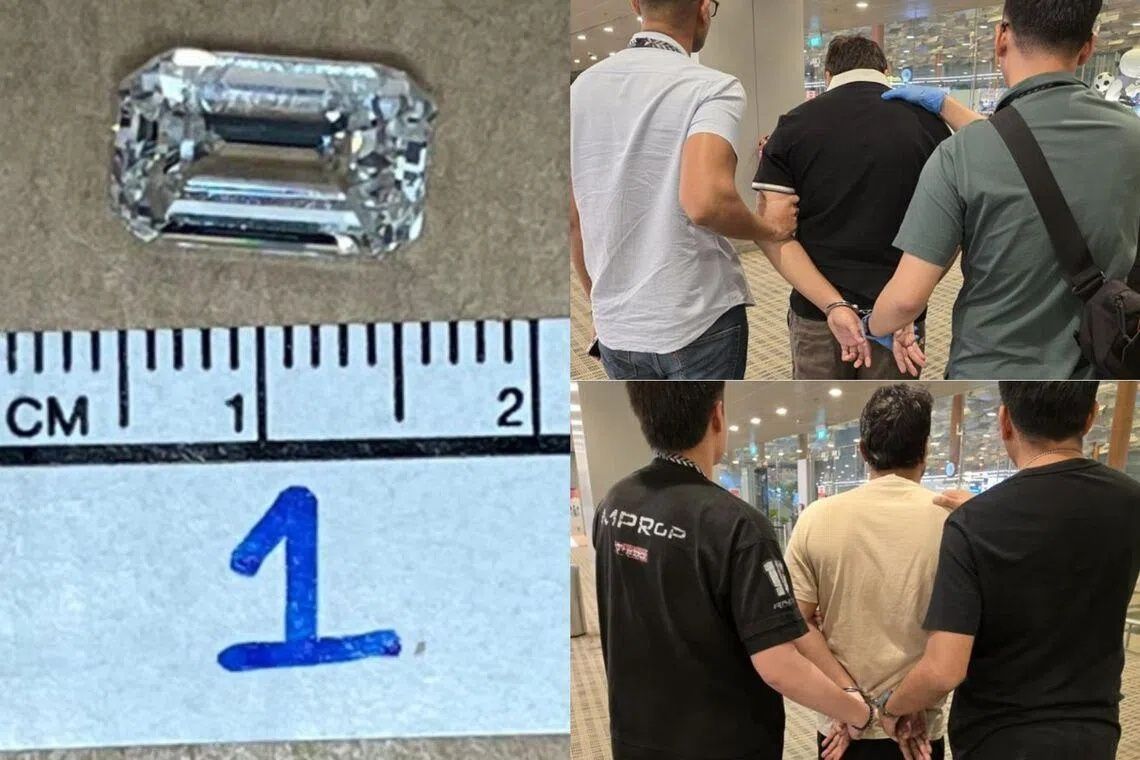
A carefully orchestrated theft at a prominent Chinatown jewellery store in Singapore has resulted in a two-year prison sentence for one of two Indian nationals involved in the crime. The incident, which unfolded over just hours on June 19, demonstrates the sophisticated methods some international thieves employ to target high-value items from retail establishments, and underscores Singapore's robust law enforcement response at airport terminals.
Mangroliya Manojkumar Kurjibhai, aged 41, pleaded guilty to the theft and received his sentence on Friday, July 17, at a Singapore court. His co-conspirator, Serasiya Milan Ramnikbhai, 30, remains in custody with his case still pending resolution. Both men are Indian nationals who had entered Singapore on the day of the incident, suggesting this was a precisely planned operation rather than an opportunistic crime. The speed with which authorities apprehended them—within hours of the theft—prevented them from departing the country with their haul.
The target was a 4.95-carat diamond held at Dianoche jewellery store located on Kreta Ayer Road in the historic Chinatown district. Court documents revealed the diamond's international valuation at US$154,000, equivalent to approximately S$199,000 at the time. What makes this case particularly noteworthy is the preparation undertaken before the pair even arrived in Singapore. The two men commissioned a counterfeit diamond in India that matched not merely the appearance but also the specifications and serial number of the genuine stone they intended to steal—a level of detail that speaks to professional planning and inside knowledge.
The execution of the theft followed a pattern designed to exploit normal retail operations. When Serasiya and Mangroliya entered the store around 3pm that afternoon, Serasiya had already secreted the fake diamond in his mouth. Mangroliya then requested to inspect the genuine diamond, with the shop manager retrieving it for viewing. The accused subsequently asked to examine several other items, a tactic deliberately calculated to remove the manager's direct supervision repeatedly. During one of these absences, Mangroliya signalled to Serasiya to execute the swap. In a coordinated move, Serasiya expelled the counterfeit diamond and retrieved the authentic stone, again concealing it in his mouth before the two men casually informed the manager they would consider the purchase and departed the premises.
The switch might have succeeded indefinitely had the store not maintained vigilant security protocols. Store management immediately subjected the diamond Serasiya had left behind to optical gemstone identification analysis, quickly confirming it as counterfeit. This discovery triggered a police investigation, with law enforcement officials obtaining crucial evidence from the shop's CCTV recordings that had captured the entire transaction and the moment of substitution. The visual evidence would prove pivotal in establishing the sequence of events and the mens rea behind the offence.
With the theft discovered and police alerted, the two men's departure from Singapore became impossible undetected. After leaving Dianoche, they checked out of their hotel accommodation and attempted to make their escape by booking a flight to India. However, immigration authorities at Changi Airport Terminal 3 apprehended both individuals at approximately 9pm that evening—roughly six hours after the theft occurred. Upon their arrest, officers discovered the stolen diamond secured in Serasiya's haversack, directly linking him to the crime and providing physical evidence to support the surveillance footage and witness testimony.
State Prosecuting Officer Yip Cheng Yee presented the case to the court, detailing how the pair's premeditation, coordination, and use of counterfeit materials demonstrated an intentional, deliberate criminal act. The prosecution did not disclose in court documents how the two men became aware of this specific diamond's presence and value at the Chinatown store, leaving a gap in the public record about whether they had inside assistance. This detail remains particularly significant, as it suggests the possibility of accomplices within Singapore's jewellery trade or community who may have provided intelligence about high-value items available for theft.
Under Singapore's Penal Code, theft carries a maximum sentence of seven years imprisonment and a monetary fine, giving courts considerable discretion in sentencing. Mangroliya's sentence of two years, two months, and two weeks falls well within this range, likely reflecting both the value of the item stolen and his admission of guilt through his plea. The fact that authorities recovered the diamond undamaged and were able to return it to the legitimate owner mitigated what could otherwise have been a more severe sentence. Serasiya's pending case may result in a comparable or potentially harsher sentence, given his active role in the actual exchange and possession of the stolen goods.
This case carries implications for jewellery retailers and luxury goods dealers throughout Southeast Asia, highlighting vulnerabilities in retail operations that international criminal networks continue to exploit. The sophistication of counterfeiting operations—complete with matching serial numbers—suggests organised involvement rather than amateur opportunism. For Malaysian retailers, particularly those in areas frequented by international visitors, the incident serves as a cautionary tale about implementing rigorous security protocols, staff training in detecting counterfeits, and maintenance of comprehensive surveillance systems. The incident also underscores the effectiveness of coordinated security at international airports, where the apprehension occurred before the thieves could clear immigration and board their flight.

