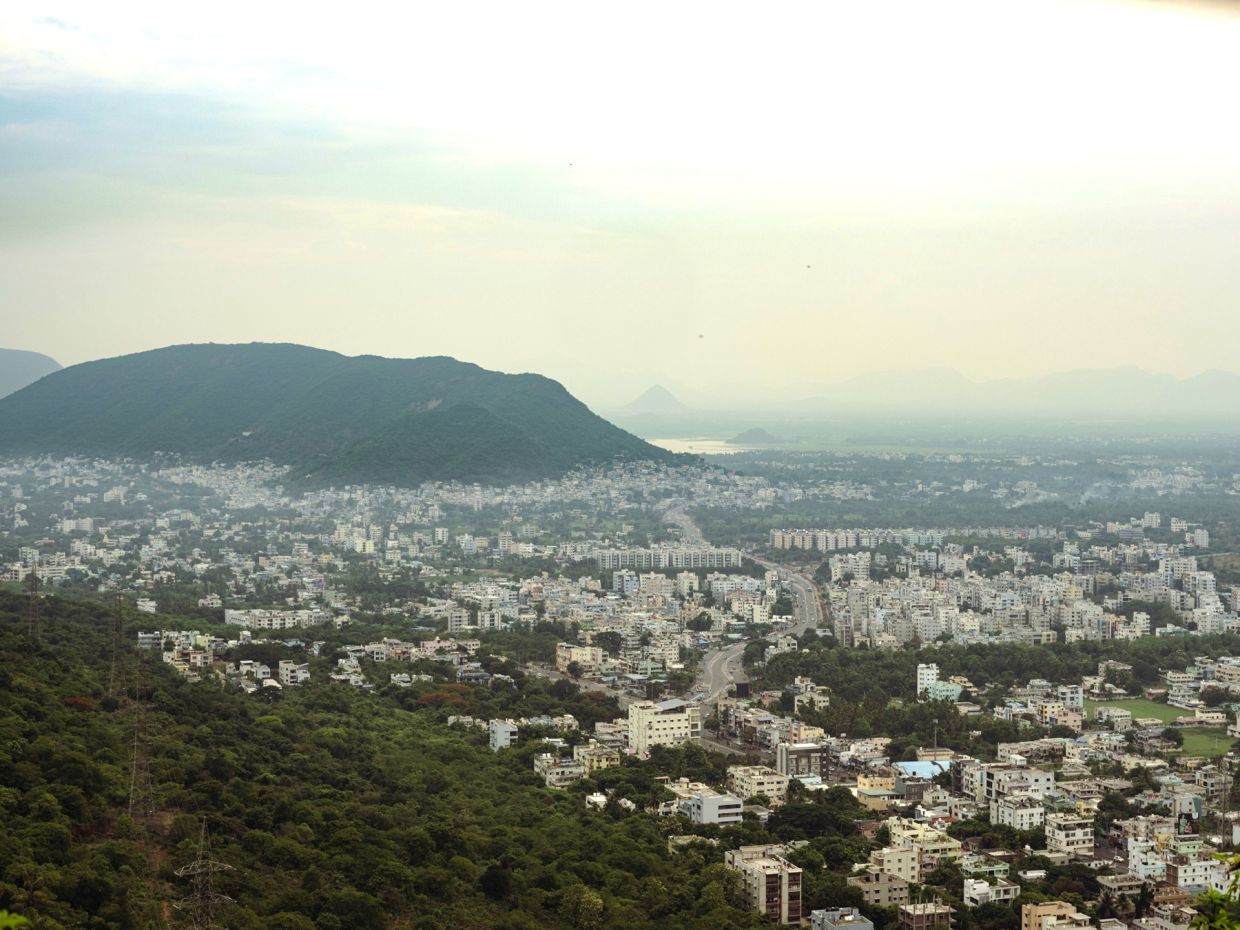
India is racing to establish itself as a player in global artificial intelligence development, and a coastal city in Andhra Pradesh has become the focal point of this ambition—though not without controversy. The village of Tarluvada, situated on the outskirts of Visakhapatnam, is preparing to host one of Google's most significant infrastructure investments outside the United States, a US$15 billion initiative announced as fundamental to India's technological future. The scale of this transformation is already visible: bulldozers have begun excavating land to accommodate a one-gigawatt data centre, while billboards featuring the smiling faces of national and regional politicians proclaim a warm welcome to the American technology giant. The project represents New Delhi's determination to narrow a widening gap in global AI infrastructure, yet it has simultaneously sparked a heated debate about the true costs of rapid industrialisation in a region already grappling with resource constraints.
The Indian government views data centre development as essential infrastructure for the artificial intelligence era, positioning these facilities as catalysts for broader economic growth and technological self-sufficiency. Nara Lokesh, Andhra Pradesh's information technology minister and an ally of Prime Minister Narendra Modi, frames the Google investment as more than mere real estate expansion. According to Lokesh, the project serves as a magnet for an entire ecosystem of supporting industries—manufacturers of power electronics, air conditioning systems, and building materials—that will establish supply chains and employment opportunities throughout the state. This vision aligns with India's broader strategy to attract foreign investment in technology infrastructure, with the central government offering Google and its local partner, the Adani Group, substantial subsidies including discounted land, subsidised energy and water rates, and extensive tax exemptions. The scale of these incentives underscores how desperately New Delhi views its position in the global artificial intelligence race.
India's structural disadvantage in artificial intelligence development has become increasingly apparent to both policymakers and international observers. Despite possessing a massive consumer market, abundant skilled technology professionals, and substantial engineering talent, the nation has been characterised by Morgan Stanley research as a relative laggard in building indigenous artificial intelligence capabilities. The disparity is particularly stark in data centre infrastructure: while India generates approximately twenty percent of the world's data, its share of global data centre capacity represents only a fraction of that figure. This mismatch has profound implications, as data centres form the computational backbone necessary for artificial intelligence training and deployment. The consequence has been a steady exodus of investment capital from India towards competitor nations such as Taiwan and South Korea, which have established themselves as hubs for cutting-edge semiconductor and artificial intelligence technology manufacturing. India's role has become increasingly oriented towards deploying foreign technologies rather than innovating and developing new artificial intelligence systems, a distinction that carries long-term economic and strategic ramifications.
Visakhapatnam's transformation into an artificial intelligence infrastructure hub reflects broader competition among India's southern states for technology investment and commercial advantage. The southern regions have cultivated reputations as more business-friendly and technologically advanced compared to their northern counterparts, attracting successive waves of foreign and domestic investment. The Google project, alongside an equally substantial data centre being developed through a joint venture involving Brookfield Asset Management and Reliance Industries, would collectively more than double India's data centre capacity relative to the previous year's figures. Yet the rapid pace and scale of development have raised questions about proper planning, environmental review, and democratic deliberation. Local activists and former government officials have expressed concern that accelerated timelines have allowed environmental clearance processes to proceed in ways that bend or circumvent standard procedures, particularly in regions designated as ecologically sensitive or experiencing water stress.
Water consumption and energy demand represent the most concrete concerns raised by Visakhapatnam residents and environmental advocates. Hyperscale data centres by their nature consume enormous quantities of both resources, requiring constant cooling of vast arrays of computing equipment operating continuously. The region surrounding Visakhapatnam already experiences water scarcity, with supply disruptions occurring regularly during summer months when agricultural and municipal demands peak. Critics have questioned whether a region with existing water stress can sustainably accommodate facilities designed for maximum computational density without placing additional burden on local households and agricultural users. The secrecy surrounding infrastructure plans has amplified anxiety: residents lack transparent information about where water will be sourced, how electricity will be generated and transmitted, and who ultimately bears the cost of subsidies granted to the technology companies. VS Krishna, a human rights campaigner working in the region, has articulated the frustration many locals feel, noting that a "developmental project" affecting millions should not remain shrouded in opacity and should instead invite genuine public debate about trade-offs and costs.
Job creation claims have emerged as another contested dimension of the proposed development. Government officials project that construction of the facilities would generate approximately one hundred twenty thousand positions during the building phase, with roughly sixty thousand permanent jobs once the data centres become operational. However, critics note that these figures appear inconsistent with employment patterns observed at comparable international data centre projects. The environmental clearance documents themselves suggest significantly lower employment levels, including detailed specifications for parking spaces and toilet facilities that imply far fewer workers than officials have publicly claimed. This discrepancy carries particular weight given India's broader challenge of generating sufficient employment opportunities for its population of 1.4 billion people. The International Monetary Fund has cautioned that artificial intelligence adoption could unleash a "tsunami" of labour market disruption, particularly threatening India's crucial information technology support industry, which currently provides stable middle-class employment to millions of workers. Heavy automation in data centre operations would exacerbate rather than alleviate this structural employment challenge.
The role of billionaire Gautam Adani as Google's local partner introduces additional dimensions to the controversy surrounding these projects. Adani, widely viewed as closely aligned with Prime Minister Modi, has seen his wealth expand substantially during Modi's twelve-year tenure in office. His business empire has earned a reputation for successfully navigating Indian regulatory environments and securing approval for large infrastructure projects, raising questions about whether political connections rather than pure economic merit drive project greenlight decisions. This perception has strengthened scepticism among residents and analysts who wonder whether the project has been subjected to the same scrutiny applied to foreign investment proposals in other democratic nations. Critics argue that tech giants are strategically exploiting India's desperation to achieve artificial intelligence parity by partnering with well-connected local actors whose political relationships ensure minimal delays from environmental, labour, or community opposition.
Google executives and representatives from the Adani subsidiary managing the project have publicly stated they have incorporated environmental and social considerations into planning to ensure local communities bear no water or energy burden. The company has indicated it will deploy cooling technologies specifically designed to minimise water consumption and operate independently from municipal potable water supplies. Google has also committed to generating clean energy for facility operations and has pledged to ensure no costs of subsidies are passed to local households, businesses, or the state government. These assurances, delivered by technical specialists and corporate officials, reflect standard commitments made by major technology companies during international infrastructure expansion. However, such statements have done little to reassure sceptical residents and analysts who point to historical patterns of cost-shifting and externality creation in large industrial projects.
Former Indian government officials have articulated more systemic concerns about the project's underlying economics and governance. EAS Sarma, who held senior positions in India's ministries of finance and energy and possesses doctoral expertise in energy planning, has questioned whether benefits genuinely outweigh costs when full economic analysis is conducted. Sarma points to the substantial expense of building new transmission lines to deliver electricity to the data centres—infrastructure costs that will ultimately manifest in residents' electricity bills through rate adjustments and system expansion fees. From this analytical perspective, subsidies granted to Google and Adani represent hidden costs absorbed by society rather than genuine public investment generating returns. The construction of dedicated transmission infrastructure, water handling systems, and transportation networks to serve the data centres all represent public expenditures or subsidised private expenditures whose burdens will be distributed across the broader population. This tension between concentrated private benefits and diffuse public costs forms the foundation of scepticism among those questioning whether the project truly serves India's development needs.
The Visakhapatnam data centre controversy reflects broader international patterns of resistance to hyperscale technology infrastructure projects. In the United States, similar projects valued at tens of billions of dollars have faced significant delays or cancellation due to local community opposition and environmental concerns. American communities have increasingly scrutinised proposals for major technology infrastructure, recognising that while corporations and national governments frame such investments as essential modernisation, local residents often bear disproportionate environmental and resource costs while capturing minimal direct employment or economic benefits. India's situation differs in that the government has actively facilitated and subsidised foreign technology investment at scales and with incentive packages that would face substantial political resistance in developed nations. Yet the underlying dynamics remain consistent: technology companies seek locations with minimal regulatory friction and maximum subsidisation, while local residents question whether rapid industrialisation serves their interests or primarily benefits foreign corporations and politically connected local billionaires.
The tension between India's national artificial intelligence ambitions and local resistance in Visakhapatnam illuminates fundamental questions about development trajectories and democratic governance in technology-driven economies. India faces genuine competitive pressure to establish domestic data centre capacity and artificial intelligence capabilities, lest it fall further behind global technological leaders and become permanently relegated to technology deployment rather than innovation. Yet achieving these national goals through projects that generate local opposition and environmental concern suggests the need for more inclusive planning processes that genuinely address resident concerns rather than dismissing them as obstacles to progress. The secrecy characterising current planning, the contested employment projections, and the opacity surrounding resource sourcing and cost allocation all suggest that current governance approaches inadequately balance national technological imperatives against legitimate local interests. For Malaysia and other Southeast Asian nations observing India's artificial intelligence infrastructure push, the Visakhapatnam experience offers important lessons about ensuring that technology investments serve broader development goals while maintaining environmental sustainability and democratic accountability, rather than concentrating benefits among technology corporations and political elites.
India's artificial intelligence aspirations remain fundamentally sound—the nation possesses genuine advantages in talent, market scale, and institutional capacity that position it well for eventual leadership in technology sectors. However, the Visakhapatnam case demonstrates that achieving these goals while marginalising local voices and externalising costs onto communities carries political, environmental, and social risks that could ultimately undermine the legitimacy and sustainability of India's technology development agenda. More transparent planning processes, genuine engagement with community concerns, more realistic employment projections, and clearer cost accounting would strengthen rather than weaken India's artificial intelligence infrastructure projects by building public confidence and ensuring projects actually deliver on their promised developmental benefits rather than primarily serving to advance private corporate interests and concentrated political power.

