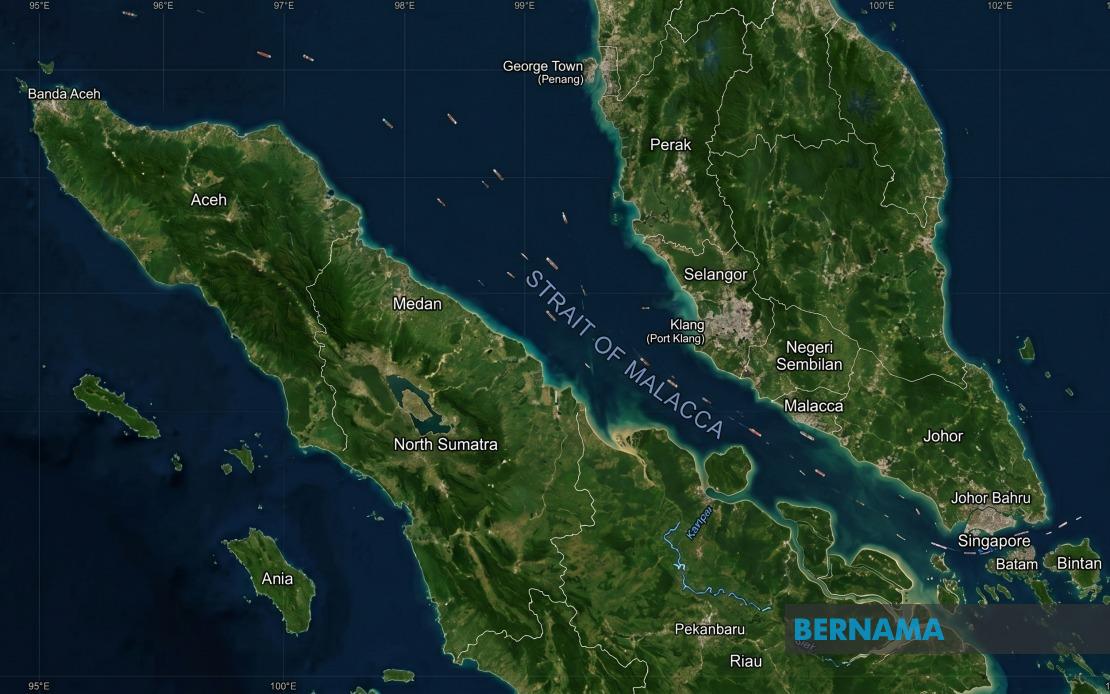
Indonesia and Singapore have jointly reaffirmed their strategic commitment to protecting the Strait of Malacca, one of the world's most critical maritime arteries, during high-level talks in Jakarta on Monday. The renewed pledge comes as both nations underscore their mutual interest in maintaining the waterway as a secure, accessible passage for international commerce while coordinating with fellow regional stakeholders Malaysia and Thailand. The announcement reflects deepening partnership between Southeast Asia's largest and most developed economies at a time of heightened global maritime tensions and emerging transnational security challenges.
President Prabowo Subianto and Singapore Prime Minister Lawrence Wong made the declaration during their second annual Leaders' Retreat at Istana Merdeka, signalling the priority both governments assign to maritime stewardship. As nations with direct territorial interests in the Strait, Indonesia and Singapore occupy uniquely consequential positions in safeguarding this 550-kilometre passage that funnels roughly one-third of global maritime trade. Their united stance carries substantial weight in regional security discourse, particularly given Indonesia's control of the western approaches and Singapore's position at the southern gateway.
The leaders emphasised adherence to the 1982 United Nations Convention on the Law of the Sea (UNCLOS), the international legal framework governing ocean rights and responsibilities. This invocation of UNCLOS underscores both nations' commitment to rules-based maritime governance, a principle increasingly tested by assertive state behaviour in contested waters elsewhere in Asia. By explicitly anchoring their Strait protection strategy in established international law, Indonesia and Singapore project a model of cooperative stewardship that contrasts sharply with unilateral approaches seen in other regional hotspots.
Beyond simple freedom of navigation, the two leaders identified multiple vulnerability points requiring coordinated vigilance. Maritime piracy, though substantially diminished from its peak in the late 2000s, remains a residual concern that demands continuous counter-piracy patrols and intelligence sharing. Equally pressing are environmental hazards including oil spills and chemical pollution from shipping traffic, which pose catastrophic risks to the region's marine ecosystems and fishing industries. The leaders also highlighted maritime accidents as a persistent danger, given the Strait's congested sea lanes where hundreds of vessels navigate simultaneously, creating collision risks that demand sophisticated traffic management systems.
The renewed commitment to multipartite coordination with Malaysia and Thailand reflects recognition that protecting the Strait requires consensus among all littoral states. Malaysia, as the eastern bulwark of the passage, and Thailand, which anchors the northern approaches, remain essential partners in any comprehensive security architecture. Such inclusive framing contrasts favourably with bilateral frameworks that might inadvertently marginalise other stakeholders, and signals Jakarta and Singapore's diplomatic sophistication in managing shared maritime interests.
Prabowo characterised the preservation effort as a matter of vital interest transcending narrow national concerns, positioning Strait security within a broader Southeast Asian stability framework. This articulation carries significance for Malaysian and regional observers, as it acknowledges that the Strait's strategic importance extends beyond its immediate bordering states to affect the entire region's economic prosperity and security environment. Disruption to shipping through the Strait would immediately cascade into supply chain ruptures affecting every Southeast Asian economy dependent on global trade.
The timing of this affirmation merits careful consideration. Wong's visit to Jakarta follows a period of intensified regional diplomatic activity and reflects Singapore's strategic calculus in maintaining robust ties with Indonesia, its closest neighbour and ASEAN's demographic and geographic heavyweight. For Indonesia, the retreat demonstrates President Prabowo's early prioritisation of maritime security and regional partnership, setting a tone for his administration's approach to geopolitical challenges. The leaders' discussion extended beyond Strait-specific concerns to encompass broader bilateral, regional and international matters, suggesting a comprehensive engagement addressing multiple fronts simultaneously.
The Leaders' Retreat framework itself warrants attention as a symbolic and practical mechanism for high-level strategic dialogue. By establishing this annual gathering, Indonesia and Singapore have created an institutional conduit for candid discussions away from public scrutiny, enabling leaders to address sensitive issues frankly. This second retreat underscores the special relationship between the two nations, a phrase Prabowo himself deployed, suggesting an intimacy in ties that transcends typical bilateral relationships. Such structured engagement mechanisms prove particularly valuable during periods of regional uncertainty or when complex transnational challenges demand sustained political attention.
Looking forward, the leaders noted with evident significance that Indonesia and Singapore will commemorate the 60th anniversary of their diplomatic relations next year. This milestone carries symbolic weight, allowing both governments to reflect on six decades of cooperation and reset expectations for continued partnership. Prabowo expressed confidence that deepened collaboration would yield regional dividends in the form of enhanced stability, economic growth and shared prosperity. For Malaysian observers, such strengthening of Indonesia-Singapore ties carries implications for the broader ASEAN framework and the power dynamics within Southeast Asia's most influential bilateral relationships.
The emphasis on peaceful resolution of disputes through dialogue and diplomacy, mentioned during the joint press conference, carries particular resonance in contemporary Asia. Both leaders reaffirmed ASEAN's foundational commitment to resolving disagreements through negotiation rather than confrontation, a principle tested repeatedly in the South China Sea and other contested maritime zones. By explicitly recommitting to these principles at their bilateral level, Indonesia and Singapore project confidence in collaborative approaches while implicitly signalling resistance to more coercive alternatives that might undermine regional stability.
The Strait of Malacca protection commitment ultimately reflects a mature understanding among regional powers that shared interests in maritime security transcend narrow competitive impulses. Indonesia and Singapore's joint stance demonstrates that even countries with distinct strategic traditions and political systems can find common ground on existential regional concerns. For Malaysia, whose coastline borders the Strait and whose maritime interests closely parallel those of Indonesia and Singapore, such tripartite coordination offers reassurance that this critical waterway will benefit from sustained multilateral vigilance and cooperation.

