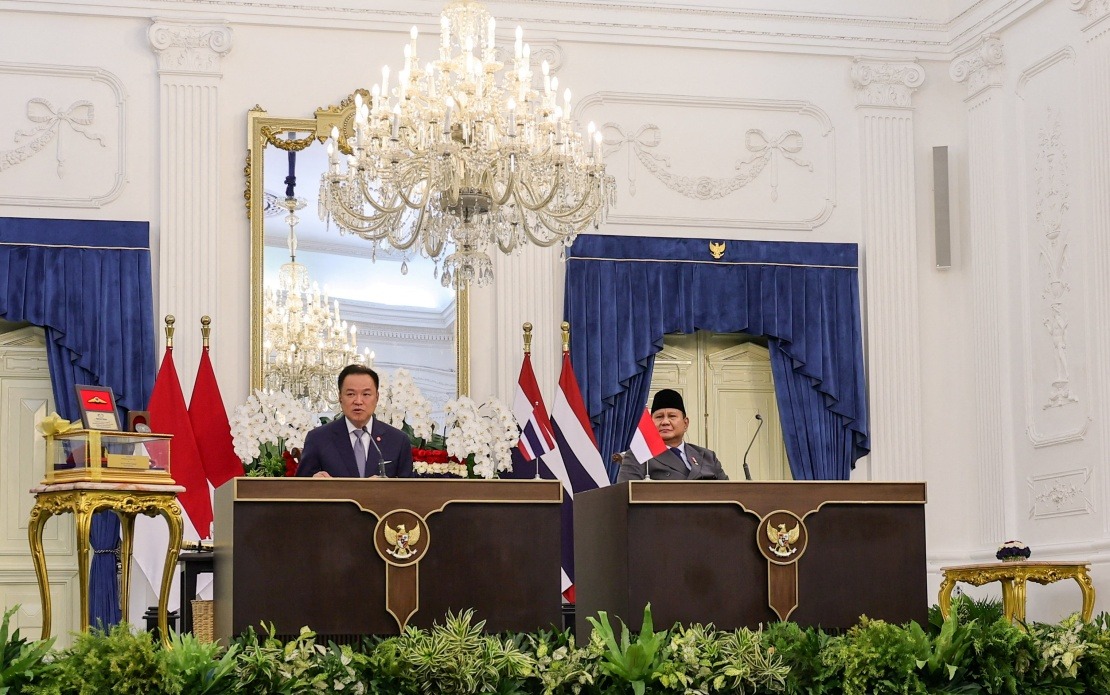
Indonesia and Thailand have jointly pledged to intensify their support for ASEAN-coordinated initiatives aimed at restoring stability in Myanmar, signalling renewed regional commitment to resolving the crisis that has destabilised Southeast Asia for over three years. The commitment emerged from the second Leaders' Consultation between Indonesian President Prabowo Subianto and Thai Prime Minister Anutin Charnvirakul held at Jakarta's Merdeka Palace, marking a significant diplomatic engagement as both leaders seek to strengthen bilateral ties and ASEAN's collective influence in the region.
Central to their discussion was the advancement of the Five-Point Consensus, ASEAN's core framework for Myanmar's path toward peace. The framework, originally drafted in April 2021, calls for an immediate cessation of violence, constructive dialogue among conflicting parties, humanitarian assistance delivery, and a timeline for political transition. Both leaders emphasised that inclusive dialogue remains the only viable pathway to sustainable resolution, recognising that military solutions have only deepened Myanmar's humanitarian catastrophe and regional instability. Their mutual commitment reflects broader Southeast Asian concern that prolonged conflict in Myanmar threatens border security, generates refugee populations, and undermines economic development across the bloc.
Prabowo articulated the philosophical foundation of their approach, stressing that maintaining ASEAN unity and upholding the principle of centrality—whereby ASEAN must remain the primary architect of regional solutions rather than external powers—are essential to achieving durable peace and stability. This rhetoric underscores a broader geopolitical calculation: Indonesia and Thailand recognise that a fragmented ASEAN response to Myanmar invites unwanted intervention from major powers, potentially transforming the crisis from a regional problem into a theatre for great power competition. By publicly reaffirming ASEAN's role, both nations signal their resistance to extraregional influence while demonstrating their willingness to lead constructive diplomacy.
Beyond Myanmar, the bilateral relationship is deepening along multiple security dimensions. Indonesia and Thailand agreed to substantially expand their defence and security cooperation framework, with particular emphasis on combating transnational organised crime networks that exploit weak governance and porous borders throughout Southeast Asia. The agreement focuses on online scam syndicates—a growing threat that has ensnared thousands of Southeast Asian victims who are coerced into fraudulent activities or become prey to financial exploitation. This targeted focus reflects an acute regional crisis: organised criminal groups operating from multiple countries have transformed digital fraud into a multi-billion-dollar enterprise, devastating families and undermining public confidence in digital financial systems.
The cooperation framework includes concrete mechanisms for intelligence sharing, joint financial investigations, and coordinated law enforcement operations designed to identify and dismantle criminal networks. Thailand's Prime Minister highlighted that the bilateral arrangement encompasses regular joint military training exercises, enhanced information exchange protocols, and expanded maritime security patrols—measures that address both traditional and emerging security threats. The intelligence-sharing dimension is particularly significant for Malaysia and the region, as it signals willingness among major ASEAN actors to create information-sharing protocols that could eventually scale across the bloc, creating a more resilient collective defence architecture against transnational crime.
A notable achievement of the consultation was agreement to develop a Transnational Referral Mechanism specifically designed to identify victims of cross-border crime, ensure their protection, and facilitate their repatriation to home countries with dignity. This mechanism acknowledges the humanitarian dimension of transnational crime—many victims are trafficked persons, forced labourers, or individuals manipulated into criminality through coercion. Prabowo publicly acknowledged Thailand's instrumental role in facilitating the repatriation of approximately 1,000 Indonesians victimised by online scam operations, recognition that demonstrates both nations' commitment to victim-centred approaches rather than purely law enforcement perspectives.
Thailand's Prime Minister Anutin proposed additional defence industry collaboration, including the supply of 36 amphibious wheeled armoured vehicles to Indonesia—a proposal that, if executed, would strengthen Indonesia's coastal and riverine operational capabilities while expanding Thailand's defence manufacturing exports. This procurement dimension reflects broader Southeast Asian trends toward deepening intra-regional defence trade, reducing dependence on external suppliers while building interoperable military platforms that enhance ASEAN collective defence consciousness. The timing of such proposals during a leaders' visit signals both nations' confidence in the sustainability of their bilateral relationship across potential political transitions.
Anutin's visit marked his first official journey to Indonesia since assuming Thailand's premiership in September 2025, elevating the symbolic importance of bilateral engagement. More significantly, his trip represents the first visit by a Thai prime minister to Indonesia in 15 years—a gap that underscores how bilateral relations between two major Southeast Asian economies had drifted during periods of political instability in Thailand. The resumption of high-level visits reflects both nations' determination to reactivate institutional mechanisms for regular consultation and cooperation, essential for managing complex security challenges that respect no borders.
The dialogue specifically addressed online scam operations, human trafficking, and drug trafficking as priority transnational threats requiring coordinated regional responses. These crime categories represent diverse challenges: online fraud involves sophisticated digital networks and financial manipulation; human trafficking involves physical movement of vulnerable persons across borders; drug trafficking connects production zones with consumption markets through vast supply chains. By treating these threats as interconnected dimensions of transnational organised crime rather than isolated problems, Indonesia and Thailand acknowledge that effective solutions require multi-agency coordination, intelligence fusion, and capacity building across law enforcement institutions.
Wildlife trafficking emerged as an additional focus area, with Thailand pledging to strengthen regional cooperation within ASEAN frameworks to combat networks that traffick endangered species. This reflects Southeast Asia's critical role in global wildlife trafficking routes, where demand from external markets drives poaching that threatens biodiversity and undermines conservation efforts. Indonesia, as the region's most biodiverse nation, has particular stakes in combating these networks, which operate through the same organisational and financial infrastructure as drug and human trafficking networks.
The bilateral agreements demonstrate how middle-power ASEAN nations are constructing security partnerships that transcend traditional alliance frameworks while preserving ASEAN's non-aligned positioning. Rather than joining formal security blocs dominated by external powers, Indonesia and Thailand are deepening functional cooperation on issues directly affecting their citizens and regional stability. This approach offers a model for how Southeast Asian nations can enhance security without compromising sovereignty or ASEAN cohesion—a delicate balance essential as the region navigates intensifying great power competition.
For Malaysian observers, these Indonesian-Thai initiatives carry implications beyond bilateral relations. They demonstrate momentum toward strengthening ASEAN institutional capacity for addressing transnational challenges, creating potential frameworks that Malaysia and other member states could eventually join. The emphasis on victim protection and repatriation mechanisms particularly resonates, given Malaysia's experience managing significant migrant worker populations and organised crime networks operating through its territory. Enhanced intelligence-sharing protocols and joint investigation frameworks could enhance Malaysia's own capacity to combat crimes that generate significant social costs.

