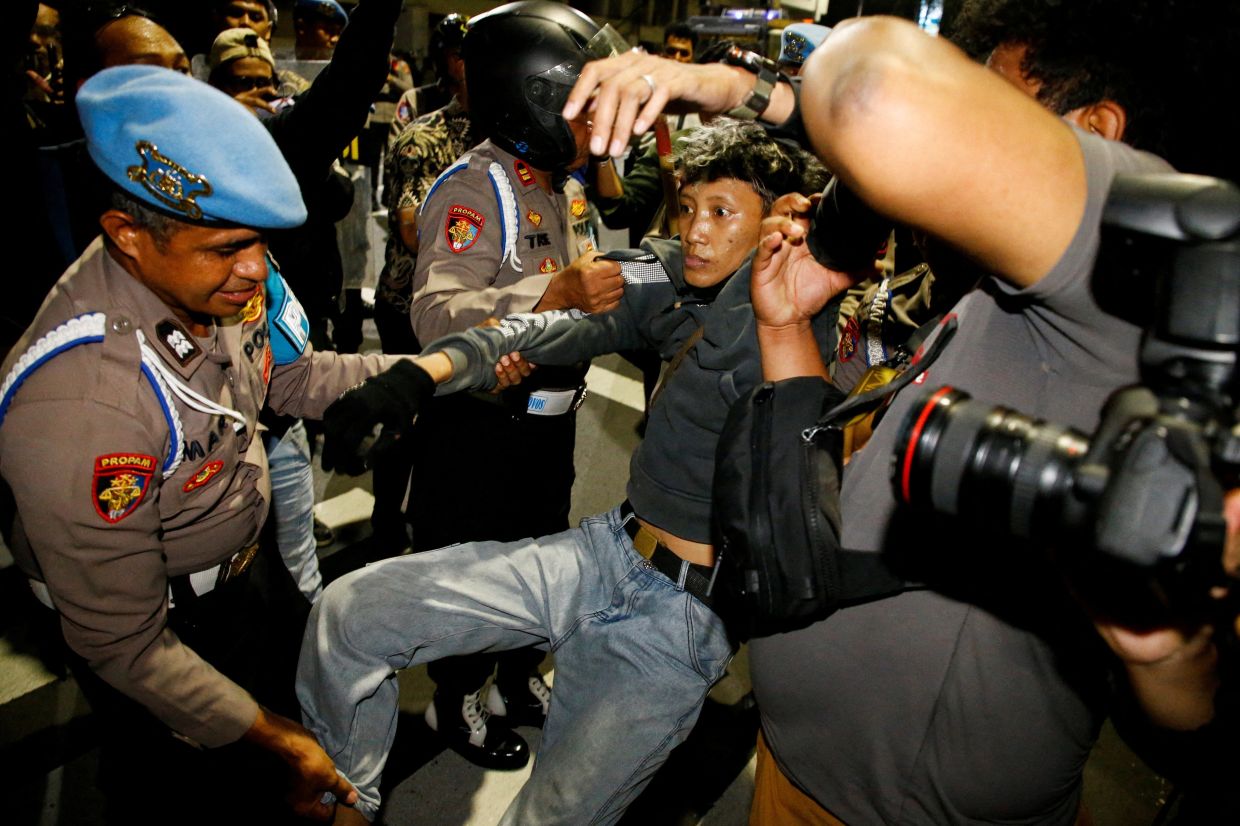
Indonesian police have moved to prosecute four individuals following an anti-government demonstration that took place in Surabaya, the country's second-largest city, on Friday. The charges came after authorities detained approximately 100 protesters who had gathered near a government building to voice opposition to a significant fuel price increase and a national free school meals initiative plagued by food poisoning incidents and corruption allegations. Surabaya police chief Luthfie Sulistiawan disclosed the charges on Sunday, stating that the four individuals would face legal proceedings for property destruction and assault against police officers.
The demonstration drew a crowd of roughly 100 people, according to estimates made by journalists at the scene. Tensions escalated when some protesters threw objects including firecrackers and rocks at the gathering, leading police to implement what authorities described as "firm actions" to bring the rally under control. In total, officers arrested 24 people during the Friday event, though most were subsequently released without being formally charged. The four individuals who now face charges represent a fraction of those detained, highlighting authorities' targeted approach to prosecuting those deemed most directly involved in the disorder.
Indonesia has experienced a wave of discontent across multiple cities this month following the government's decision to raise prices of non-subsidised petrol by approximately 30 percent. The price adjustment forms part of broader efforts to reduce mounting budget pressures as geopolitical tensions in the Middle East have disrupted global oil supply chains and driven up international crude prices. For a nation that relies heavily on fuel subsidies to cushion consumers against volatile world markets, the move represents a significant policy shift with far-reaching economic implications for ordinary Indonesians.
The fuel subsidy system has long represented a fundamental feature of Indonesia's social contract with its citizens. As Southeast Asia's largest economy and a considerable oil producer in its own right, Indonesia nonetheless remains a net importer of petroleum products. This structural dependency on imported oil means the country remains vulnerable to international price fluctuations and supply disruptions, creating persistent budgetary challenges for policymakers seeking to maintain affordable domestic fuel prices. The recent price increase reflects the government's assessment that the fiscal burden of maintaining subsidies had become unsustainable.
The discontent extends beyond fuel costs to encompass the government's flagship free school meals programme, which has become increasingly controversial. The initiative, which was intended to address childhood malnutrition across the archipelago, has been beset by implementation problems ranging from corruption to public health concerns. Tens of thousands of people have fallen ill following contaminated meals distributed under the scheme, generating public anxiety about food safety standards and the government's capacity to deliver such large-scale programmes effectively.
The free meals initiative represents a multi-billion-dollar commitment that the government has promoted as a critical intervention to combat nutritional deficiencies among Indonesian schoolchildren. Yet the programme's troubled rollout has severely damaged public confidence. Critics argue that the scheme combines fiscal inefficiency with organisational dysfunction, creating opportunities for corrupt officials to divert resources while simultaneously failing to meet its humanitarian objectives. The partial suspension of the programme acknowledges these systemic failures, though questions persist about whether reforms can restore public trust.
In the capital Jakarta, the discontent has crystallised among student populations who have organised street demonstrations opposing both policy initiatives. Young Indonesians have emerged as vocal critics of both the fuel price hikes and the mismanagement of the free meal scheme, amplifying concerns about governance and economic management that resonate broadly across Indonesian society. These youth-led protests reflect growing frustration with policies perceived as adversely affecting ordinary citizens while failing to deliver promised public benefits.
The broader context reveals tensions between fiscal discipline and social welfare in a nation grappling with inflation and budget constraints. The government faces genuine pressures to rationalise spending and align domestic fuel prices more closely with international market rates, yet such adjustments inevitably spark popular resistance. Indonesia's history of fuel price protests demonstrates the political sensitivity surrounding energy costs in a country where many households remain vulnerable to price shocks.
Luthfian's disclosure that six individuals remain under investigation after testing positive for drugs represents an additional dimension to the police response. The authorities' decision to pursue substance-related charges against protest participants suggests they may employ various legal mechanisms to discourage future demonstrations. This approach has raised concerns among civil liberties observers who worry that authorities may use drug charges as a pretext for suppressing legitimate political protest, a practice that has been documented in previous instances across Indonesia.
The Surabaya incident underscores the volatile intersection of economic policy and public opinion in Indonesia. As the government pursues difficult fiscal adjustments necessary for macroeconomic stability, it must navigate the political costs of measures that directly affect living standards. The convergence of fuel price grievances with concerns about public health and institutional corruption has created a potent source of popular discontent that extends well beyond Surabaya, suggesting that authorities may face continued pressure to address underlying public concerns about both economic management and governance quality.

