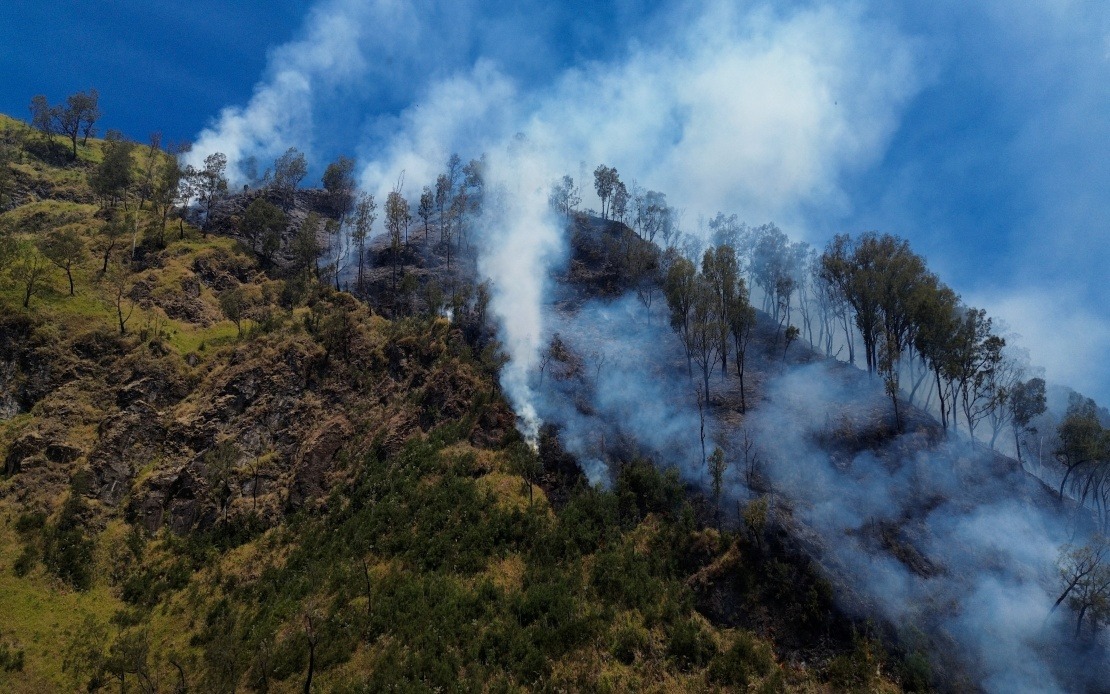
Indonesia has halted all tourism operations at the iconic Mount Bromo, one of East Java's most visited natural attractions, following a rapidly spreading forest fire that has consumed vast tracts of the Bromo Caldera. The Bromo Tengger Semeru National Park authority implemented the complete shutdown effective from 10pm on Saturday, restricting access through all five primary entry points to prioritise firefighting operations and protect public safety.
The closure encompasses every major entrance serving the national park, including the Cemorolawang gateway in Probolinggo Regency, Wonokitri in Pasuruan Regency, and the dual access points at Jemplang and Coban Trisula in Malang Regency, along with the Senduro entrance in Lumajang Regency. This comprehensive approach reflects the authorities' assessment that the wildfire presents an imminent threat across the entire caldera system. For tourists who had secured advance online bookings during the closure period, the park authority has offered flexibility through rescheduling options or full refunds, acknowledging the economic impact on both visitors and local tourism operators.
The wildfire, which ignited on Monday, has already devastated an estimated 176.20 hectares of vegetation spanning Probolinggo and Malang regencies by Saturday evening. According to Abdul Muhari, head of the National Disaster Management Agency's Disaster Data, Information, and Communication Centre, active hotspots continued releasing dense smoke throughout Saturday night, presenting ongoing challenges for containment efforts. The persistence of visible hotspots indicates the fire remains in its mid-stages, with moisture content in vegetation and wind patterns determining whether suppression attempts will prove successful or whether the blaze might expand further.
Indonesian authorities have mobilised significant aerial resources to combat the spreading flames, deploying two helicopters specifically equipped with water-carrying capacity of 1,000 litres each. This equipment represents a critical asset for tackling fires across Mount Bromo's volcanic terrain, where ground-based firefighting becomes logistically challenging due to steep slopes and limited vehicle access. The decision to station helicopters reflects recognition that traditional terrestrial firefighting methods alone cannot effectively manage a blaze of this magnitude across the caldera's complex topography.
The incident at Mount Bromo follows a separate forest fire in the Sembalun Resort area of Mount Rinjani National Park located in East Lombok Regency, Nusa Tenggara Barat province. That fire, which erupted on Friday evening at approximately 8pm, consumed around 30 hectares before firefighting teams successfully contained it by 1:30am on Saturday. While the Rinjani fire was brought under control relatively swiftly, its near-simultaneous occurrence with the Mount Bromo incident suggests regional fire risk conditions remain elevated across East Java and the broader eastern Indonesia region, potentially linked to seasonal weather patterns or human activity.
Investigators have yet to determine the underlying causes of either the Bromo or Rinjani wildfires. Understanding how these fires originated remains crucial for developing prevention strategies, as volcanic regions across Indonesia frequently experience fire incidents during specific seasons when vegetation dries sufficiently to become fuel for rapid combustion. Officials have indicated that cause determination remains an active investigation, with preliminary findings expected as evidence from affected areas undergoes analysis.
For Malaysia's travel industry and Southeast Asian tourists, the Mount Bromo closure presents immediate disruptions to holiday plans. The volcano ranks among East Java's premier tourist destinations, attracting thousands of international and domestic visitors monthly who undertake pre-dawn hikes to witness sunrise over the caldera's dramatic landscape. The suspension of access will persist until authorities certify that fire risk has diminished sufficiently to permit safe visitor operations, creating uncertainty for bookings across the regional tourism sector.
Beyond tourism impacts, the Mount Bromo fire highlights broader environmental concerns affecting Indonesia's protected areas. Forest and land fires across the archipelago generate transboundary haze that regularly impacts air quality throughout Southeast Asia, including Malaysia, Singapore, and Brunei. The wildfire's continued expansion reinforces the vulnerability of Indonesia's national parks to uncontrolled combustion, particularly during seasons when rainfall decreases and vegetation moisture reaches critical thresholds.
The incident underscores challenges inherent in managing vast protected ecosystems across challenging terrain where fire suppression requires coordination between national, provincial, and local authorities. Mount Bromo's status as a UNESCO World Heritage Site intensifies the significance of protecting its ecological integrity. The closure, while disruptive economically, represents a pragmatic prioritisation of environmental preservation and immediate human safety over short-term tourism revenue.
Authorities have indicated that the park will remain closed indefinitely pending developments in fire containment and environmental assessment. Visitors should monitor official announcements from the Bromo Tengger Semeru National Park authority before planning visits to the region. The situation illustrates how natural disasters can rapidly reshape travel patterns across Southeast Asia, affecting not only Indonesia's tourism infrastructure but also the broader regional economy dependent on accessible natural attractions.

