Indonesian authorities have successfully dismantled an organised cross-border drug trafficking network centred in Batam, marking a significant success in regional narcotics enforcement. The National Narcotics Agency (BNN) and the Customs and Excise Directorate General conducted coordinated raids that resulted in six arrests, though investigators are continuing to track two Malaysian nationals believed to have orchestrated the smuggling and distribution operation. The syndicate's sophistication and cross-border reach highlight the persistent challenges facing Southeast Asian law enforcement in combating transnational drug crime, particularly through the heavily trafficked maritime corridors linking Malaysia and Indonesia's Riau Islands.
The investigation originated when Customs officials at Soekarno-Hatta International Airport intercepted a parcel arriving from Malaysia that aroused suspicion due to its declared contents. Laboratory analysis at the Customs and Excise Laboratory in Jakarta revealed that the package, falsely labelled as an Orange Fiber Xtra food supplement, contained 3,4-Methylenedioxymethamphetamine (MDMA), ketamine, and other controlled substances. This discovery proved pivotal, prompting BNN and Customs personnel to launch a comprehensive tracing operation that ultimately unravelled an extensive network operating throughout Batam and the surrounding islands. The initial seizure demonstrated how criminals attempt to exploit legitimate commercial channels and standard postal procedures to move contraband across borders.
The operational response was swift and coordinated. When suspect BAP attempted to collect the intercepted package in Batam on Wednesday, officers apprehended him immediately. His subsequent testimony accelerated the investigation, leading authorities to rapidly identify and arrest three additional suspects—ED, who had allegedly placed the order, and NC and TFS—at a hotel in Baloi. This quick progression from initial seizure to multiple arrests within a single operational window showcases the effectiveness of intelligence-led policing when agencies share information and coordinate their activities across traditional departmental boundaries. The ability to convert one successful interception into multiple arrests demonstrates how a single successful enforcement action can yield cascading results when pursued thoroughly.
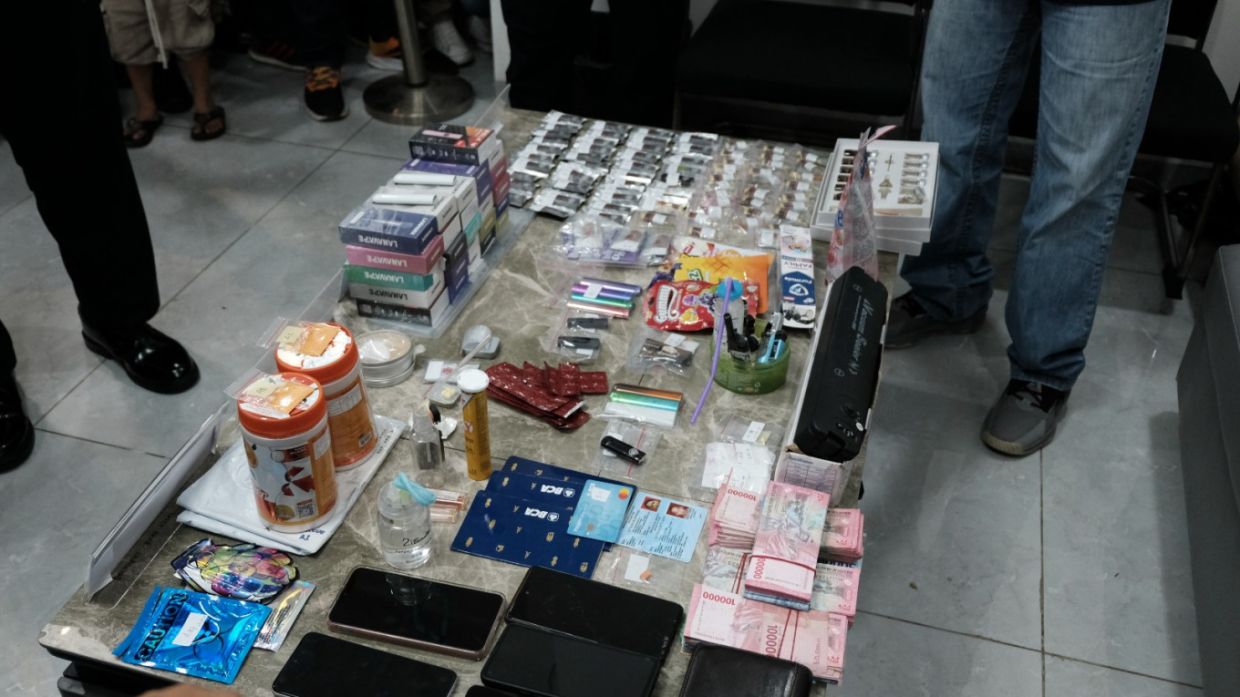
Raids on four separate locations yielded substantial quantities of narcotics and drug paraphernalia. Officers discovered dozens of electronic cigarette cartridges containing etomidate—a pharmaceutical anaesthetic increasingly diverted into recreational use—alongside methamphetamine, ketamine powder, and ecstasy pills. The raiding of an apartment in Teluk Tering and a boarding house in the Sakura Garden shophouse area in Batu Ampar uncovered additional contraband, including Happy Five tablets and sachets of Happy Water drinks, substances that have become concerning fixtures in Southeast Asian drug markets. The deployment of a K-9 sniffer dog during the Batu Ampar operation underscored the sophisticated investigative resources applied to dismantling the network.
The seizures were staggering in scale. Officers confiscated over one kilogram of MDMA, significant quantities of methamphetamine and ketamine powder, and 170 vape cartridges containing etomidate alongside 12 vials of the substance. The recovery of drug paraphernalia—nine bongs, plastic sealing devices, and digital scales—revealed the syndicate's operational infrastructure for processing and packaging. Authorities also seized multiple vehicles including a Toyota Alphard van, suggesting the network maintained dedicated logistics capabilities for distribution across Batam. The comprehensive asset seizure extended to motorcycles and various paraphernalia, dismantling not merely the human network but also its supporting infrastructure.
A parallel enforcement action at Batam Centre International Ferry Terminal prevented a separate smuggling attempt, illustrating the breadth of the trafficking challenge. Malaysian passenger PS attempted to bring 48 cartridges of etomidate through the ferry terminal arriving from Stulang Laut International Ferry Terminal in Johor Bahru. This incident, occurring alongside the primary operation, suggests either coordination with the dismantled network or independent criminal activity exploiting the same routes and methods. The near-simultaneous detection of two smuggling attempts underscores how the Johor Bahru-Batam corridor has become a major trafficking transit point requiring heightened vigilance.
The syndicate's operational sophistication lay in its deceptive packaging methodology. Drugs and etomidate cartridges were carefully concealed within dried food packages and food supplement sachets, then resealed with plastic devices to restore an appearance of commercial legitimacy. This technique exploits the sheer volume of food and supplement imports flowing through Southeast Asian borders, attempting to hide contraband within statistically massive volumes of legitimate commerce. Insp. Gen. Aswin Sipayung, the BNN's deputy for enforcement, characterised the operation as highly organised, spanning illegal port smuggling through to repackaging and street-level distribution. The methodical nature of the enterprise, complete with dedicated storage locations, repackaging facilities, and distribution networks, indicates a mature criminal operation rather than opportunistic smuggling.
Two Malaysian nationals—identified as SL and WKC—remain the subject of an active manhunt, their absence suggesting they recognised the operational risk and departed before arrests accelerated. Authorities have placed both individuals on wanted lists, indicating they are regarded as the syndicate's principal suppliers and architects. Their suspected role as the primary narcotics sources highlights how Malaysian smuggling networks have become crucial nodes in Southeast Asian drug trafficking architecture, utilising geographic proximity to Indonesia and access to pharmaceutical supply chains. The continued investigation into whether this syndicate connects to a recently raided drug manufacturing facility in Batam suggests a vertically integrated operation potentially combining local production with Malaysian supply lines.
The enforcement action's quantified social impact provides perspective on the disruption achieved. Batam Customs and Excise Office head Agung Widodo stated that the operation potentially saved 6,770 people from drug addiction and prevented Indonesian state healthcare rehabilitation costs estimated at Rp10.8 billion (approximately US$599,000). These calculations, while inherently speculative, underscore the public health dimensions of narcotics enforcement beyond merely criminal consequences. The figures illustrate how drug trafficking disruption translates into measurable preventive health outcomes, providing a counterweight to assertions that border enforcement represents merely reactive criminal justice activity.
The legal framework applied to the detained suspects carries extraordinary severity. Prosecution will proceed under Article 114(2) in conjunction with Article 132(1) and/or Article 112(2) in conjunction with Article 132(1) of Indonesia's Law No. 35/2009 on Narcotics. Conviction carries minimum sentences of five years' imprisonment extending to capital punishment, alongside potential fines reaching Rp10 billion. This formidable sentencing structure reflects Indonesia's determination to impose severe consequences for large-scale narcotics trafficking, though Malaysian nationals SL and WKC would require extradition to face prosecution. The severity of potential punishment illustrates how Southeast Asian countries have progressively hardened narcotics legislation in response to transnational trafficking challenges.
The operation carries significant implications for Malaysia-Indonesia bilateral law enforcement cooperation. The active involvement of both countries' law enforcement networks, combined with the pursuit of Malaysian nationals allegedly supplying the Batam network, demonstrates functional cross-border coordination despite occasional diplomatic tensions. However, the ease with which the Malaysian suspects apparently evaded apprehension raises questions about extradition mechanics and the capacity for Malaysian authorities to detain and transfer individuals wanted for narcotics offences. Successful resolution of this case will require Malaysian cooperation in locating, arresting, and potentially extraditing SL and WKC, testing the institutional frameworks for regional narcotics enforcement cooperation.
The Batam operation reflects broader patterns of Southeast Asian drug trafficking adapting to enforcement pressures. The shift toward pharmaceutical diversions like etomidate, the disguising of drugs within food commerce, and the utilisation of maritime smuggling corridors between Malaysia and Indonesia represent criminal entrepreneurship responding to conventional enforcement methods. The sophistication of the network—from organised illegal port operations through repackaging and distribution—indicates that narcotics trafficking in the region has evolved beyond small-scale opportunistic smuggling into systematised criminal enterprises. Future enforcement success will require sustained intelligence sharing, coordinated multi-agency operations, and possibly legislative harmonisation regarding pharmaceutical diversion and maritime smuggling penalties. The dismantling of this particular network represents a tactical victory, yet the underlying structural vulnerabilities enabling such operations persist throughout the region's porous maritime borders and complex pharmaceutical supply chains.

