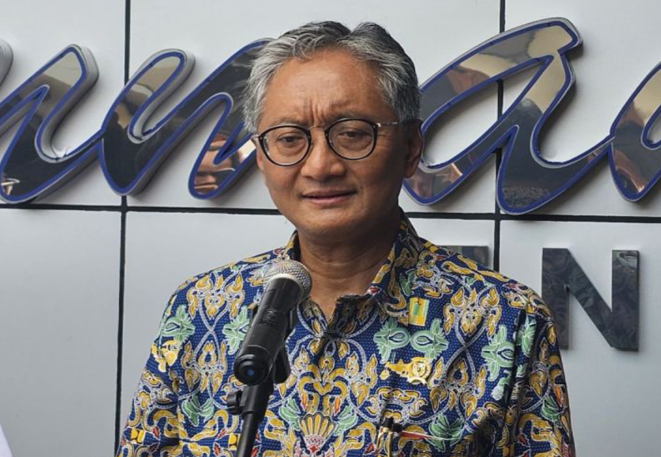
Indonesia's Public Works Ministry has descended into internal chaos following the public exposure of an official document that listed Minister Dody Hanggodo's wife and daughter among delegates scheduled for a New York trip in mid-July. The disclosure has prompted accusations of government resource misuse and sparked a wave of personnel transfers that ministry observers believe may be retaliatory in nature, though the minister categorically denies this characterisation.
The controversial document, dated June 29 and signed by ministry secretary-general Apri Artoto, identified eight officials selected to represent Indonesia at a United Nations-organised meeting scheduled for July 16 and 17. Alongside Hanggodo's wife Irma Hermawati and daughter Aurellia Tsabitha Meidirama, the travel roster included senior civil servants. When the letter circulated on social media platforms early in the month, it generated immediate public backlash centred on questions about whether state resources were being deployed to facilitate a family holiday under the guise of official business.
The backlash proved swift enough that the New York trip never materialised. However, the reputational damage persisted and soon morphed into broader allegations about internal power consolidation. Within days of the viral circulation, social media became flooded with claims that Hanggodo had begun reassigning officials who were suspected of leaking the document. While the minister has acknowledged the transfers, he has firmly rejected suggestions that they constituted punishment. At a media gathering on Wednesday, he challenged critics by pointing out the sheer scale of his ministry's workforce, asking rhetorically why he should not be permitted to reassign personnel from a total establishment of 38,600 employees.
Apri offered an alternative explanation during a July 7 press conference, arguing that the inclusion of Hanggodo's family members had been purely administrative—intended to streamline visa processing through coordination with the Foreign Ministry. He maintained that no state funds would actually have subsidised the family members' participation. The secretary-general simultaneously vowed to identify whoever had leaked the document to the media, hinting darkly at potential legal consequences should culprits be identified. This combination of defensive positioning and threats to investigate has only intensified speculation about the true nature of the minister's intentions.
Hanggodo's tenure since assuming office in October 2024 has been marked by a pattern of continuous and extensive personnel shuffling that extends far beyond the recent episode. The 60-year-old engineer-turned-politician, whose background includes business connections to South Kalimantan entrepreneur Andi "Haji Isam" Syamsuddin Arsyad and affiliation with the Democratic Party, has orchestrated multiple rounds of reassignments affecting more than a hundred employees. These reshuffles have ranged across the entire hierarchy, from director-general positions down to junior civil servants, creating an atmosphere of institutional instability.
Most significantly, in May Hanggodo appointed seven high-ranking officials to new posts, including Apri himself as secretary-general—a move that replaced Wida Nurfaida, who had occupied the position for less than a year following yet another shake-up in July 2025. This repeated cycling through leadership positions and mid-level transfers has begun to attract serious attention from parliamentary overseers. During a June meeting of the House of Representatives Commission V, which supervises infrastructure matters, Yasto Soepredjo Mokoagow of the Indonesian Democratic Party of Struggle expressed alarm about the cumulative psychological impact on ministry personnel. He specifically cited instances where officials had been demoted from structural posts to non-structural positions, observing that such disciplinary actions were creating workplace anxiety that threatened to paralyse programme delivery.
Hanggodo has offered a particular justification for his interventionist approach to staffing, repeatedly invoking the metaphor of a "deep state" embedded within the ministry. He describes this shadow network as akin to termites silently destroying the institution from within, necessitating aggressive bureaucratic restructuring. This framing positions his personnel decisions as defensive measures against embedded institutional resistance rather than arbitrary displays of authority. Whether his characterisation reflects genuine governance challenges or represents post-hoc rationalisation remains contested among observers and parliamentary commentators who worry about the operational impact of perpetual instability.
The ministry's credibility difficulties extend beyond internal management disputes into concrete criminal matters. Several senior officials have become embroiled in corruption investigations related to water resources projects. The Jakarta High Prosecutor's Office formally named suspects in June, including Dwi Purwantoro, the ministry's former water resources director-general, and Yosiandi Radi Wicaksono, who previously served as acting irrigation and swamp director. When confronted about these developments, Hanggodo stated publicly that he would neither shield wrongdoers nor obstruct law enforcement actions against his subordinates, attempting to position himself on the side of institutional integrity.
Yet despite these assurances, recent video evidence circulating on social media has complicated the narrative surrounding Hanggodo's leadership style. Footage from an April visit to an East Java school construction site shows the minister reprimanding an employee in notably aggressive terms, including accusations that the subordinate had offered "dumb excuses." Such public displays of ministerial displeasure have reinforced concerns among civil servants about the tenor and consequences of working within an organisation under such intense top-down pressure. The accumulation of leaked documents, contested personnel decisions, criminal investigations, and documented instances of confrontational management has created a portrait of institutional dysfunction that extends beyond typical political transitions and into territory that invites sustained international and domestic scrutiny of Indonesia's public administration standards.

