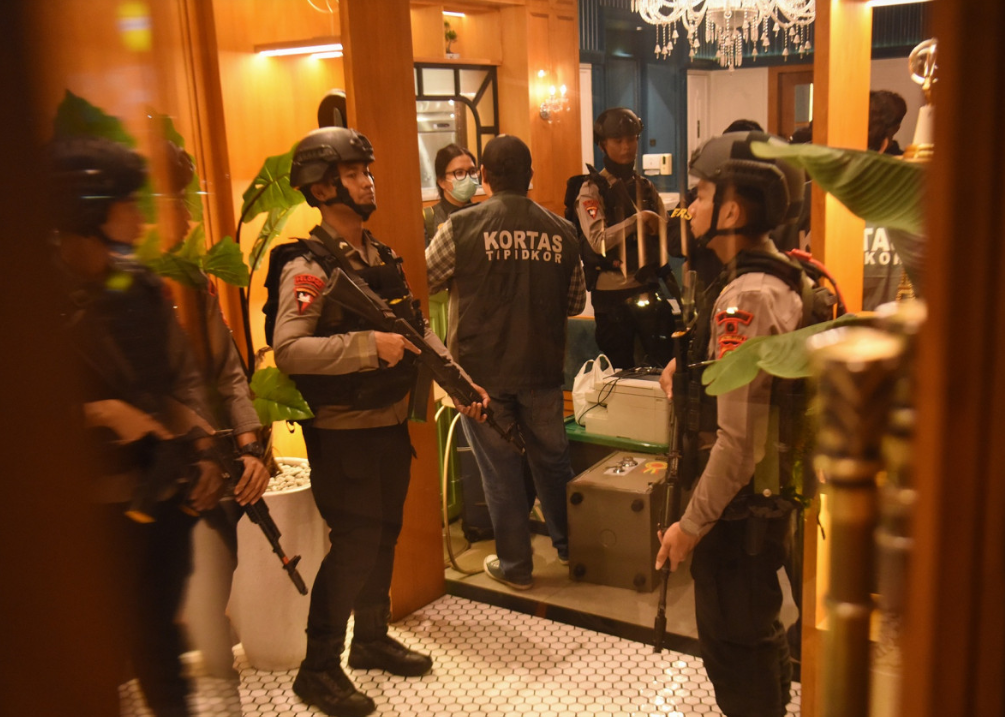
A dramatic series of dawn raids across Jakarta on Wednesday evening exposed one of Indonesia's gravest institutional corruption crises in recent memory, with police seizing approximately US$26.3 million in gold bullion and multiple currencies from locations connected to Febrie Adriansyah, the newly resigned deputy attorney general for special crimes. The coordinated operation, which stretched from fashionable South Jakarta neighbourhoods into suburban enclaves and continued into Thursday morning, has thrust questions about systemic integrity within Indonesia's law enforcement hierarchy into sharp public focus at a moment when institutional credibility remains fragile.
The operation began methodically in the afternoon at de'Clan Signature, an upscale restaurant situated in Cipete, where heavily armed personnel from Jakarta's police department and the National Police's corruption investigation unit, accompanied by Mobile Brigade officers dressed in tactical gear and wielding long-barrel firearms, breached the establishment to access a two-metre-high safe concealed behind a cabinet. The dramatic intervention immediately attracted attention from patrons and passersby, who observed as officers extracted documents and substantial quantities of cash denominated in multiple currencies—a haul valued in the millions of dollars. The operation expanded seamlessly to an adjacent money-changing business, Koin Money Changer, where officers discovered additional safes containing hundreds of thousands of dollars in rupiah-denominated notes.
However, the most spectacular discovery occurred at a residence in the hillside community of Sentul, approximately one hour's drive south of the capital. Police located seven suitcases within the property containing 74 kilograms of gold bars alongside cash reserves in various currencies, accumulating to the staggering total of US$26.3 million. The residence belongs to Febrie, who had occupied his position as deputy attorney general overseeing special crimes prosecutions for more than four years before his sudden resignation over the weekend. While authorities named him as a suspect in concurrent corruption and money-laundering investigations, he has not been detained, instead issuing statements acknowledging ownership of the Sentul property whilst insisting the seized assets belong to third parties whose identities would emerge through legal proceedings.
The visually arresting imagery of gleaming gold bars and thick bundles of currency stacked and displayed by authorities has crystallised into the iconic representation of an institutional scandal that reverberates across Indonesia's entire law-enforcement apparatus. The sequential searches, originating in Cipete and culminating in Sentul, encompassed at least ten additional locations throughout the metropolitan region, including a residence within the prestigious Pacific Place condominium towers positioned near Jakarta's financial exchange, multiple office spaces affiliated with various companies, and properties in affluent South Jakarta neighbourhoods such as Gandaria.
The investigation expanded to encompass Don Ritto, a lawyer designated as a suspect and subsequently detained by authorities, whose business entanglements connected him to both the raided restaurant and money-changing operation. Corporate documentation analysed by Indonesian media outlets established Ritto's ownership stakes in entities with direct connections to the establishments raided during the operation, suggesting a network of financial relationships potentially spanning years. The breadth of the investigation and the diversity of locations targeted indicate authorities are pursuing complex chains of financial activity rather than isolated instances of misconduct.
As inquiries widened and authorities consolidated evidence, speculation intensified within Jakarta's political and legal circles regarding investigative jurisdiction and procedural legitimacy. The decision to transfer the investigation from police authorities to the Attorney General's Office sparked immediate constitutional scrutiny from prominent legal scholars and former judicial officials. Mahfud MD, a respected constitutional law specialist who previously served as chief justice of Indonesia's Constitutional Court and as coordinating minister for political, legal and security affairs, publicly questioned the legality of this institutional shift through his YouTube platform, arguing that Indonesia's criminal procedure code contains no provision authorising such a transfer.
Mahfud's intervention introduced a procedural vulnerability potentially exposing the entire case to pretrial dismissal challenges, representing a significant complication in an already complex institutional situation. His public statements, delivered whilst wearing traditional Batik formal attire, emphasised that the constitutional Corruption Eradication Commission, an independent state body established specifically to investigate high-level institutional corruption, should assume investigative responsibility. This position reflected broader concerns about whether investigative authority should remain within potentially compromised institutional structures or be elevated to genuinely independent oversight mechanisms.
The scandal arrives amid an extended period of public scrutiny regarding corruption within Indonesian institutions, testing whether existing anti-corruption frameworks function adequately or whether institutional design flaws permit sustained financial misconduct to flourish undetected. The discovery of such substantial assets—particularly the existence of multiple currency caches and precious metal reserves—raises fundamental questions about financial oversight mechanisms, reporting requirements, and asset declaration procedures within Indonesia's justice sector. For Malaysian observers, the case underscores shared governance challenges across Southeast Asia regarding the vulnerability of internal anti-corruption institutions to the very malfeasance they are designed to combat.
The timing of these raids reflects evolving enforcement responses to institutional corruption, suggesting that investigative capacity targeting high-level officials exists within Indonesia's police and judicial apparatus. However, the subsequent questions regarding investigative jurisdiction and jurisdictional transferability reveal structural vulnerabilities within Indonesia's institutional frameworks that could undermine prosecutorial effectiveness. The distinction between police-led investigations and Attorney General's Office control carries substantial implications for case outcomes, evidence handling protocols, and ultimate judicial consequences, each factor influencing public confidence in anti-corruption enforcement credibility.
As investigations deepen and additional details emerge, the case will likely serve as a consequential test of Indonesia's institutional capacity to hold senior justice sector officials accountable. The involvement of a deputy attorney general—an official occupying one of the nation's most sensitive law enforcement positions—in alleged corruption and money-laundering schemes strikes at the heart of institutional legitimacy. For Southeast Asia more broadly, the episode illustrates how systemic corruption can penetrate even those institutions theoretically responsible for combating it, presenting persistent governance challenges that transcend individual nations or administration changes.

