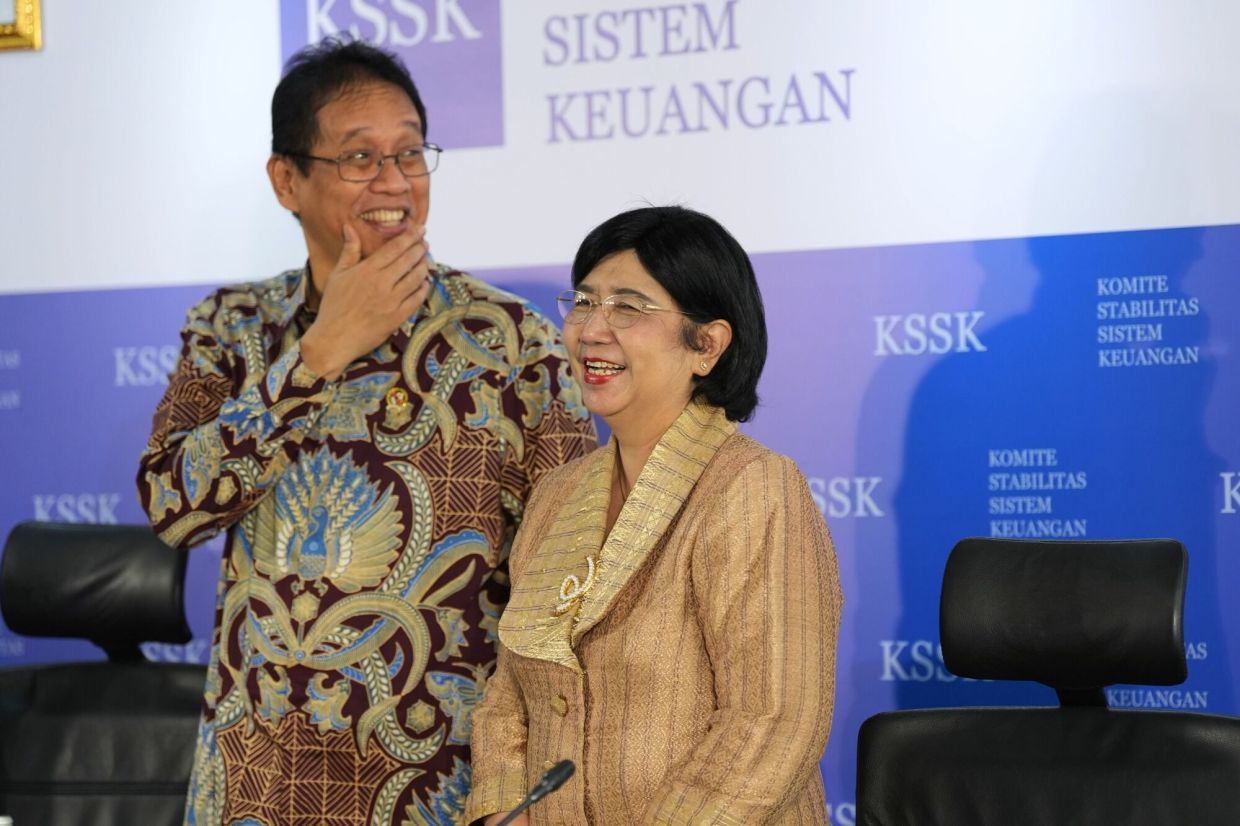
Indonesia's central banking leadership has entered a critical transition phase with the appointment of Destry Damayanti as acting governor two weeks ago, a choice that signals President Prabowo Subianto's intention to forge closer ties between the monetary authorities and his government's economic agenda. The timing of Damayanti's initial meetings tells much about the direction being charted: her first stop after the presidential palace announcement was the finance ministry, where she met with Finance Minister Purbaya Yudhi Sadewa in what observers read as a deliberate demonstration of collaborative intent. This strategic gesture stands in sharp contrast to the more formal, institutional distance maintained by her predecessor Perry Warjiyo, whose interactions with the finance ministry typically occurred within broader governmental forums at the presidential palace or through regulatory committees rather than through private bilateral engagement.
Prabowo's decision to nominate Damayanti, who served as Warjiyo's deputy since 2019, reflects a calculated attempt to achieve what many policymakers view as an impossible equilibrium: installing a governor sufficiently aligned with the administration's pro-growth policies to earn political support, while retaining enough technocratic credibility to reassure international investors and financial markets. The challenge ahead extends far beyond typical central banking operations; it encompasses questions about the institutional independence of Southeast Asia's largest economy's monetary authority during a period of considerable economic and political flux. With parliamentary approval still required, the nomination signals where power dynamics lie, yet also reveals anxieties about whether a more cooperative central bank can simultaneously maintain the discipline financial markets demand.
Economists and market analysts have generally received Damayanti's appointment with cautious optimism, viewing her continuity from the Warjiyo administration as a stabilising force during uncertain times. Her demonstrated rapport with Finance Minister Sadewa has prompted expectations of improved governmental coordination on monetary and fiscal matters, potentially accompanied by a marginally more accommodative policy posture. Citigroup's Helmi Arman noted in recent analysis that communication between Bank Indonesia and government agencies should improve markedly under the new leadership, though he cautioned that the broader institutional environment remains fluid and subject to shifting political winds. Market reaction was initially positive, with the rupiah strengthening to levels not seen in a month on the day of the announcement, outpacing most other Asian currencies in a striking endorsement of investor hopes for policy stability.
Yet this optimism exists against a backdrop of genuine concern about Indonesia's recent economic trajectory. The rupiah has depreciated roughly six percent against the American dollar during the current calendar year, making it Asia's worst-performing major currency and reflecting deeper anxieties about policy direction under Prabowo's administration. International rating agencies Fitch and Moody's have placed Indonesia's sovereign credit ratings on negative watch, explicitly citing worries about policy uncertainty stemming from the president's populist initiatives, including substantial spending programmes on free school meals and expanded state intervention in commodity markets. Standard and Poor's has maintained its stable outlook, but the divergence among rating agencies itself underscores the precarious situation facing Indonesia's external credibility.
Damayanti inherits a central bank that has been pursuing a nuanced and multifaceted approach to managing several competing objectives simultaneously. Under Warjiyo's stewardship, Bank Indonesia raised its policy interest rates on three occasions beginning in May, while simultaneously intervening directly in foreign exchange markets to provide support for the embattled rupiah. Parallel to these rate adjustments, the central bank has deployed an array of non-rate tools designed to sustain credit availability and underpin economic growth, acknowledging the tension between currency stability and expansion. This balancing act reflects the genuine dilemmas confronting emerging-market policymakers globally, where tighter monetary conditions necessary for currency defence can dampen domestic economic momentum.
The immediate pressures weighing on Indonesia's currency regime remain formidable. Rising global interest rates emanating from the Federal Reserve and other advanced-economy central banks continue to exert downward pressure on the rupiah, as does the broad dollar appreciation that characterises contemporary foreign exchange markets. Simultaneously, Prabowo has articulated an explicit growth objective of reaching eight percent annual expansion by 2029, a trajectory that would ordinarily require accommodative monetary conditions rather than the tightening that external vulnerabilities demand. This structural contradiction between external stability needs and domestic growth aspirations has plagued Indonesia for much of the past decade and shows no signs of resolution.
Damayanti's critical test will involve demonstrating to sophisticated investors and financial analysts that she possesses both the willingness and the institutional autonomy to raise interest rates further when economic conditions warrant such action, and that decisions regarding liquidity provision will continue to be driven by technical assessments of inflation dynamics, currency stability and financial system health rather than by political considerations. Irman Faiz, chief economist at PT Bank Danamon, has articulated this tension with particular clarity: central bank coordination with government agencies is not merely desirable but essential for coherent macroeconomic management, yet the subordination of monetary policy to political objectives would constitute a fundamental breach of the institutional independence that underlies credibility. This distinction between cooperation and subordination will likely define whether Damayanti's tenure stabilises or further undermines confidence in Indonesian institutions.
Damayanti arrives at the central bank with credentials that command respect within both domestic and international policy circles. Her undergraduate training in economics at the University of Indonesia was supplemented by graduate study in regional science at Cornell University, providing her with rigorous academic preparation for complex policy questions. Before joining Bank Indonesia in its senior ranks, she served as chief economist at PT Bank Mandiri, Indonesia's largest state-owned lender, and held a commissioner position at the Indonesia Deposit Insurance Corporation, an agency previously led by Finance Minister Sadewa himself. This prior connection to Sadewa potentially explains both the chemistry observers noted during their joint press appearance and lingering questions about whether proximity to the finance ministry might subtly influence her monetary policy judgments.
Damayanti's tenure as a senior central banker has also been marked by consistent engagement with the international investor and analyst communities, making her a familiar figure in the quarterly investor conferences and meetings that shape market perceptions of Indonesian policy direction. This established relationship with global financial markets participants could prove valuable in maintaining foreign investor confidence, provided her actions align with her professional reputation. However, the reverse risk also exists: if her policies diverge significantly from investor expectations regarding monetary discipline, the betrayal of established credibility could trigger particularly sharp market reactions.
Fakhrul Fulvian, chief economist at PT Trimegah Sekuritas Indonesia, has articulated a vision of what successful central banking under Damayanti should accomplish that extends beyond merely preserving the stability achievements of recent years. In his assessment, Bank Indonesia must now translate its hard-won currency stability into improved liquidity conditions throughout the financial system, a normalisation of the yield curve that currently reflects considerable stress, stronger transmission of monetary policy impulses into real economic outcomes, and ultimately renewed confidence among private-sector participants in the sustainability of the policy framework. This aspirational agenda suggests that competent central banking requires not just defending against deterioration but actively building the conditions for sustainable expansion.
The broader regional context matters considerably for Indonesia's central banking challenge. As the largest economy in Southeast Asia and the dominant member of the Association of Southeast Asian Nations, Indonesian policy choices reverberate throughout the region's financial systems and currency markets. A loss of confidence in Bank Indonesia's independence or competence could trigger broader questions about institutional quality across Southeast Asia, potentially affecting capital flows and currency stability well beyond Indonesia's borders. Conversely, successful demonstration that an emerging-market central bank can balance political relationships with institutional autonomy might offer a model for other regional economies navigating similar pressures.
Destry Damayanti's appointment ultimately represents neither a triumph for central bank independence nor a capitulation to presidential preferences, but rather a moment of genuine institutional testing. The months ahead will reveal whether the warm rapport she has cultivated with the finance ministry can coexist with the austere monetary discipline that market stability requires, or whether this compatibility proves illusory under real stress. Her success will depend less on her personal qualities, which appear solid, than on whether the broader political environment permits the central bank sufficient autonomy to make unpopular decisions when economic circumstances demand them.

