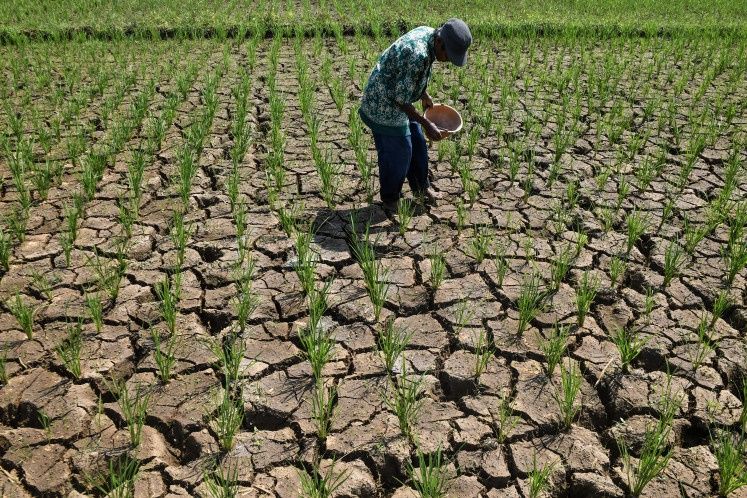
Indonesia is confronting an escalating water crisis as meteorological patterns shift toward an exceptionally dry season, with authorities acknowledging that the problem will likely worsen substantially over the coming months. The National Disaster Mitigation Agency has expanded its list of affected areas to include Gunungkidul in Yogyakarta, Semarang in Central Java, and Jember in East Java, bringing the total number of impacted households to more than 7,100 across multiple provinces. The simultaneous emergence of water shortages in geographically dispersed regions underscores the nationwide scope of the phenomenon and the strain it places on Indonesia's already fragmented water management systems.
The underlying cause stems from El Niño, a periodic warming of Pacific Ocean surface temperatures that fundamentally alters global rainfall patterns. This year's manifestation is expected to prove particularly severe, with meteorological forecasts indicating that the dry season will peak between July and September, with precipitation falling below historical averages across more than 80 per cent of Indonesian territory. The Meteorology, Climatology and Geophysics Agency has explicitly warned that conditions could be "extreme," language that typically portends significant impacts on agricultural productivity and daily water access for vulnerable populations.
The geographical distribution of the crisis reveals how unevenly Indonesia's water infrastructure serves its archipelagic population. Beyond the newly identified areas, existing shortages persist in Central Java's Cilacap, Klaten, and Jepara regions, as well as Bantul in Yogyakarta and multiple West Javanese districts including Karawang, Tasikmalaya, and Sukabumi. The eastern reaches of the archipelago are also affected, with Seram in Maluku experiencing acute shortages. Regional authorities have responded by declaring 90-day drought alert statuses—a mechanism intended to expedite emergency interventions. West Lombok in Nusa Tenggara Barat escalated its response further in mid-June by declaring a full drought emergency as approximately 3,600 households lost reliable water access.
Immediate response efforts have focused on emergency water delivery through tanker truck distribution networks, a temporary solution that addresses acute household needs but cannot substitute for sustainable infrastructure improvements. These emergency measures, while necessary, consume significant governmental resources and reveal the fundamental vulnerability of regions lacking permanent piped water systems. The temporary nature of tanker distribution also creates inequities, as some communities receive supplies while others in equally affected areas may not. Local authorities across multiple provinces are working to expand these emergency logistics networks, but the sheer geographical expanse of Indonesia and the number of affected communities present coordination challenges.
The drought's implications extend far beyond household water access, directly threatening Indonesia's agricultural sector and national food security. The agriculture ministry has acknowledged the crisis and indicated preparatory measures, with Minister Amran Sulaiman publicly confirming that his department anticipated worsening conditions and has accelerated mitigation efforts. These interventions include expanding irrigation pump capacity to sustain water availability for cultivated crops and adjusting cultivation schedules to align with precipitation forecasts. The government has also promoted adoption of drought-tolerant and early-maturing crop varieties, alongside diversification of food crops beyond rice to reduce dependency on water-intensive staples.
Government assurances regarding food supply hinge on maintaining current production levels and drawing down existing rice reserves. Minister Sulaiman has repeatedly characterized national rice stockpiles as historically elevated and sufficient to meet domestic demand through the following year, suggesting that even with reduced harvest outputs this season, acute shortages may be avoided. However, this analysis assumes that current production disruptions remain limited and that infrastructure investments proceed as planned. Should drought conditions persist longer than forecasted or prove more severe than anticipated, these buffer stocks could deplete faster than replacement production can occur, potentially creating price pressures that disproportionately affect lower-income households.
The House of Representatives' Commission IV, responsible for agricultural and food security oversight, has pushed the government to accelerate resource distribution to vulnerable agricultural communities. These resources include seeds for replanting, fertilisers to maximize yields under constrained conditions, farming equipment, and livestock feed. This approach recognizes that drought impacts extend beyond crop production to affect livestock herds, which represent crucial protein sources and income streams for rural families. The commission's advocacy suggests parliamentary awareness that emergency water distribution alone will prove insufficient to preserve rural livelihoods and that proactive agricultural support represents a more comprehensive crisis response.
Water policy experts have articulated perspectives that extend beyond the immediate drought emergency toward systemic infrastructure challenges. Bagas Yusuf Kausan of the Yayasan Amerta Air Indonesia research organization contends that Indonesia requires sustained investment in water infrastructure, particularly throughout drought-prone regions lacking reliable clean water access. His recommendation centers on expanding regional water utility services, known as PDAM, with government subsidisation to ensure affordability for communities with limited financial capacity. This approach would establish permanent solutions rather than perpetuating cycles of emergency response followed by normalcy until the next crisis occurs.
Kausan additionally identifies environmental degradation as a compounding factor alongside climate variability. Land conversion practices—including conversion of water catchment areas to agricultural, urban, or industrial uses—have diminished natural water retention capacities across multiple regions. Simultaneous groundwater depletion, driven by agricultural and industrial extraction exceeding natural recharge rates, has progressively reduced water reserves available during dry periods. These human-driven environmental changes interact with natural climate variability to amplify drought impacts beyond what either factor would produce independently. Reversing this trajectory would require tightening governmental restrictions on land conversion in hydrologically sensitive areas, a politically contentious measure requiring coordination across national and regional authorities.
The current drought episode thus represents both an immediate humanitarian and agricultural challenge and a diagnostic moment revealing underlying infrastructure and environmental vulnerabilities. Short-term emergency measures—water tanker distributions, adjusted planting schedules, strategic rice reserve drawdowns—can moderate immediate impacts. However, addressing the recurring vulnerability requires investments in permanent water infrastructure, rebalancing of groundwater extraction rates, and restoration of water catchment areas. For Malaysia and other Southeast Asian nations, Indonesia's experience underscores how climate variability intersects with infrastructure capacity and environmental management quality to determine resilience outcomes. The region's increasing exposure to El Niño oscillations suggests that comparable drought episodes will recur, making infrastructure investments and environmental protection increasingly central to economic stability and food security across Southeast Asia.

