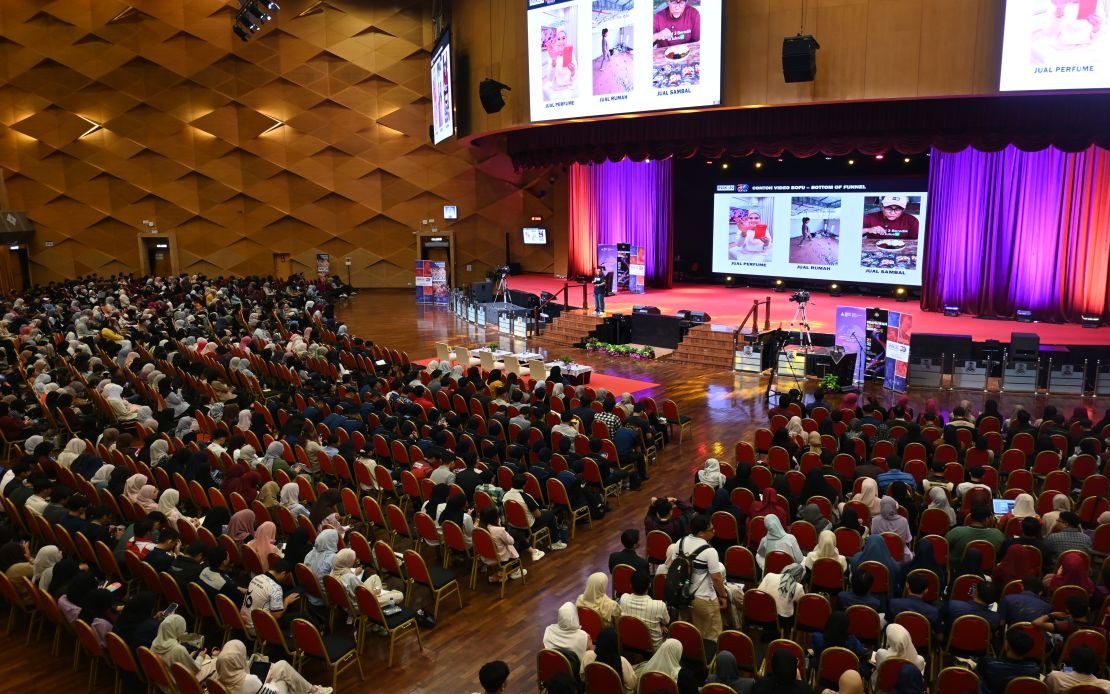
The National Entrepreneurship Institute (INSKEN) and Universiti Teknologi MARA (UiTM) have set a new benchmark for youth entrepreneurship engagement in Malaysia, drawing 6,877 participants to SUM MEGA 2026, the Usahawan MADANI Mega entrepreneurship seminar held at UiTM Shah Alam. The unprecedented turnout, achieved through a hybrid format combining physical and online attendance, has secured the distinction of the 'Largest Student Participation in an Entrepreneurship Seminar' in the Malaysia Book of Records, underscoring the remarkable appetite among university students nationwide to explore business ownership as a legitimate career trajectory.
The recognition carries significance beyond mere numbers. It signals a fundamental shift in how Malaysia's younger generation views employment and economic participation. Traditionally, salaried positions in the civil service and established corporations dominated career aspirations among tertiary students. The scale of this gathering suggests that entrepreneurship—once perceived as a risky, uncertain venture—has gained considerable legitimacy and appeal. This cultural movement towards self-employment and business creation aligns with broader regional trends where Southeast Asian youth increasingly seek autonomy and innovation-driven pathways in their professional lives.
Deputy Minister for Entrepreneur and Cooperatives Development Datuk Mohamad Alamin framed the seminar's success as evidence of entrepreneurship's growing significance to Malaysia's economic future. He contextualised the initiative within the government's broader strategic vision, emphasising that startup creation and small-medium enterprise development have transcended the realm of optional career choices to become essential mechanisms for economic dynamism. In an era marked by automation, artificial intelligence, and shifting labour markets, the minister suggested that entrepreneurship represents not merely an alternative to employment, but an increasingly necessary engine of job creation, wealth distribution, and innovation at both national and community levels.
The MADANI government, operating through the Ministry of Entrepreneur and Cooperatives Development (KUSKOP), has structured its approach around five pillars: capacity building, financing accessibility, market access facilitation, digitalisation support, and comprehensive business development assistance. This multifaceted framework reflects an understanding that entrepreneurial ambition alone proves insufficient without institutional backing. Young founders require not just inspiration but practical tools—mentorship, capital access, digital infrastructure, and pathways to customers. By embedding these support mechanisms across government agencies, financial institutions, and educational bodies, policymakers attempt to reduce friction points that have historically deterred student entrepreneurs from transitioning ideas into sustainable ventures.
INSKEN Board of Trustees chairman Datuk Mustaffa Kamil Ayub advanced a philosophical perspective on the seminar's broader significance. He advocated for repositioning entrepreneurship from a discrete career option into a foundational mindset permeating Malaysian culture and education. This framing echoes international best practices in entrepreneurial ecosystems—nations with robust startup sectors typically embed entrepreneurial thinking across primary, secondary, and tertiary education, treating business creation as a legitimate expression of creativity and problem-solving rather than a marginal pursuit. By cultivating such mindset shifts early, societies create pipeline effects where entrepreneurial behaviour becomes normalised, knowledge transfer accelerates, and ecosystem density increases.
The seminar itself deployed a pedagogical approach centred on the MOFA methodology, an acronym encompassing Marketing, Operations, Finance, and Administration. This practical framework equips prospective entrepreneurs with foundational competencies across business functions, addressing a common gap in academic training where theory often outpaces real-world application. Participants gained exposure to operational resilience strategies, financial management fundamentals, market positioning techniques, and administrative processes that separate successful ventures from well-intentioned failures. By concentrating on these concrete dimensions, INSKEN grounds entrepreneurial education in tangible skills rather than abstract motivation.
The institutional collaboration architecture underpinning SUM MEGA 2026 deserves particular attention for Malaysian policymakers. By coordinating the National Entrepreneurship Institute, the Malaysian Academy of SME and Entrepreneurship Development (MASMED), UiTM, and multiple government ministries, organisers demonstrated that entrepreneurial ecosystem development requires ecosystem-wide participation. Higher education institutions provide talent pools and venues; government agencies furnish policy frameworks and financing mechanisms; development bodies contribute expertise and networks; financial institutions offer capital. This horizontal coordination model contrasts with siloed approaches where individual agencies pursue entrepreneurship mandates independently, often generating duplication and missed synergies.
The National Entrepreneurship Policy 2030 provides the strategic scaffolding for initiatives like SUM MEGA 2026. This policy document articulates Malaysia's aspiration to cultivate resilience, competitiveness, and impact-driven entrepreneurship across its economy. The policy recognises that Malaysia's continued prosperity depends less on resource extraction or low-cost manufacturing—sectors vulnerable to global competition and commodity fluctuations—and increasingly on knowledge-intensive entrepreneurship generating high-value goods, services, and intellectual property. Student entrepreneurs represent frontline soldiers in this strategic reorientation, potentially establishing companies that employ thousands, create intellectual property, and contribute disproportionately to export earnings and foreign exchange reserves.
For Malaysian and broader Southeast Asian contexts, the SUM MEGA 2026 result hints at demographic advantages that regional economies might leverage more systematically. Southeast Asia possesses one of the world's youngest populations, with substantial cohorts entering universities and labour markets annually. Channelling even modest percentages of these cohorts toward entrepreneurship could generate substantial economic activity. Nations like Vietnam and Indonesia have demonstrated that youth-targeted entrepreneurship programmes, often with modest capital requirements, generate outsized economic multipliers when coupled with enabling infrastructure. Malaysia, with higher educational attainment rates and more developed financial systems than several regional peers, possesses comparative advantages in scaling such programmes.
The record-breaking seminar attendance also reflects practical realities of the Malaysian entrepreneurship landscape. Students increasingly recognise that UiTM, as the nation's largest university system by enrolment and geographically distributed across peninsular Malaysia, represents an ideal platform for mass engagement. The hybrid delivery model—combining in-person and online participation—proved instrumental in achieving geographic breadth, allowing students from Sabah, Sarawak, and throughout Peninsular Malaysia to participate without bearing significant travel costs. This accessibility dimension matters considerably for equitable entrepreneurship development, ensuring that geographic remoteness does not preclude engagement with government-sponsored capacity-building initiatives.
INSKEN's complementary programming—the Masterclass series, BANGKIT, and PROTÉGÉ initiatives—creates a developmental continuum extending beyond single events toward sustained support. Masterclass offerings typically distil expertise from successful entrepreneurs and business leaders into condensed knowledge-transfer sessions. BANGKIT likely targets earlier-stage capacity building, while PROTÉGÉ suggests mentoring relationships pairing emerging entrepreneurs with experienced guides. This portfolio approach recognises that entrepreneurship development requires multiple intervention points; prospective founders need exposure opportunities, skill-building platforms, mentoring relationships, and community networks. Single-event seminars, however well-attended, provide necessary but insufficient engagement.
The Malaysia Book of Records recognition carries symbolic weight beyond numerical achievement. Record-setting designations generate media attention, institutional pride, and competitive reputational effects that encourage sustained commitment and future participation. Universities and government bodies invest prestige and resources into initiatives bearing record-setting potential. This recognition architecture, while seemingly superficial, generates tangible behavioural incentives that amplify programme reach and visibility across target populations. Word-of-mouth promotion, media coverage, and institutional enthusiasm converge to create network effects that ensure subsequent iterations achieve comparable or expanded participation.
Looking forward, the challenge for Malaysian entrepreneurship policymakers involves sustaining momentum beyond headline participation numbers. Record-setting attendance generates headlines but does not automatically translate into venture creation, job generation, or economic impact. Critical questions persist: How many SUM MEGA 2026 participants subsequently establish registered businesses? What survival and growth rates characterise ventures founded by programme participants compared to non-participants? Which support mechanisms prove most impactful—financing, mentoring, market access, or infrastructure provision? Answering these questions requires longitudinal tracking systems that many developing economies lack, yet such data proves essential for optimising public investment in entrepreneurship infrastructure and justifying continued resource allocation to such initiatives in fiscally constrained environments.

