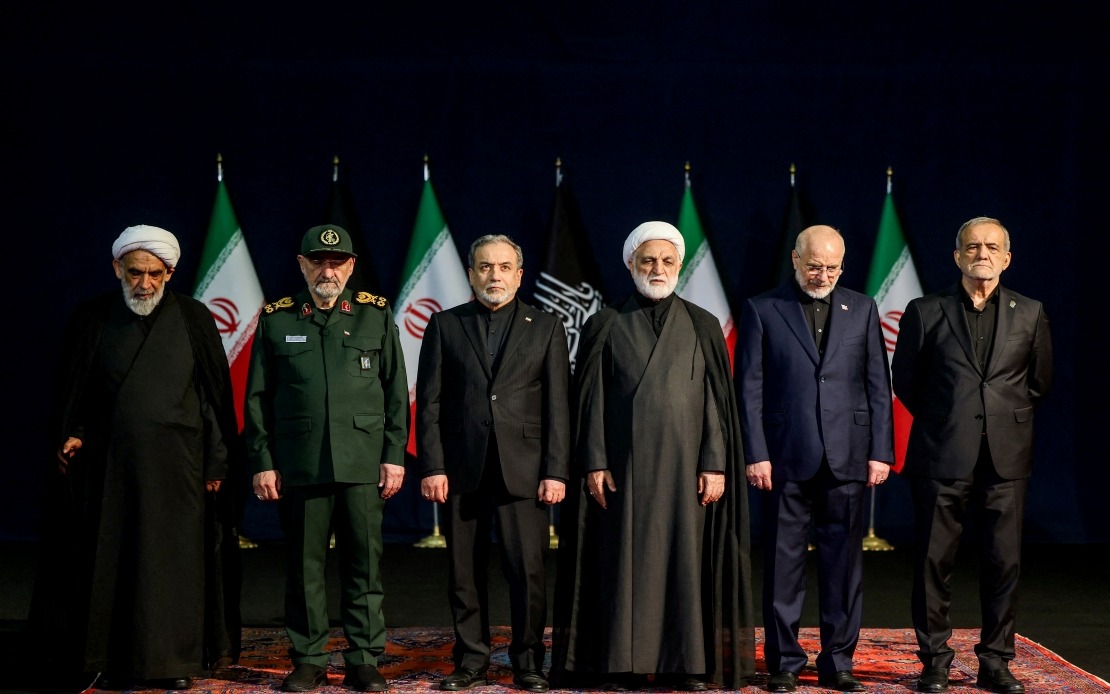
Iran staged a significant state ceremony on Friday to honour Ayatollah Ali Khamenei, the country's late Supreme Leader, drawing an array of high-ranking officials from Tehran and abroad. The tribute took place at Imam Khomeini's Mosalla prayer hall in central Tehran, beginning in the morning and extending throughout the day, underscoring the ceremonial importance Iran attached to marking his passing.
The Iranian state's institutional establishment turned out in force. President Masoud Pezeshkian, Parliament Speaker Mohammad Baqer Qalibaf, Judiciary Chief Gholamhossein Mohseni-Ejei, and Sadeq Amoli Larijani, who chairs the Expediency Discernment Council, were among the prominent domestic figures present. Their attendance reflected the formal, state-level nature of proceedings and signalled continuity within Iran's power structures at a transitional moment.
The international dimension proved equally substantial, with delegations arriving from numerous neighbouring and major powers. Pakistan sent Prime Minister Shehbaz Sharif alongside Chief of Army Staff Field Marshal Syed Asim Munir, indicating Islamabad's desire to maintain diplomatic ties with Tehran despite regional tensions. Armenia's Prime Minister Nikol Pashinyan, Georgian President Mikheil Kavelashvili, and Iraqi President Nizar Amedi were also present, alongside Emomali Rahmon of Tajikistan and Nechirvan Barzani, the Kurdistan Region's president. Senior representatives from both China and Russia attended, reflecting the broader geopolitical alignments in which Iran operates.
The ceremony extended beyond political figures to encompass religious scholars, clerics, and community leaders, highlighting the spiritual and social dimensions of Khamenei's role within Iranian society. This broad participation underscored that his position transcended mere political office; he was viewed as a religious authority whose influence permeated Iranian institutional and cultural life.
Khamenei's death followed a dramatic military incident on February 28, when a coordinated United States and Israeli airstrike struck Tehran, resulting in his killing. The operation represented a significant escalation in the region's ongoing confrontation and triggered profound consequences for Iran's political succession. The timing and scale of the international response at the tribute ceremony may partly reflect concerns among regional and international actors about stability in the aftermath of such a high-profile assassination.
Iran has structured an extended mourning period spanning multiple days through July 9, with formal processions planned across three major cities—Tehran, Qom, and Mashhad—reflecting the three pillars of Iran's religious geography. Additionally, ceremonial rites are scheduled in Iraq, demonstrating Iran's religious connections across borders and the transnational significance attached to this leadership transition. The Iranian government declared Thursday a national day of mourning, while imposing public closures and airspace restrictions in Tehran and Mashhad to manage the expected crowds and ensure security during sensitive proceedings.
The succession mechanics moved swiftly following Khamenei's death. By March, Iran's leadership had formally selected Mojtaba Khamenei, his son, as the new Supreme Leader. This familial succession, while anticipated in some quarters, represented a notable consolidation of power within the Khamenei lineage and signalled the regime's preference for institutional continuity over competitive selection among senior clerics. For Malaysia and Southeast Asia, the appointment carries implications for regional security, given Iran's expanding presence through proxies and diplomatic initiatives across the Middle East and beyond.
The gathering itself served multiple political functions simultaneously. Domestically, it projected an image of stable, orderly succession and demonstrated the legitimacy of the new leadership structure through the presence of senior figures and international visitors. Internationally, it allowed Iran to showcase its diplomatic relationships and underline that the succession would not precipitate broader regional instability or diminish its standing among key partners. The attendance of Pakistan and Iraq, both countries with significant Sunni populations and complex relationships with Iran, carried particular diplomatic weight in this context.
For Malaysian observers, the ceremony highlighted Iran's integration within a broader multipolar order centred on relationships with China, Russia, and Pakistan—alignments that have gradually intensified over the past decade as Western sanctions isolated Iran from traditional trading partners and diplomatic channels. The participation of Central Asian states like Tajikistan further reflected Iran's efforts to maintain influence across its northern frontier, an area of long-standing strategic importance.
The succession of Mojtaba Khamenei introduces questions about potential shifts in Iranian policy direction, particularly regarding nuclear negotiations, regional military posturing, and engagement with the wider world. Unlike his father, who accumulated nearly four decades of authority before his death, Mojtaba assumed leadership under circumstances of active military confrontation and regional volatility. His approach to managing these challenges will shape not only Iran's internal trajectory but also the security environment affecting Southeast Asian interests in the broader Middle East.

