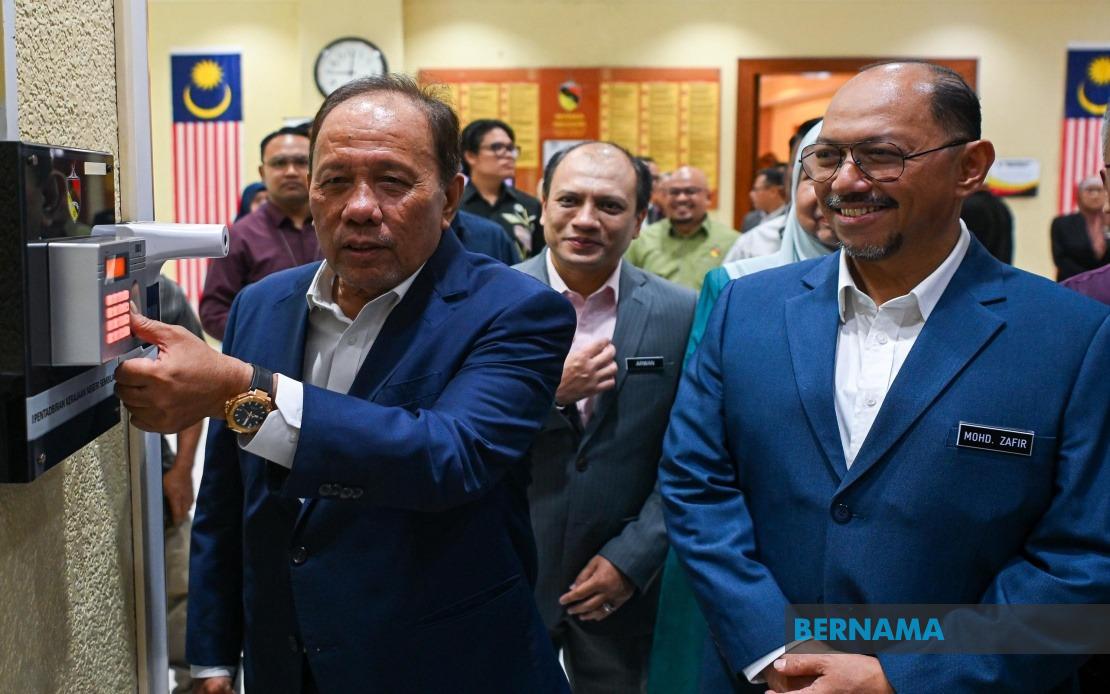
Newly appointed Negeri Sembilan Menteri Besar Datuk Ismail Lasim has moved to counter criticism of his recent elevation to the top state office, insisting that every step of the selection and appointment procedure adhered to established protocols and constitutional requirements. Speaking to journalists at Wisma Negeri in Seremban on August 4, Lasim made clear his conviction that the machinery governing his transition to the helm of state government operated without deviation from standard practice, thereby lending legitimacy to what some observers have questioned as an irregular process.
The assertion comes in response to scrutiny from prominent political figure Tan Sri Rais Yatim, chairman of Wawasan, who has alleged that the appointment of the Negeri Sembilan Menteri Besar involved procedural irregularities and potentially inappropriate external influences that may have overridden the state's established constitutional customs and legal frameworks. Such accusations carry particular weight in Malaysian politics, where the appointment of a Menteri Besar typically falls within the discretion of the Sultan and the state assembly, making transparency in the process a matter of institutional integrity.
Lasim, who represents the Juasseh state constituency, was formally invested with the office during a ceremony at Istana Besar Seri Menanti the previous Sunday, where he took his oath before Yang Dipertuan Besar of Negeri Sembilan Tuanku Muhriz Tuanku Munawir. The swearing-in ceremony marked the formal commencement of his duties and represented the culmination of weeks of political negotiations and coalition-building that followed the state election. His confirmation as chief minister came after a period during which the direction of Negeri Sembilan's political alignment remained uncertain.
The electoral outcome that paved the way for Lasim's appointment delivered a decisive result, with Barisan Nasional capturing 18 of the 36 available state assembly seats in the recent Negeri Sembilan state election. This performance positioned the coalition as the dominant political force in the state, though it fell short of granting them an outright majority. Perikatan Nasional, the rival coalition of Pakatan Harapan and Parti Islam Se-Malaysia, secured seven seats, a result that left both major groupings significantly behind BN in terms of electoral support.
The arithmetic of the state assembly configuration proved consequential for government formation, as both BN and PN together commanded sufficient numbers to theoretically claim the two-thirds supermajority threshold required under certain constitutional provisions. This overlap in potential governing coalitions created a period of political fluidity immediately following the election, during which the actual composition of the state government remained subject to negotiation and agreement. The eventual alignment that crystallised around Lasim's appointment represented one resolution to this period of uncertainty, though it has not satisfied all observers regarding the methodology employed.
The controversy surrounding Lasim's appointment reflects broader tensions within Malaysian state-level politics regarding the proper exercise of discretionary powers by ruling sultans and assemblies in selecting the chief minister. While the Yang Dipertuan Besar retains significant constitutional authority in this domain, convention and political practice have generally suggested that such appointments should emerge from clear electoral mandates or transparent coalition agreements. When these conditions appear ambiguous or contested, questions naturally arise regarding whether external pressure or irregular influence may have shaped the outcome.
Rais Yatim's intervention into the dispute carries particular resonance given his prominence as an intellectual voice on constitutional matters and his platform through Wawasan, which positions itself as an independent observer of governance standards. His public questioning of the appointment process signals that concerns about procedural propriety have extended beyond disappointed political factions into the broader commentary class. This broader questioning underscores that the legitimacy of executive appointments in Malaysian states depends not merely on legal formality but on public perception of fairness and adherence to customary practice.
For Lasim, the task of establishing effective governance in Negeri Sembilan now extends beyond initial policy priorities to encompassing a broader project of legitimising his position and building consensus around the administration he leads. The early emphasis on procedural correctness and adherence to established channels represents a defensive posture, one that acknowledges the controversy while attempting to insulate the appointment from further legal or political challenge. Whether this framing proves sufficient to resolve lingering doubts about the appointment's propriety remains an open question that may influence the trajectory of his tenure.
The situation in Negeri Sembilan mirrors dynamics seen elsewhere in Malaysia where complex electoral arithmetic and coalition possibilities have generated disputes over the proper interpretation of mandate and custom in executive selection. As state-level politics increasingly reflect fragmented electoral preferences and coalition instability, mechanisms for translating electoral outcomes into legitimate governments face mounting pressure. The clarity and transparency of such processes matter not only for institutional health but for public confidence in the fairness and integrity of democratic governance at the state level, dimensions that carry implications well beyond the borders of any single state.

