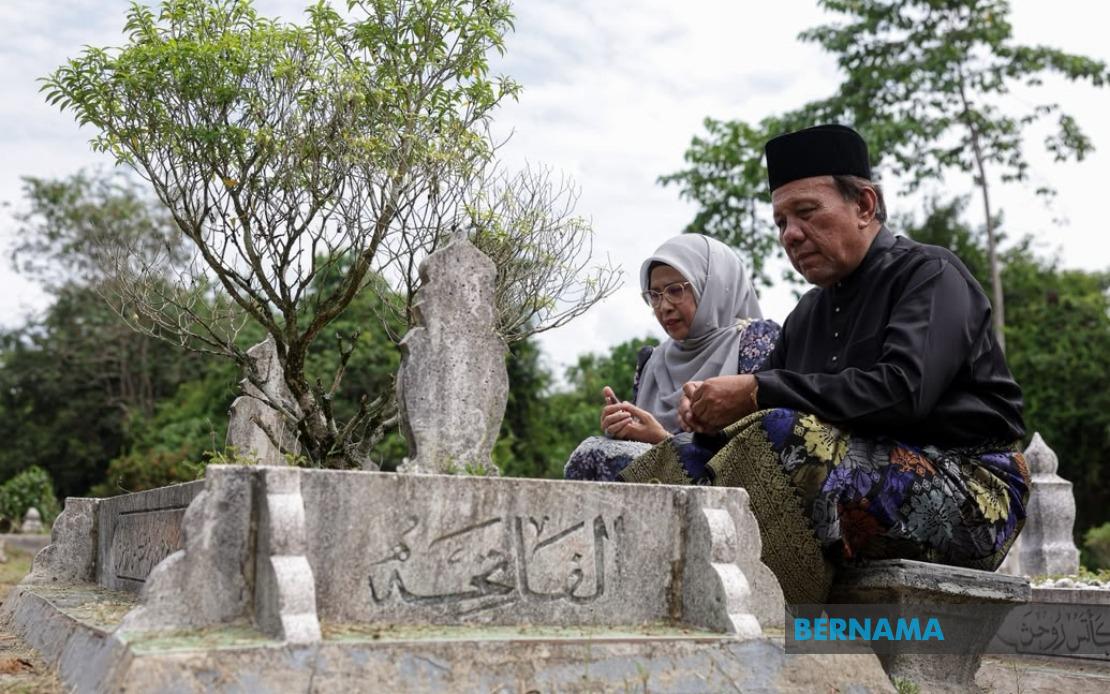
Datuk Ismail Lasim made a poignant gesture shortly after assuming office as Menteri Besar of Negeri Sembilan on August 2, visiting the graves of his parents at Tebing Tinggi Muslim cemetery in Kuala Pilah. Accompanied by his wife Datin Noraishah Othman and dressed in traditional black Malay attire, the new state leader paid his respects at the burial ground, honouring the memory of those who shaped his life and values before stepping into one of Malaysia's most significant state leadership positions.
Ismail's swearing-in ceremony took place earlier that day before Tuanku Muhriz Tuanku Munawir, the Yang di-Pertuan Besar of Negeri Sembilan, at the official residence of Istana Besar Seri Menanti. The ceremonial occasion marked a transition in the state's political leadership, with the new Menteri Besar inheriting the responsibility of governing the centrally located state during a crucial period for Malaysia's subnational governance. His first official act—honouring his deceased parents—reflects the personal values and family-oriented ethos that the new leader brings to the position.
Ismail's late father, Lasim Yaman, passed away on March 5, 2020, at the advanced age of 97, having lived through multiple epochs of Malaysian history and development. His mother, the late Bedah Othman, preceded him in death on September 16, 2014. By visiting their graves immediately after taking the oath, Ismail demonstrated a commitment to acknowledging the sacrifices and legacy of the generation that came before him—a symbolic recognition that informed decision-making in public service often draws strength from familial roots and ancestral values.
The swearing-in followed Ismail's successful campaign in the Juasseh state constituency during the 16th Negeri Sembilan state election held on August 1. His victory at the ballot box, combined with the broader electoral performance, positioned him to lead the state government. The election results delivered a decisive mandate that would shape the political landscape of Negeri Sembilan for the coming term, establishing the conditions necessary for him to form a government.
Barisan Nasional's commanding performance in the state election, capturing 18 of the available seats, demonstrated continued electoral support for the coalition in Negeri Sembilan. Perikatan Nasional's seven seats complemented this result, creating a political arrangement where the two coalitions together secured a two-thirds supermajority in the state assembly. This substantial parliamentary advantage provides the incoming government considerable latitude in advancing its legislative agenda and implementing policy initiatives without relying on opposition support.
The two-thirds majority holds particular significance for state governance, as it enables the government to pursue constitutional amendments and policy reforms that require enhanced parliamentary majorities. For Negeri Sembilan, historically a swing state in Malaysian politics, this electoral outcome suggests a consolidation of support around the Barisan Nasional-led coalition after a period of political volatility. The result reflects voter preferences for political stability and continuity in state administration.
Ismail's elevation to Menteri Besar represents a notable development in Negeri Sembilan's political progression. As a representative from Juasseh, he brings his constituency's perspectives and concerns into the highest echelon of state decision-making. The Juasseh area, located in the southern reaches of the state, has its own distinct economic and social dynamics that will undoubtedly inform his approach to statewide governance.
The ceremonial nature of the swearing-in, conducted at Istana Besar Seri Menanti in the presence of the Yang di-Pertuan Besar, underscores the constitutional framework governing Malaysia's states. The ruler's role in appointing and swearing in the Menteri Besar remains a cornerstone of the monarchical system, grounding state leadership within the broader constitutional architecture. This formal process, repeated across Malaysian states, reinforces the continuity of institutional governance.
For Malaysian observers, particularly those in the Klang Valley region and surrounding areas, the political outcome in Negeri Sembilan carries implications for regional dynamics. As a state situated between Selangor and Pahah, its governance affects interstate cooperation on infrastructure, water resources, and economic development. The formation of a government with a strong majority suggests that Ismail will have the political capital to negotiate effectively with neighbouring state administrations and the federal government on matters of mutual concern.
The personal moment of Ismail visiting his parents' graves, captured in formal reporting of his swearing-in, provides insight into the individual who will now shape Negeri Sembilan's development trajectory. Public figures who consciously acknowledge their heritage and family connections often bring a grounded perspective to governance, balancing ambition with respect for established values. Whether Ismail will leverage his electoral mandate to undertake significant reforms or pursue incremental progress will become apparent through his early policy announcements and legislative initiatives.
Negeri Sembilan now enters a new chapter under Ismail's leadership, with electoral endorsement and institutional support positioning him to pursue his vision for the state. The immediate future will reveal whether he prioritises economic diversification, infrastructure improvement, or social welfare as his administration's defining characteristics. His first hours in office, marked by filial piety and ceremony, suggest a leader conscious of balancing tradition with the demands of contemporary governance.

