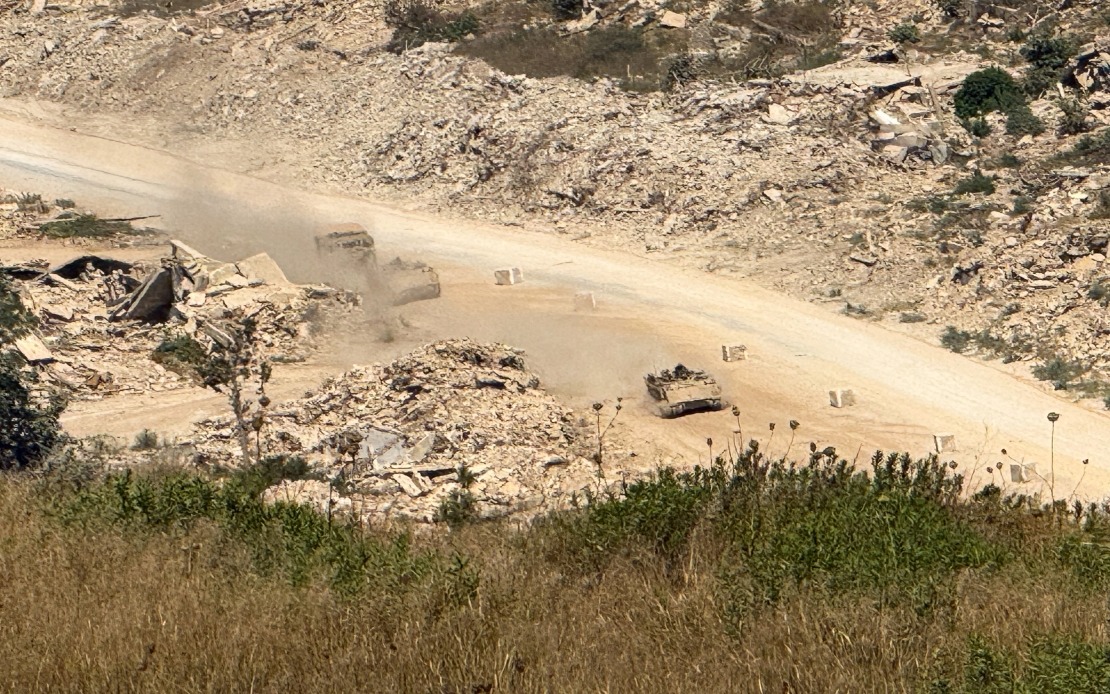
Israeli military operations in southern Lebanon intensified on Monday as forces executed coordinated strikes across multiple towns and villages, underscoring the disconnect between battlefield actions and ongoing diplomatic efforts to establish a durable ceasefire. The Lebanese national news agency documented machine gun fire directed at Wadi al-Salouqi in Nabatieh governorate alongside overnight artillery barrages targeting the town of Mansouri, with additional explosions reported in the same area. These operations occurred as Israeli troops advanced into the western approaches of Mays al-Jabal supported by concentrated artillery fire, while separate incursions in Khiam involved the deliberate burning of multiple residential structures. Low-altitude drone reconnaissance flights over the Zahrani region further demonstrated the systematic nature of these operations, painting a picture of sustained military engagement across the southern border zone.
The scale of Israeli military presence in Lebanese territory has expanded considerably since the current campaign began in March. Israeli forces have penetrated more than 10 kilometres into Lebanon, occupying strategic positions in the south that some analysts describe as a buffer zone despite official international frameworks calling for full withdrawal. The occupation encompasses both newly captured territory during the 2023-2024 conflict and longstanding positions held for decades, creating a complex territorial situation that negotiators must address. This geographical reality fundamentally shapes the dynamics of ceasefire discussions, as Israel maintains physical control over disputed areas while diplomats attempt to chart withdrawal timelines.
The timing of these operations carries particular significance given recent diplomatic momentum. Just four days prior, Lebanese and Israeli negotiators concluded their seventh round of talks in Rome under United States mediation, with discussions centring on the technical implementation of a framework agreement originally reached on 26 June. Lebanese President Joseph Aoun declared that discussions had yielded "positive progress" on critical matters including border demarcation and the fate of detained individuals held by both sides. These incremental advances suggested a narrowing of disagreements and the possibility of translating theoretical commitments into concrete actions on the ground.
The framework agreement itself represents a carefully calibrated compromise reflecting years of regional tension and multiple failed ceasefire attempts. It envisions phased Israeli withdrawal coordinated with Lebanese army deployment into previously contested zones and the disarmament of Hezbollah, the armed group whose cross-border operations triggered the escalation. This three-pronged approach aims to simultaneously address Israeli security concerns regarding hostile forces on its border, Lebanese sovereignty restoration, and the broader regional security architecture. However, the agreement's implementation depends critically on mutual restraint and good-faith execution, conditions that Monday's operations appear to undermine.
The humanitarian consequences of sustained military operations have become staggering. Lebanese authorities have documented 4,335 deaths and 12,277 wounded since March, figures that represent a generational trauma for a nation already ravaged by decades of civil conflict and regional instability. Beyond casualty statistics, over one million Lebanese civilians have been displaced from their homes, creating a humanitarian crisis of exceptional proportions. Villages emptied of their residents become shells, their infrastructure damaged, their social fabric torn. Reconstruction efforts remain distant as military operations continue, leaving displaced populations uncertain about whether they can safely return and rebuild their lives.
For Malaysia and other Southeast Asian nations monitoring Middle Eastern developments, this situation exemplifies the precarious nature of ceasefires that lack robust enforcement mechanisms and international guarantees. The disconnect between diplomatic progress and battlefield reality reflects a broader regional pattern where military advantages incentivize actors to maintain maximum leverage while negotiations proceed. The lack of immediate, verifiable consequences for ceasefire violations creates perverse incentives for continuation of hostilities, particularly when territorial control translates into negotiating strength in subsequent political settlements.
The broader Israeli occupation framework extending beyond Lebanon adds additional context to these operations. Simultaneous Israeli occupations of Palestinian territories and Syrian land, coupled with refusals to withdraw from these areas or permit Palestinian statehood as called for in United Nations resolutions, suggest a pattern of territorial consolidation that transcends the current Lebanese situation. This strategic approach prioritizes military control and security buffer zones over diplomatic resolution, creating a region where military facts on the ground persistently undermine negotiated agreements. For observers in Southeast Asia familiar with territorial disputes and the challenges of enforcing international law, this pattern carries cautionary implications.
The role of United States mediation in the Rome talks represents a critical variable in ceasefire implementation prospects. American involvement provides diplomatic infrastructure and enforcement credibility that regional actors alone cannot generate, yet Washington's capacity to enforce agreements against either Israeli or Lebanese resistance remains constrained by broader geopolitical considerations and domestic political pressures. The United States has incentives to stabilize the situation but limited tools to compel compliance from an Israeli government that maintains substantial domestic political support for security-focused policies. This structural limitation means that ceasefire viability ultimately depends on whether the parties themselves develop sufficient confidence that implementation serves their long-term interests better than continued conflict.
Lebanese officials must navigate an extraordinarily difficult position, seeking to recover sovereign territory while lacking military capacity to compel Israeli withdrawal and operating under constrained circumstances where international support remains inconsistent. President Aoun's emphasis on "positive progress" appears designed to maintain diplomatic momentum despite the observable reality of continued military operations. This rhetorical approach reflects the limited options available to weaker actors in asymmetrical conflicts—sustaining engagement with stronger opponents through language that acknowledges achievements while implicitly accepting ongoing violations as the cost of maintaining dialogue.
The structural dynamics underlying this conflict reflect competing security imperatives that defy simple resolution. Israel prioritizes prevention of cross-border attacks and maintenance of a controllable security environment along its northern border. Lebanon seeks restoration of full territorial sovereignty and displacement of occupying forces. Hezbollah's military capacity and integration with Lebanese state institutions creates additional complexity, as disarmament cannot proceed without Lebanese government capacity to establish legitimate monopoly on force in southern regions. These competing objectives have resisted resolution for decades and show minimal signs of yielding to current diplomatic efforts absent fundamental shifts in regional power balances or international pressure.
Moving forward, ceasefire implementation will require mechanisms substantially more robust than those underlying current agreements. Effective monitoring structures with enforcement authority, defined timelines for Israeli withdrawal, and verifiable Hezbollah disarmament procedures would address core concerns driving each party's negotiating positions. However, establishing such mechanisms presupposes agreement that neither side has yet demonstrated willingness to accept. The continuation of military operations despite parallel diplomatic progress suggests that negotiators and military planners operate within separate strategic frameworks, with diplomacy designed to manage conflict rather than resolve underlying disputes. For Malaysian observers, this situation underscores how ceasefires function as pauses rather than conclusions to deep-rooted conflicts absent fundamental political settlements addressing core grievances and power distribution.

