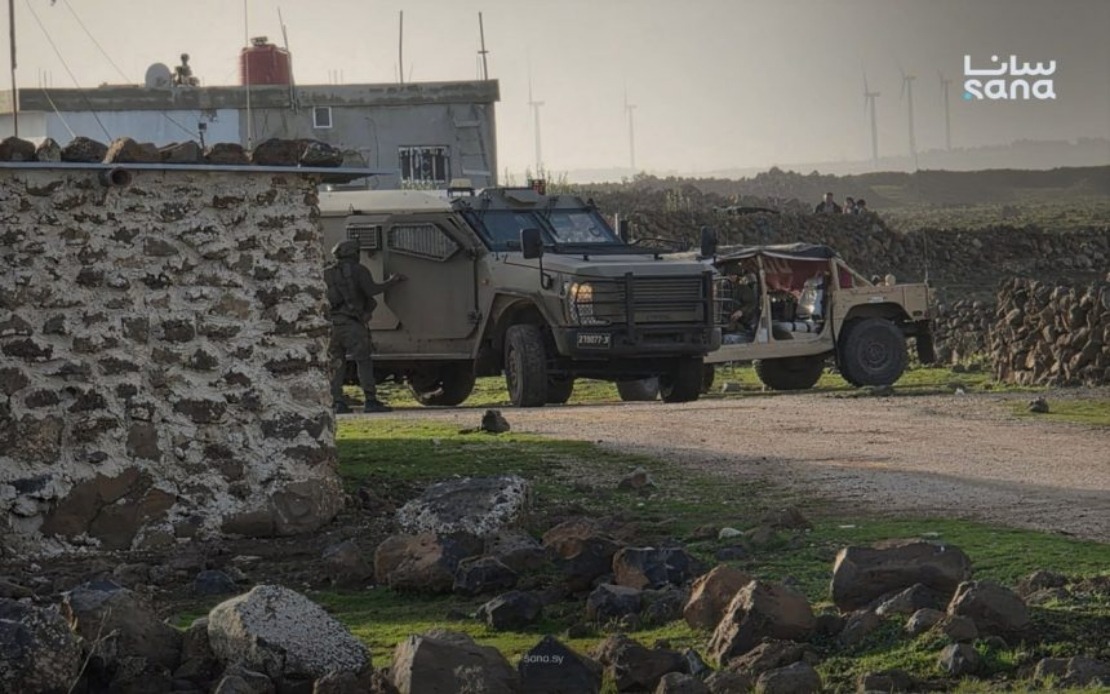
Israel has deployed six military vehicles across the border into Syria's southwestern Quneitra province, according to reports from Syria's state news agency. The incursion occurred on Saturday, with the Israeli force proceeding toward the Kudna Dam located in central Quneitra's countryside. The movement was accompanied by unmanned aerial vehicles conducting surveillance operations over the contested zone. The episode represents another chapter in an escalating series of cross-border military activities that have fundamentally reshaped the security landscape in southern Syria.
The geopolitical context surrounding this latest development is critical to understanding why such incursions have become more frequent and assertive. The collapse of Bashar al-Assad's government in December 2024 fundamentally altered the regional balance of power and created what many analysts describe as a power vacuum in territories previously under centralized Syrian state control. Israel responded to this political upheaval by formally renouncing the 1974 disengagement agreement that had established a demilitarized buffer zone between the two nations—a framework that had governed their relationship for five decades. By abandoning this accord, Jerusalem signaled its intention to exercise greater military freedom in the region and assert direct control over strategic border areas.
The pattern of Israeli military activity in southern Syria has intensified markedly in recent months, extending well beyond isolated incidents. Ground forces have conducted repeated raids, established military checkpoints throughout the border region, undertaken systematic searches of communities, and detained individuals deemed to pose security threats. Drone operations have become routine rather than exceptional, with aerial surveillance platforms regularly patrolling Quneitra and adjacent provinces. These activities collectively represent a comprehensive repositioning of Israeli military presence rather than temporary or reactive measures. The strategic objective appears to be establishing a more permanent security perimeter that extends further into Syrian territory than was previously permitted under the 1974 agreement.
For Malaysian and Southeast Asian observers, this development carries broader implications regarding international law, sovereignty, and the fragility of multilateral agreements. The 1974 disengagement accord, brokered through United Nations mediation, represented a foundational element of post-Cold War Middle Eastern stability. Its unilateral repudiation by Israel demonstrates how dramatic shifts in regional power dynamics can render longstanding international frameworks obsolete. This raises uncomfortable questions about the durability of similar agreements elsewhere, including various mechanisms that have maintained stability in other volatile regions.
The security implications for Syria itself are particularly severe. The Syrian state, already fractured by over a decade of civil conflict, now confronts an adversary that has removed the legal and diplomatic constraints previously governing Israeli military conduct. Local populations in Quneitra and neighboring areas face an uncertain security environment in which armed Israeli forces operate with minimal oversight or restraint. The absence of functioning Syrian state institutions means there exists no legitimate authority capable of defending territorial integrity or protecting civilians. This combination of state weakness and external military pressure creates conditions ripe for further destabilization.
Regional powers have responded to this situation with cautious concern but limited concrete action. The broader Arab world finds itself constrained by the reality of Israel's military superiority and the current weakness of potential counterbalancing forces. Meanwhile, international bodies have largely remained silent or ineffectual, reflecting the broader polarization that characterizes contemporary global governance. The United Nations, which originally brokered the 1974 agreement, has proven unable to enforce the framework it helped establish.
The drone operations accompanying ground incursions suggest Israel is implementing a comprehensive intelligence-gathering campaign throughout southern Syria. This aerial surveillance capability allows for detailed mapping of terrain, identification of strategic targets, and monitoring of any military activities that might threaten Israeli interests. The combination of boots on the ground and eyes in the sky represents a substantially more invasive security posture than the 1974 agreement permitted.
For neighboring states including Lebanon and Jordan, these developments create troubling precedents. If Israel successfully consolidates control over buffer zones in Syria without meaningful international consequences, similar logic might eventually be applied elsewhere. The established principle that territorial violations can be remedied through military fait accompli, rather than negotiation or multilateral pressure, carries ominous implications for regional stability more broadly.
The humanitarian dimension of these incursions remains largely unexamined in mainstream coverage. Syrian civilians in affected areas experience the everyday reality of foreign military occupation—checkpoints that restrict movement, searches that violate privacy, and arrests that separate families. The psychological impact of living under sustained external military control, coupled with the absence of legitimate governance structures, creates conditions that feed both instability and radicalization.
Moving forward, the trajectory appears set toward further Israeli consolidation of control rather than de-escalation. Without either Syrian state capacity to resist or meaningful international pressure to enforce existing agreements, the incentives favor continued Israeli expansion of its security footprint. The collapse of the Assad regime has thus paradoxically strengthened Israeli strategic dominance in the region, even as it has created humanitarian and political chaos within Syria itself.

