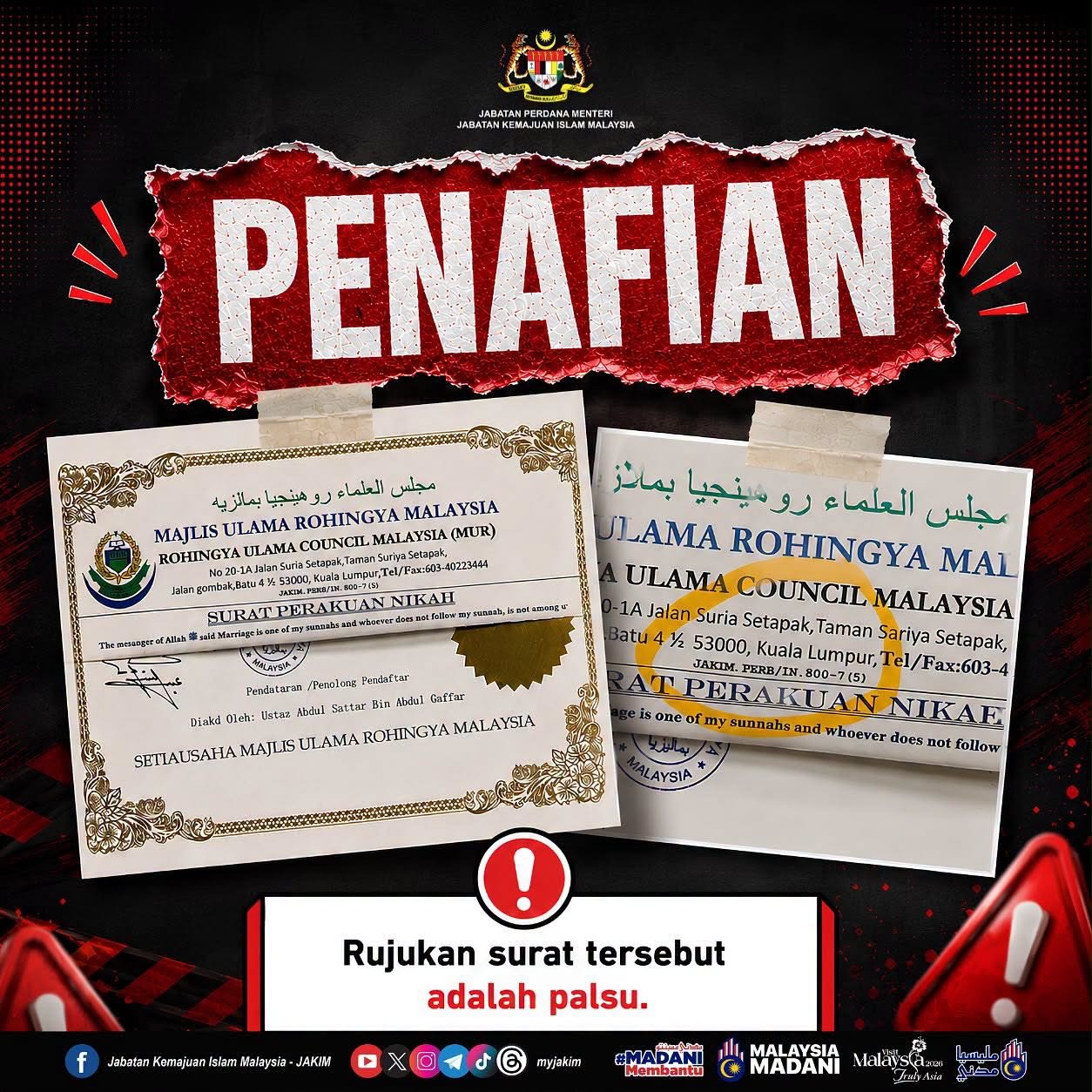
Malaysia's Department of Islamic Development (JAKIM) has moved decisively to counter misinformation by publicly confirming that a marriage letter circulating widely on social media platforms contains a fabricated reference number and was never issued by any legitimate Islamic authority in the country. The announcement, released through JAKIM's official Facebook account on July 15, represents a significant effort to combat the spread of fraudulent religious documents that could mislead unsuspecting members of the public.
The controversial document purportedly originated from the Malaysia Rohingya Ulama Council and carried the reference designation "JAKIM.PERH/LN.800-7(5)", which appeared to grant official status to the organisation's authority over marriage-related matters. This superficially credible formatting led many social media users to accept the letter as genuine without further verification, enabling rapid dissemination across WhatsApp groups, Facebook, and other platforms commonly used for sharing information within Malaysian communities.
JAKIM's statement explicitly clarifies that neither the federal body nor any of the state-level Islamic religious councils and departments across Malaysia have ever sanctioned or appointed the Malaysia Rohingya Ulama Council, or indeed any external organisation, to manage, oversee, or certify matters related to marriage arrangements and registration. This categorical denial addresses a critical gap between public perception and regulatory reality, as many Malaysians may understandably assume that any document bearing an official-looking reference number has undergone proper institutional vetting.
The implications of such fraudulent documents extend beyond mere administrative inconvenience. In Islamic contexts, marriage documentation carries profound legal and religious significance, affecting inheritance rights, spousal benefits, child custody arrangements, and social recognition within communities. Individuals who rely on forged marriage letters could face severe complications when attempting to register unions officially, access government services tied to marital status, or resolve disputes in shariah courts. The vulnerability of communities less familiar with official channels and procedures makes them particularly susceptible to exploitation through counterfeit documents.
Minister in the Prime Minister's Department (Religious Affairs) Dr Zulkifli Hasan acknowledged the seriousness of the situation, indicating that formal investigations would commence once comprehensive details had been gathered. This signals government recognition that document fraud affecting religious matters requires systematic response rather than dismissal as a minor social media phenomenon. The investigative process will likely examine how the false reference number was constructed, whether it was deliberately designed to mimic JAKIM's actual formatting conventions, and whether any individuals profited from distributing or endorsing the fraudulent letter.
For Malaysian readers and Southeast Asian communities navigating these systems, JAKIM's public guidance carries practical importance. The agency has explicitly recommended that citizens encountering any questionable religious documents should directly contact either JAKIM or their respective state Islamic religious authorities before treating such materials as legitimate. This simple verification step could prevent individuals from acting on false information or from inadvertently participating in schemes that exploit forged credentials.
The incident reflects broader challenges facing governmental bodies across Southeast Asia in combating document fraud and online misinformation simultaneously. Religious documents occupy a unique position in such efforts because they intersect with deeply held beliefs and community trust networks. Scammers exploit this by creating materials that appear bureaucratically authentic while targeting populations that may have limited experience challenging official-seeming credentials. The viral nature of social media amplifies this vulnerability, allowing false information to reach thousands before verification mechanisms can intervene.
JAKIM's proactive public statement serves multiple functions beyond simply debunking a single fraudulent letter. It signals to potential document forgers that the agency actively monitors circulating materials and will publicly expose fakes, raising the reputational and practical risks of such activities. Simultaneously, it educates the broader public about proper verification procedures and the importance of consulting original sources rather than relying on circulating copies of documents.
The Malaysia Rohingya Ulama Council's involvement in this incident raises additional questions about organisational oversight and the potential misuse of religious institutional names by parties seeking to lend credibility to schemes. Whether the council itself was complicit, unaware of fraudulent use of its name, or entirely separate from the document's creation remains unclear and forms part of the ongoing investigation. The clarification of these circumstances will be important for understanding how such deceptions can be prevented in future.
For individuals who may have already relied on the fraudulent letter, JAKIM's confirmation provides clarity on its invalidity but also necessitates corrective action. Those seeking to formalise marriage arrangements should engage directly with appropriate shariah court authorities or state Islamic departments who can guide them through proper registration procedures. This remedial process, while potentially inconvenient, ensures that personal and family matters are documented through legitimate channels that provide legal and religious recognition.
The episode underscores the importance of institutional vigilance and public communication in combating fraud affecting religious and legal matters. As social media continues to serve as a primary information channel for many Malaysians and other Southeast Asian populations, government agencies must balance rapid response to misinformation with thorough investigation and sustained public education. JAKIM's approach—combining immediate denial, clear explanation, and practical guidance for verification—offers a model that other institutions might consider when addressing similar challenges in their respective domains.

