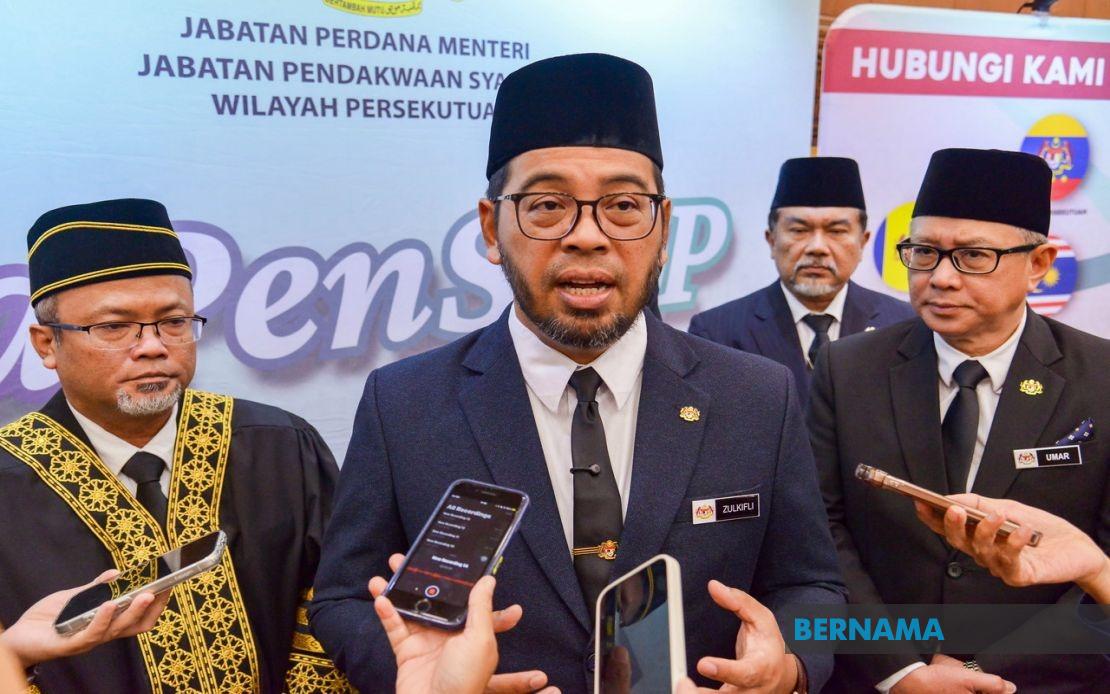
The Prime Minister's Department (Religious Affairs) is launching a formal investigation into allegations that a reference number belonging to the Department of Islamic Development Malaysia (JAKIM) has been leveraged to lend credibility to marriage declaration documents purportedly issued by the Malaysia Rohingya Ulama Council. Religious Affairs Minister Dr Zulkifli Hasan disclosed the inquiry during a press interaction held in Putrajaya on July 15, acknowledging that his ministry has yet to compile comprehensive details on the controversy that has recently circulated across social media platforms.
The disputed marriage declaration letter surfaced online bearing the reference number "JAKIM.PERH/LN.800-7(5)", sparking immediate concern about potential misuse of an official government identifier. The appearance of the JAKIM reference prompted public and institutional scrutiny regarding the document's legitimacy and whether it carried any official endorsement from Malaysia's Islamic regulatory body. This development has raised significant questions about document authenticity and the ease with which official-seeming credentials can be fabricated or misappropriated in the digital sphere.
The Perak Islamic Religious Department (JAIPk) has since clarified its position, categorically stating that it does not recognise the marriage declaration letter as a valid legal instrument. Beyond rejecting the document itself, the department has articulated a broader institutional challenge: marriages involving members of the Rohingya community cannot be officially registered within Perak's jurisdiction, citing unresolved policy matters currently under review by relevant state religious authorities. This stance reflects the complex intersection of administrative law, religious governance, and the precarious legal status of stateless populations in Malaysia's Islamic framework.
Dr Zulkifli's measured response indicates the sensitivity surrounding this matter, which touches upon multiple jurisdictional boundaries and institutional responsibilities. The minister emphasised that while his department at the federal level would pursue the investigation, the ultimate responsibility for marriage registration and the validation of religious documents rests with state-level religious authorities. This delineation of powers underscores the decentralised nature of Islamic governance in Malaysia, where states retain considerable autonomy over religious and personal law matters affecting their populations.
Beyond the immediate Rohingya marriage document controversy, Dr Zulkifli raised a connected concern about the proliferation of religious lectures and teachings disseminated through social media without proper accreditation or oversight. The minister indicated that his department is actively reviewing mechanisms to address this challenge, which represents an emerging frontier in religious regulation. However, he stressed that enforcement authority again rests primarily with state governments, which hold the constitutional mandate to oversee the accreditation of religious teachers and to approve individuals qualified to deliver Islamic instruction.
The online religious teaching issue presents regulatory complexities that extend beyond traditional oversight mechanisms. Digital platforms transcend geographical boundaries and enable instantaneous mass dissemination, making conventional licensing and accreditation systems potentially obsolete or at least severely strained. The government's current approach involves ongoing examination of how best to tackle unaccredited religious content online while navigating legal frameworks that were developed before the digital age fundamentally altered information distribution and consumption patterns.
At the departmental level, Dr Zulkifli indicated that his ministry implements internal protocols requiring speakers and contributors appearing on official broadcasts and other communication channels to possess appropriate accreditation credentials. This approach represents a form of gatekeeping at the federal level, though it provides only limited protection given the vast ecosystem of private religious content creators operating beyond government platforms and institutional frameworks.
The broader context of Dr Zulkifli's remarks during the second Malaysian Syariah Prosecutors Conference (PePSSM) 2026 reveals a government increasingly focused on modernising Islamic law enforcement to address contemporary challenges. The minister emphasised that Syariah prosecutors must develop sophisticated capabilities in digital forensics, data analysis, and technology literacy to effectively investigate and prosecute crimes that exploit digital infrastructure. This recognition reflects the reality that religious violations increasingly involve cyber-mechanisms, from document forgery to online fraud to the dissemination of unauthorised religious content.
Intensified cooperation between JAKIM, the Malaysian Communications and Multimedia Commission (MCMC), the Royal Malaysian Police (PDRM), and the Attorney General's Chambers has been identified as essential to strengthen Syariah enforcement mechanisms and prosecution outcomes. These inter-agency frameworks acknowledge that modern religious compliance violations rarely fit neatly within single institutional mandates, requiring coordinated intelligence-sharing and enforcement strategies that cut across traditional bureaucratic silos.
For the Rohingya community specifically, these developments carry significant implications for their precarious legal position within Malaysia. Unable to register marriages through conventional channels and facing scrutiny regarding religious documentation, Rohingya residents confront heightened uncertainty about the legal recognition of fundamental personal status decisions. The investigation into the allegedly fraudulent JAKIM reference number may ultimately serve to tighten institutional scrutiny of Rohingya community institutions, potentially complicating rather than resolving the underlying policy questions about their place within Malaysia's legal and religious frameworks.
The situation also highlights broader vulnerabilities within Malaysia's religious authentication systems to fraud and misuse. If government reference numbers can be easily appropriated to fabricate official-appearing documents, this suggests potential gaps in documentation security and verification protocols that extend beyond the specific Rohingya marriage document case. Addressing these vulnerabilities will require systematic review of how JAKIM and other religious authorities issue, track, and protect their official reference numbers and letterhead from unauthorised duplication.
Moving forward, the investigation's findings and any subsequent policy responses will likely establish important precedents for how Malaysia addresses religious documentation fraud and the broader challenge of regulating religious instruction and practice in an increasingly digital environment. The outcome may influence not only treatment of Rohingya community institutions but also the government's strategic approach to managing religious authority and legitimacy across multiple institutions and platforms as Malaysian society continues its complex navigation of modernisation, religious governance, and institutional credibility in the digital age.

