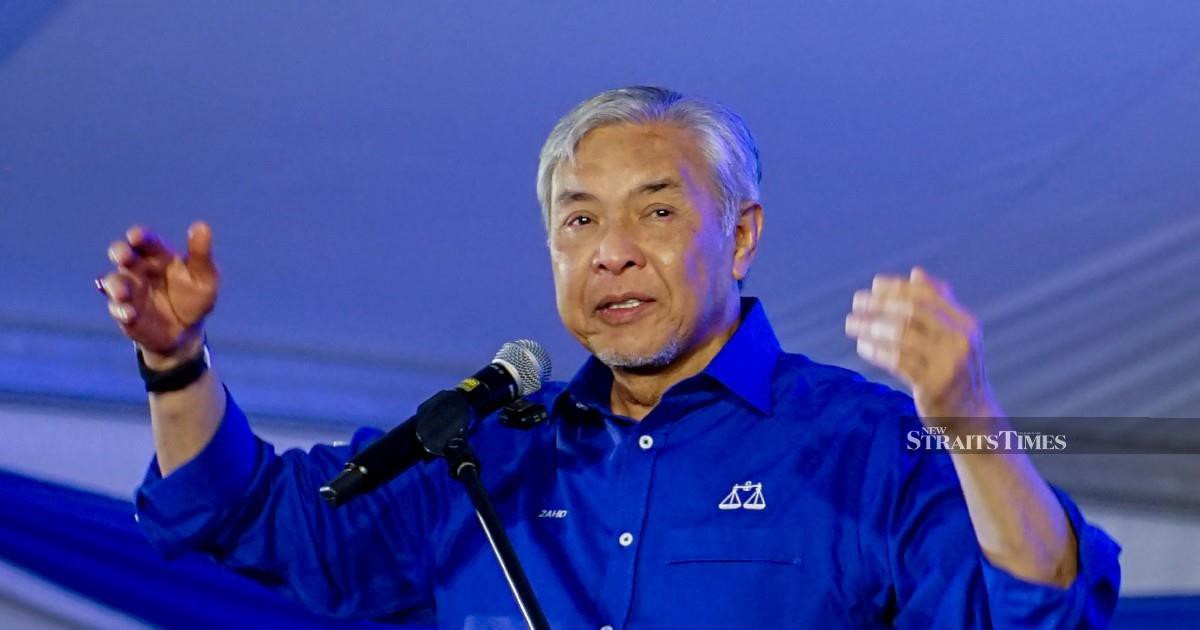
Barisan Nasional's chairman Datuk Seri Dr Ahmad Zahid Hamidi has signalled Jalaluddin as the coalition's leading contender for the Negri Sembilan Menteri Besar position, stepping back from earlier ambiguity about the appointment process. Speaking in Jelebu, Zahid indicated that while the Perikatan Nasional coalition maintains a roster of qualified administrators capable of steering the state, the preference has crystallised around a single figure heading into the crucial electoral contest.
The announcement represents a critical juncture for coalition politics in Negri Sembilan, a crucial battleground in the broader struggle for peninsular influence. By narrowing the field of candidates and alighting upon Jalaluddin, Barisan Nasional seeks to project unity and decisiveness at a moment when internal divisions within the broader Perikatan Nasional alliance could undermine voter confidence. The move signals an attempt to forestall the kind of protracted leadership wrangling that has occasionally plagued state-level politics across Malaysia, potentially damaging the coalition's electoral prospects.
The identification of a specific candidate carries particular weight in Negri Sembilan, where state politics operates within the unique constitutional framework of an elected monarchy. The Negri Sembilan constitution vests considerable influence in the Yang di-Pertuan Negeri, who ultimately appoints the Menteri Besar following legislative elections. This ceremonial dimension adds complexity to any candidacy, as coalitions must ensure their preferred nominee commands not only parliamentary majority support but also the confidence of the state ruler. Zahid's designation of Jalaluddin thus carries implications extending beyond mere party preference into the delicate realm of royal prerogative and constitutional convention.
While Zahid's public remarks acknowledged the existence of alternative capable candidates within coalition ranks, the strategic weight given to this particular utterance effectively signals organizational consensus around Jalaluddin's elevation. In Malaysian political communication, such statements frequently function as trial balloons preceding formal announcements, allowing party leadership to gauge public and internal reaction whilst preserving technical flexibility. The framing simultaneously demonstrates confidence in the coalition's bench strength—a rhetorical necessity in competitive elections—whilst establishing a clear hierarchy of preference for voters and party members alike.
For Negri Sembilan specifically, this candidacy holds ramifications across multiple governance domains. The state faces ongoing challenges in economic diversification beyond its traditional reliance on palm oil, tin mining heritage, and agricultural sectors. Infrastructure development, particularly connections to the Klang Valley and Kuala Lumpur, remains a consistent election issue. Education provision and healthcare accessibility in rural constituencies continue generating voter concern. Any incoming Menteri Besar must demonstrate capacity to navigate these priorities whilst managing the state's relatively modest fiscal position compared to wealthier counterparts like Selangor. Jalaluddin's track record and administrative experience thus become central to voter assessment of coalition competence.
The broader Perikatan Nasional formation has itself undergone significant evolution since the 2022 general election transformed Malaysian politics. The governing coalition at federal level comprises Barisan Nasional, Perikatan Nasional's core components, and various independent and smaller-party parliamentarians. State-level contests, however, operate under distinct dynamics. Negri Sembilan presents an opportunity for the broader coalition to consolidate state-level governance and demonstrate administrative effectiveness. Success here reinforces the coalition narrative of competent stewardship; reversal would provide opposition parties with valuable momentum heading toward potential future contests.
The timing of Zahid's declaration warrants consideration within the calendar of Malaysian electoral politics. State elections across the federation occur on varying schedules determined by constitutional dissolution dates and dissolution discretion vested in respective rulers. Negri Sembilan's electoral horizon shapes campaign calendars and strategic positioning for all contending forces. By establishing frontrunner status early, Barisan Nasional creates organizational advantages in candidate recruitment, volunteer mobilization, and campaign resource allocation. Opposition parties must meanwhile recalibrate their own positioning in response to this clarified coalition strategy.
Jalaluddin's emergence as preferred candidate reflects evaluation of multiple factors extending beyond mere seniority or longevity within party structures. Modern Malaysian electoral contests increasingly demand candidates demonstrating specific competencies in digital communication, grassroots engagement, economic literacy, and administrative track record. The individual must navigate increasingly sophisticated voter expectations whilst maintaining credibility across diverse constituencies—urban areas with sophisticated policy concerns, semi-urban communities balancing development with preservation, and rural regions prioritizing infrastructure and agricultural support.
For Malaysian readers monitoring regional political developments, the Negri Sembilan contest offers a microcosm of broader coalition dynamics and governance competition. State elections serve as important laboratories for policy approaches subsequently scaled to national level, whilst simultaneously functioning as confidence votes on governing performance. Results shape future federal coalition stability and positioning ahead of ultimate general elections. The emergence of clearly identified leadership candidates thus carries implications transcending any single state's boundaries, touching on fundamental questions of coalition governance, political accountability, and voter preferences across Malaysia's federal structure.
The coalition's strategy of publicly identifying a preferred candidate whilst technically maintaining flexibility represents sophisticated political positioning. Zahid's careful framing—acknowledging multiple capable candidates whilst signalling clear preference—attempts to maximize coalition cohesion and voter confidence whilst preserving constitutional propriety around the Yang di-Pertuan Negeri's ultimate prerogative. This balance between transparent democratic processes and constitutional custom reflects enduring tensions within Malaysia's hybrid monarchical-democratic governance system, tensions that persist most visibly at state electoral moments such as this.

