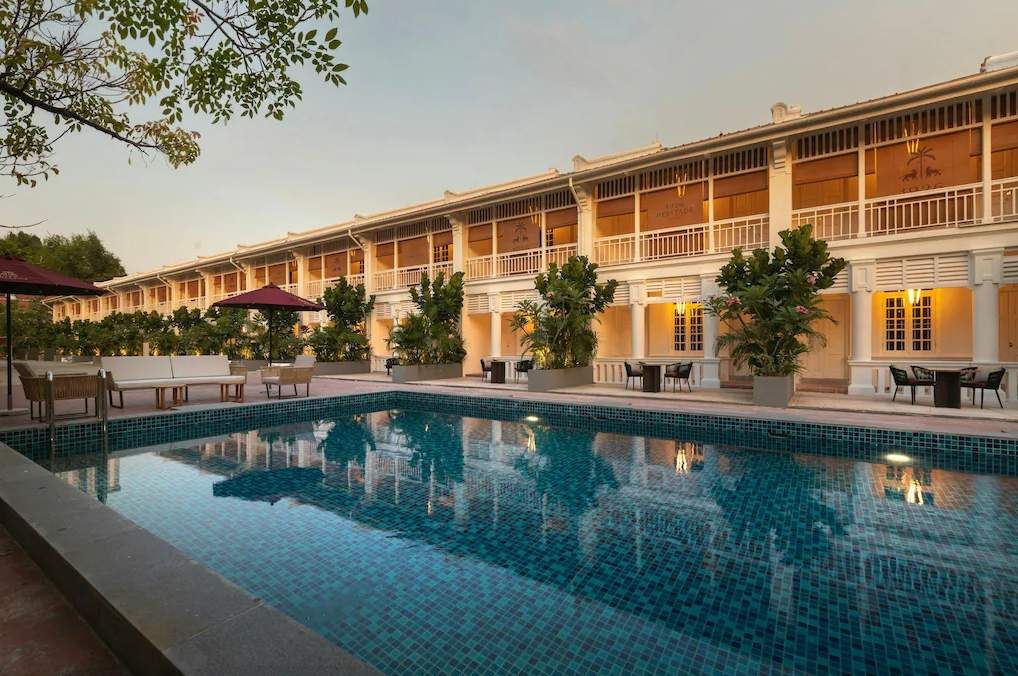
Jalan Burma stands as one of George Town's most intriguing thoroughfares, offering travellers an unconventional route through Penang's culinary and architectural landscape that extends well beyond the familiar tourist corridor. At nearly five kilometres in length, this arterial road connects the established heritage zone with the more residential charm of Pulau Tikus, serving as both a practical transport artery and an authentic window into how locals navigate their city. Unlike the heavily touristed Beach Street and Armenian Street, Jalan Burma provides a more organic experience of George Town's evolution, where heritage preservation meets contemporary dining culture in ways that feel less curated and more genuinely lived-in.
The road's most prominent landmark is undoubtedly the newly restored heritage hotel, a property that celebrates its centennial this year having been built in 1926. The structure exemplifies the Anglo-Malay architectural vocabulary that defined colonial-era Penang, with design elements that reflected both British sensibilities and local adaptation. Originally comprising 24 interconnected link houses that served as government quarters, the building underwent significant transformation in 1999 when the Penang Development Corporation converted it into a hospitality establishment. Today, those same link houses have been reconfigured into 78 distinct rooms and suites, with offerings ranging from the Heritage Room suited for solo travellers to the expansive Straits Suite, maintaining the property's character while meeting modern guest expectations.
What makes Jalan Burma particularly compelling for food-focused visitors is its concentration of Michelin-recognised establishments alongside traditional shophouse eateries. Penang's Michelin dining ecosystem encompasses 74 venues overall, with the majority concentrated in George Town itself. Of these, two maintain one-star status, 33 operate under the prestigious Bib Gourmand designation, and 39 carry the Michelin Selected designation. Rather than representing a departure from authentic Penang dining, these recognitions often identify venues operating from simple food courts and coffeeshops rather than elaborate fine dining settings. For discerning travellers seeking culinary excellence without formality, this distinction proves invaluable, as the Bib Gourmand category particularly emphasises quality and value in humble settings.
The street's food culture reveals itself in layers of familiarity and discovery. Duck Blood Curry Mee operates from a modest stall just down from the heritage hotel, serving the white curry noodles that have sustained countless breakfast conversations. However, immediately adjacent sits Restoran Old Green House, which claims distinction as the original home of the Bib Gourmand-listed Green House Prawn Mee & Loh Mee. The relationship between the original establishment and its newer iteration at Green House Prawn Mee/Law Mee Corner further down the street illustrates how Penang's food narratives depend heavily on provenance and authenticity rather than mere replication. Locals maintain strong opinions about which venue maintains superior credentials, a debate that reflects deeper cultural attitudes toward heritage and legitimacy in a destination famous for its nasi kandar variations.
Navigating George Town's dining landscape has traditionally proven challenging for visitors unfamiliar with the city's intricate structure. Rather than attempting to impose artificial food zones, more practical approaches organise establishments according to dietary categories such as halal, pork-free, street food, cafes, or nasi kandar variants. This taxonomy acknowledges that George Town's food distribution follows organic patterns shaped by community settlement, culinary tradition, and commercial evolution rather than formal planning. Jalan Burma exemplifies this organic development, as its concentration of quality establishments reflects neither deliberate tourist infrastructure but rather the natural gathering of skilled cooks and favourable conditions across generations.
The road's historical nomenclature reveals Penang's multicultural palimpsest in fascinating detail. Originally known as Burmah Road in colonial records, Jalan Burma carried multiple identities across different communities. Malay residents called it Jalan Tarek Ayer or Water Cart Road, referencing its initial function transporting water via bullock carts during the pre-modern period. Hokkien speakers termed it Gui Chia Chui or Water On Bullock Carts, while Cantonese communities maintained their own linguistic designation. The 19th-century establishment of a Burmese settlement in nearby Pulau Tikus ultimately crystallised the road's enduring English name, though the area retains strong Burmese cultural imprints. Contemporary Burmese-influenced street names including Rangoon Road, Mandalay Road, and Moulmein Close cluster throughout the vicinity, while the Dhammikarama Burmese Temple, established two centuries ago, continues anchoring this heritage along one of Jalan Burma's subsidiary lanes.
An information board positioned beneath the Komtar Octopus Pedestrian Bridge documents this linguistic and historical layering in simplified form, offering visitors accessible entry points into understanding how George Town's nomenclature encodes multiple community narratives simultaneously. Rather than representing dead history, these naming conventions remain functionally embedded in how long-term residents navigate and discuss their city. The road's journey from utilitarian water transport route to multicultural commercial corridor mirrors broader patterns of how Southeast Asian cities have evolved through layered settlement, trade specialisation, and community persistence.
Physically traversing Jalan Burma presents an accessible and relatively safe walking experience for tourists, despite the road's considerable length. Nearly all sections feature established pedestrian pathways, with only one or two brief intervals lacking formal infrastructure. This walkability emerges as particularly valuable for visitors seeking exercise while exploring the city, as the approximately four-kilometre return journey from the heritage zone through to upper Jalan Burma provides meaningful physical engagement without requiring specialised fitness. The heterogeneous streetscape reveals residential diversity, with the road transitioning from more touristy sections near the heritage hotel through progressively quieter residential neighbourhoods as it approaches the upscale Pulau Tikus district.
For travellers spending multiple days in George Town, the Michelin framework offers a structured yet flexible approach to culinary exploration. Rather than dismissing these recognitions as overly formal or touristy, embracing the Bib Gourmand category in particular allows visitors to identify consistently high-quality establishments operating in formats that feel authentic rather than performance-oriented for outsiders. The 33 Bib Gourmand venues across Penang provide reasonable sampling across different cuisines and price points, with concentrations in areas like Jalan Burma reflecting how culinary excellence often clusters where infrastructure, community knowledge, and customer demand converge naturally.
The evening dining experience at Root House by Gen, a modern Chinese restaurant operating within the heritage hotel itself, demonstrates how contemporary culinary ambition can coexist with heritage preservation. Rather than positioning itself as either oppositionally trendy or reverentially traditional, the establishment occupies an intermediate space where skilled technique meets culturally rooted ingredients and flavour profiles. This represents a broader pattern across George Town's hospitality sector, where new establishments frequently seek meaningful dialogue with heritage contexts rather than aggressive rupture.
Beyond Jalan Burma's immediate commercial interests, George Town's weekend culture deserves visitor attention. The Hin Bus Depot marketplace operates exclusively on weekends and provides windows into local creative production and community gathering practices. Curators, artists, and homemade food vendors congregate in this converted transport depot, which now functions as marketplace, cultural venue, and social hub simultaneously. Live music accompaniment and the prevalence of homemade beverages and prepared foods distinguish this from conventional tourist shopping, instead emphasising authentic local commerce and artistic expression within informal frameworks.
For Malaysian and Southeast Asian travellers particularly, Jalan Burma offers validation that culinary excellence and heritage preservation need not represent opposing values or experiences. The road demonstrates how established communities maintain commercial vitality while welcoming external recognition without surrendering fundamental character. Its evolution from utilitarian water transport infrastructure through multicultural settlement to contemporary tourism destination illustrates the resilience of urban fabric when development respects rather than erases prior use patterns and community investments across generations.

