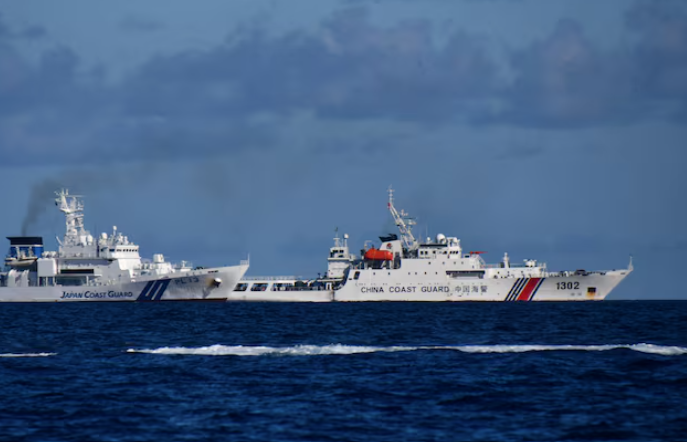
Japan's coast guard successfully forced two Chinese vessels out of its claimed territorial waters near the contested Senkaku Islands on Tuesday morning, the Japanese authorities announced. The Chinese ships had been approaching a Japanese fishing vessel operating in the area when Japanese coast guard personnel intervened, issuing orders to leave at approximately 9.20am local time. This latest confrontation underscores the persistent friction between Tokyo and Beijing over one of Asia's most contentious maritime flashpoints.
The Senkaku Islands, referred to as Diaoyu by China, sit strategically between Taiwan and Japan's Okinawa prefecture and remain at the heart of a decades-long territorial dispute. Both nations claim sovereignty over the uninhabited archipelago, and control of the waters surrounding it carries not only symbolic political weight but also potential economic significance. The area is believed to contain valuable energy reserves, making the dispute about more than mere pride—it touches on resource security for both regional powers. The islands have functioned as a barometer of Japan-China relations for generations, with each escalation in rhetoric or military posturing sending ripples through Southeast Asia's delicate geopolitical balance.
What made Tuesday's incident noteworthy was its proximity to civilian fishing operations. While four Chinese coast guard vessels had been patrolling the area, only two entered waters that Japan administers. The approach toward the Japanese fishing boat represented an unusually aggressive maneuver, as Chinese incursions typically involve patrol activity rather than direct engagement with commercial vessels. Japan's coast guard responded by deploying assets specifically to shield the fishing vessel and maintain a protective perimeter around it while ordering the Chinese ships to withdraw. The Japanese authorities labeled the Chinese actions a violation of international law, emphasizing their commitment to safeguarding both territorial integrity and the livelihoods of Japanese fishermen who depend on these waters.
This encounter arrives against a backdrop of deteriorating bilateral relations that accelerated following comments made by Japanese Prime Minister Sanae Takaichi last November. Takaichi suggested that Japan could intervene militarily should Taiwan face armed attack, a statement that provoked sharp condemnation from Beijing. China views Taiwan as a renegade province and has never formally renounced the use of force to achieve unification. Tokyo's explicit linkage of its security interests to Taiwan's defense crossed a diplomatic line that Beijing found unacceptable. The statement represented a significant shift in Japanese rhetoric, moving beyond careful ambiguity toward clearer strategic alignment with Taipei.
Beijing's response to Takaichi's remarks has been multifaceted and designed to impose both economic and diplomatic costs on Tokyo. Chinese authorities have discouraged their citizens from traveling to Japan through official advisories, directly impacting Japan's crucial tourism sector. Simultaneously, Beijing has implemented trade restrictions targeting specific Japanese firms, weaponizing commercial relationships to signal displeasure. These measures, combined with increased coast guard deployments around the Senkaku Islands, reflect China's strategy of applying incremental pressure across multiple domains rather than engaging in dramatic military confrontation. For regional observers, the pattern suggests a deliberate campaign to test Japanese resolve while remaining below the threshold that might trigger military escalation.
The frequency of Chinese coast guard incursions has become almost routine, though the intensity and nature of these operations vary. Chinese vessels last entered waters claimed by Japan on June 10, yet encounters involving approaches to fishing boats remain comparatively rare. This distinction matters because it suggests an escalation in Chinese assertiveness or perhaps a testing of how Japan will respond to more provocative behavior. Each such incident carries the potential to spiral if either side misreads the other's intentions or if a miscalculation occurs at sea. For Southeast Asian nations watching this rivalry, including Malaysia, the unpredictability poses genuine concerns about regional stability and maritime freedom of navigation that affects commerce throughout the region.
Japan's coast guard has made clear that it intends to maintain its defensive posture without escalating tensions further. In its official statement, the organization pledged to respond with calm but firmness, invoking both international and domestic law as the basis for its actions. This language reflects Tokyo's broader strategy of positioning itself as the rules-based actor in the dispute, appealing to international legal frameworks and established maritime conventions. Japan recognizes that any appearance of aggression or overreaction could undermine its diplomatic position, particularly among regional states concerned about Chinese military rise. The careful calibration of response—protection without provocation—represents the difficult balance Tokyo must maintain.
The broader context of these maritime confrontations includes China's assertive posture across multiple disputed waters in the East China Sea and South China Sea. Beijing has deployed coast guard and civilian militia vessels throughout these regions, establishing what analysts describe as a gray-zone dominance strategy. By using civilian maritime forces rather than direct military deployment, China maintains plausible deniability while gradually shifting facts on the ground. These tactics have proven effective in other disputes, though the Senkaku situation differs due to Japan's stronger administrative control and regional support from allies including the United States. For countries like Malaysia with interests in Southeast Asian maritime stability, China's operational approach in the Senkaku waters provides a template for understanding potential tactics that could emerge elsewhere.
The incident also reflects broader tensions within the Japan-China relationship that extend well beyond territorial disputes. Economic interdependence that once served as a stabilizing force has weakened as both nations have pursued more nationalistic policies and as geopolitical competition between Washington and Beijing has intensified. Japan, as a key American ally, has increasingly aligned itself with broader Indo-Pacific strategies that China views as containment. Against this strategic backdrop, disputes over islands and waters take on added significance as proxies for larger questions about regional power distribution and influence. Tuesday's expulsion of Chinese vessels, though operationally routine, thus carries symbolic weight in demonstrating Japan's determination to maintain its position in contested waters despite Chinese pressure.
Looking ahead, the likelihood of further incidents appears high given the structural factors driving these confrontations. Chinese coast guard deployments around the Senkaku Islands show no sign of diminishing, and Japanese resolve to defend what it considers its territory remains unwavering. The challenge for both nations lies in managing these interactions without allowing a single miscalculation to trigger broader conflict. Regional actors, particularly Southeast Asian nations relying on stable maritime conditions for trade and security, will continue watching this rivalry with concern. The ability of Tokyo and Beijing to maintain operational discipline while competing over these strategic waters will significantly influence whether the East China Sea remains a zone of managed tensions or becomes an arena of open conflict.

