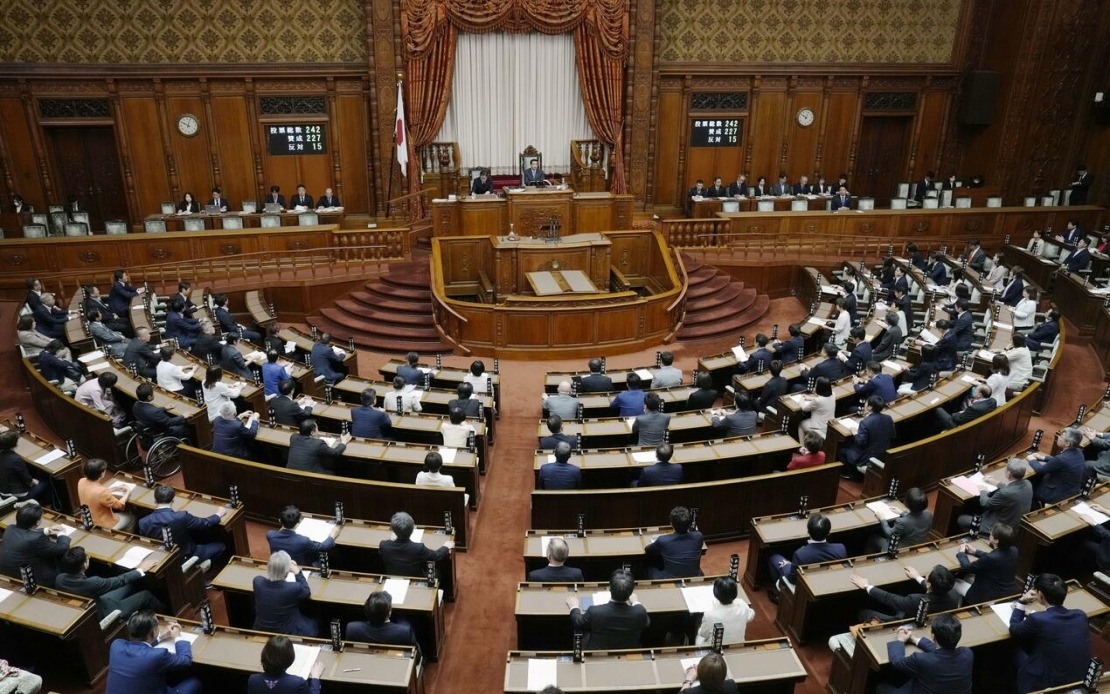
Japan's parliament has enacted significant defence legislation that will transform the country's military structure and capabilities, reflecting Tokyo's growing concern about emerging security threats in an increasingly contested region. The House of Councillors voted Friday to approve the measures, which centre on reorganising and renaming the Air Self-Defence Force to explicitly include space defence operations, underscoring Japan's recognition that control of orbital space has become critical to national security. The restructured military branch will be formally established during the fiscal year ending March 2027, marking a fundamental shift in how Japan conceptualises and organises its defence posture across traditional and emerging domains.
At the heart of these reforms lies the creation of a dedicated space operations group, which will operate under the command of a lieutenant general. This new unit represents Japan's most substantial investment in space-based military capabilities to date, reflecting a dramatic acceleration in Tokyo's space defence priorities. The primary mission of this group will be to enhance space domain awareness and strengthen the country's satellite surveillance systems, capabilities that have assumed paramount importance as military operations increasingly depend on reliable access to orbital assets. For Malaysia and other Southeast Asian nations, Japan's move signals that regional powers are now viewing space security as inseparable from conventional defence, a development with implications for how the region approaches broader security architecture.
Defence Minister Shinjiro Koizumi framed the reforms not merely as military necessities but as essential infrastructure for modern society. At a news conference, he emphasised that contemporary civilian life has become utterly dependent on space-based services, from satellite navigation systems that guide commercial vehicles to the smartphone mapping applications that millions use daily, as well as the weather forecasting systems that inform disaster preparedness and economic planning. This framing is significant because it suggests Japan views space security as a foundation for civilian resilience, not simply military advantage. The minister stated that the government would methodically establish the institutional frameworks necessary for the Self-Defence Forces to execute their missions with maximum effectiveness in this evolving environment.
Beyond space operations, the legislation also authorises the establishment of a second senior vice defence minister position, a structural innovation designed to distribute administrative burden more evenly across Japan's defence establishment. This additional senior appointment will prove particularly valuable during national emergencies and major natural disasters, periods when defence ministries must coordinate extensively with civilian agencies and manage complex multi-agency responses. The move also facilitates deeper defence engagements with the United States and other security partners, acknowledging that Japan's security increasingly depends on seamless integration with allied military forces and intelligence networks. The government intends to make this senior vice minister appointment during the current summer, indicating the urgency with which Tokyo views these reforms.
Recognising that sustained military capability depends on personnel, the legislation includes measures to address the Self-Defence Forces' persistent recruitment and retention challenges. The approved reforms raise post-retirement benefits for SDF members, acknowledging that the military's attractiveness as a career has diminished relative to civilian opportunities in Japan's competitive labour market. The mandatory retirement ages for SDF personnel, which vary by rank, typically occur considerably earlier than standard civil service roles, creating a significant career disadvantage for military officers. By enhancing retirement provisions, Tokyo hopes to make military service more attractive to Japan's younger demographic, which faces declining birth rates and an ageing population.
The legislation also encompasses significant changes to Japan's ground forces, particularly in strategically sensitive regions. The Ground Self-Defence Force's 15th Brigade, stationed in Naha in Okinawa Prefecture, will be upgraded to full divisional status, a promotion that reflects Tokyo's determination to strengthen defences across its southwestern island chain. This geographical focus directly responds to China's increasingly assertive maritime behaviour in waters adjacent to Japan's territory, particularly around the Senkaku Islands and other disputed maritime zones. The elevation of the 15th Brigade represents a concrete manifestation of Japan's strategic pivot, shifting resources and organisational weight to the southwestern flank where demographic decline and historical underinvestment had created vulnerabilities.
For Southeast Asian observers, Japan's defence restructuring carries several important implications. First, it demonstrates that Tokyo is making substantial and sustained commitment to military modernisation despite its ageing population and fiscal constraints. Second, the explicit inclusion of space operations within the renamed air force signals that orbital domain competition will increasingly define regional security dynamics. Third, Japan's focus on southwestern island defence indirectly affects the broader regional balance, as a more capable Japanese military presence in these waters influences how other regional powers, including China and potentially others, calculate their strategic options.
The reforms also reflect broader strategic assumptions that Japan's leadership has adopted regarding the medium-term security environment. Tokyo appears convinced that the window for undertaking fundamental military reforms is narrowing, driven by demographic constraints and the accelerating pace of technological change. By acting now to restructure institutions, Japan is attempting to lock in advantages before population decline makes sustained defence spending increasingly difficult politically. The space operations focus, in particular, suggests Japanese planners believe that future conflicts, whether conventional or hybrid, will hinge on orbital superiority and reliable access to satellite intelligence and communications.
The passage of this legislation also demonstrates the relative consensus among Japan's political parties on defence matters, a notable feature of Japanese politics in recent years. The House of Councillors vote indicates that both governing and opposition parties recognise the urgency of modernising Japan's defence establishment and strengthening security partnerships. This cross-party support provides the stable political foundation necessary for implementing these complex institutional changes across the defence bureaucracy.
Looking forward, Japan's defence transformation will likely accelerate regional military competition and innovation. Other Asian democracies will likely monitor Japan's space operations initiatives closely, potentially spurring similar investments in satellite and orbital capabilities. The restructuring also signals Japan's determination to remain a credible security partner for the United States and other allies in the Indo-Pacific, reinforcing the military dimension of regional alignments that will shape geopolitical competition for decades to come.

