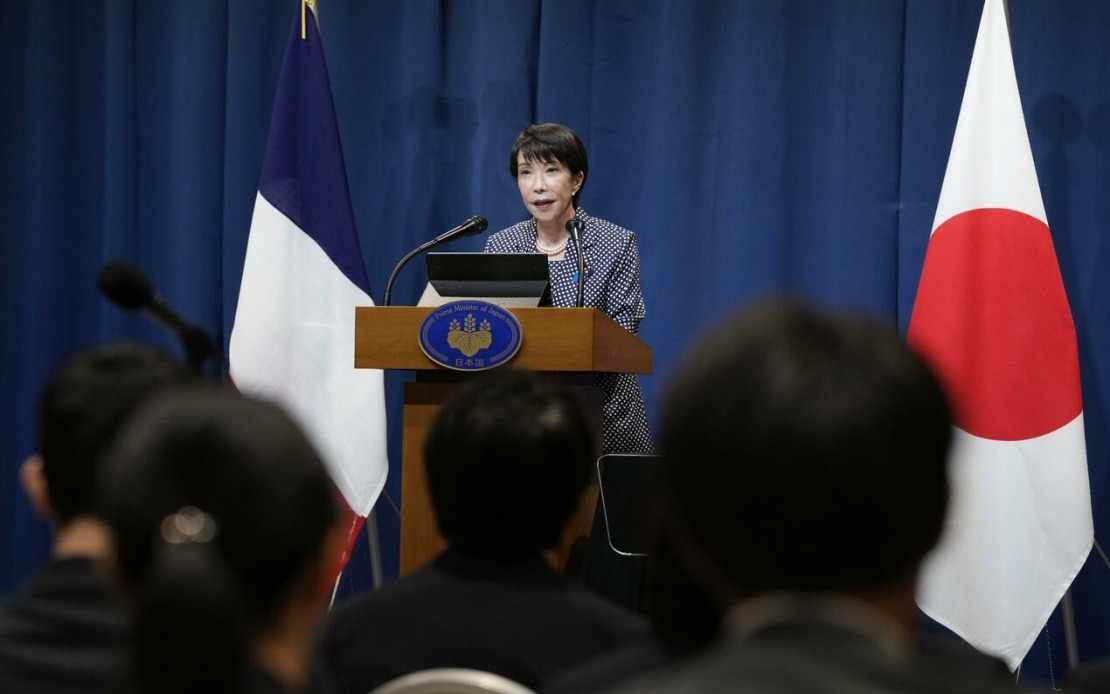
Prime Minister Sanae Takaichi's governing cabinet has experienced a notable erosion in public support, with her approval rating sliding to 55.8 per cent according to a Kyodo News poll conducted over the weekend. This represents the weakest endorsement the administration has received since Takaichi assumed office in October, reflecting growing public anxiety about Japan's economic trajectory and the government's capacity to address mounting pressures on household finances.
The timing of this decline is significant, coming in the wake of a preliminary peace agreement between the United States and Iran that includes provisions for Tehran to reopen the Strait of Hormuz. For a resource-dependent nation like Japan, which relies heavily on imported energy, such geopolitical developments carry substantial implications for domestic economic stability. The tentative resolution of tensions in West Asia had been expected to ease supply chain concerns and moderate energy costs, yet the polling data suggests the Japanese public remains unconvinced that meaningful relief is imminent.
A major contributor to the Cabinet's eroding support appears to be the persistent struggle faced by ordinary households contending with elevated consumer prices. The cost-of-living crisis has become a defining economic challenge, with inflation eating into disposable incomes and consumer purchasing power. The government's response to these inflationary pressures has therefore become a critical barometer of public confidence, with citizens closely scrutinising policy initiatives aimed at alleviating their financial burden.
On the fiscal front, the poll reveals telling attitudes towards potential tax relief measures. When respondents were asked about reducing the consumption tax rate on food and beverages from its current level of 8.0 per cent, a substantial plurality of 43.9 per cent indicated that a reduction to 1.0 per cent would be an acceptable policy direction, particularly if implementation could be expedited. This suggests that many Japanese citizens are willing to entertain moderate tax cuts that maintain government revenue to some degree, viewing it as a pragmatic balance between relief and fiscal responsibility.
However, an additional 22.6 per cent of survey respondents advocated for a more aggressive approach, calling for the consumption tax on food and beverages to be eliminated entirely, reducing it to zero. This demand aligns with commitments made by Japan's ruling coalition parties, suggesting that a significant segment of the electorate expects the government to follow through on these pledges. The combined 66.5 per cent supporting some form of consumption tax reduction on essential food items underscores the urgency with which the public views this issue.
The question of Japan's potential military involvement in securing critical maritime corridors also featured prominently in the survey. A majority of 54.7 per cent of respondents expressed opposition to dispatching the Japanese Self-Defence Forces to safeguard commercial vessels transiting through strategic waterways, despite the economic importance of such routes to Japan's trade and energy security. This indicates a public preference for non-military solutions to geopolitical challenges, or alternatively, a reluctance to expose Japanese personnel to potential conflict in distant regions.
Conversely, 36.6 per cent of those surveyed supported the possibility of Self-Defence Forces deployment to maintain freedom of navigation for commercial shipping. This minority viewpoint reflects awareness among some segments of the population that Japan's economic prosperity is inextricably linked to open and secure sea lanes. The substantial gap between these two positions reveals a fundamental divide within Japanese society regarding the appropriate balance between military preparedness and restraint.
For Southeast Asian nations monitoring developments in East Asia, Japan's domestic political climate carries indirect but meaningful implications. Japan remains a crucial economic partner and security presence in the region, and declining cabinet support could potentially constrain the government's ability to pursue regional initiatives or maintain defence spending at current levels. Malaysian observers, in particular, should note that Japanese economic weakness or political instability could ripple through regional trade networks and investment patterns.
The convergence of external geopolitical uncertainty with internal economic hardship presents a challenging environment for the Takaichi administration. While the preliminary U.S.-Iran peace agreement offers some hope for stabilisation in West Asia, it appears insufficient to restore public confidence in the government's overall economic management. The central challenge facing Tokyo is demonstrating credible progress on domestic price stabilisation while maintaining Japan's strategic positioning in an increasingly complex regional security environment.
Moving forward, the government faces mounting pressure to translate campaign commitments into concrete policy action, particularly regarding consumption tax relief for essential food items. The breadth of public support for such measures—evident in the combined 66.5 per cent favouring some reduction—suggests that failure to act decisively could further erode Takaichi's political capital. The Cabinet's ability to arrest the decline in approval ratings may well depend on its success in delivering tangible improvements to household purchasing power in the months ahead.

