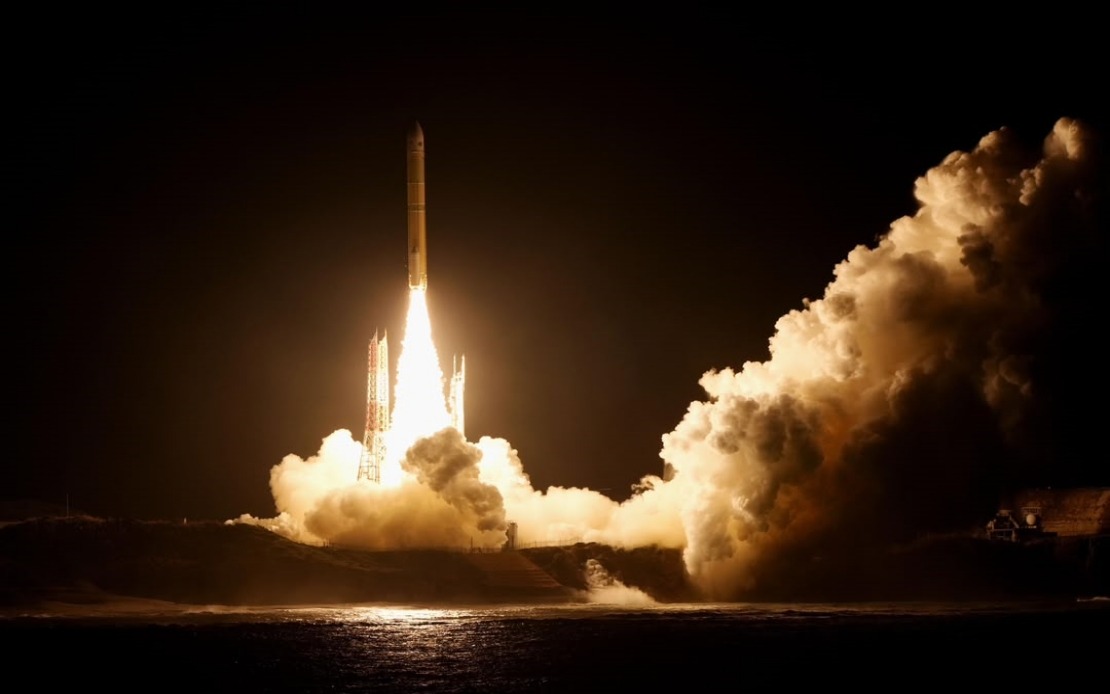
Japan has successfully deployed another satellite from its homegrown positioning network, demonstrating renewed confidence in its next-generation H3 rocket platform. The Japan Aerospace Exploration Agency lifted off the H3 rocket No. 9 from Tanegashima Space Centre on Tuesday, carrying the Michibiki No. 7 satellite into orbit. This achievement represents a critical turning point for the programme, following a disappointing failure in December and consolidating Japan's capability to maintain an independent space infrastructure in an increasingly competitive regional environment.
The Michibiki satellite forms part of Japan's Quasi-Zenith Satellite System, a network designed to provide precise positioning data for civilian applications across the country. Unlike global navigation systems that rely on foreign infrastructure, the Quasi-Zenith system ensures that Japan can deliver high-accuracy location services to smartphones, vehicle navigation systems, and other positioning-dependent technologies without dependence on external powers. This strategic independence carries significant implications for national security, technological sovereignty, and economic resilience in Southeast Asia's broader technological landscape.
Weather proved a persistent challenge for this particular mission. The launch was originally scheduled for Friday but had to be postponed as a typhoon approached the Tanegashima facility. Officials moved the operation to Monday, only to encounter further inclement conditions that forced a second delay until Tuesday. Such schedule adjustments are routine in space operations but underscore the vulnerability of launch infrastructure to environmental factors, a concern increasingly relevant as climate patterns become less predictable.
The road to this success was marked by setbacks that tested the programme's resilience. In December, JAXA attempted to deploy the Michibiki No. 5 satellite aboard an H3 rocket but encountered a critical failure that prevented orbital insertion. This mishap triggered a cascading delay affecting the entire deployment schedule, with the subsequent Michibiki No. 7 launch originally planned for February forced to slip by several months. The December failure prompted JAXA engineers to conduct thorough investigations and implement corrective measures across the H3 system.
The June intermediate launch, which successfully deployed multiple miniature satellites, provided crucial validation that JAXA's remedial work had addressed the underlying technical issues. That mission functioned as a proof-of-concept before committing the more valuable Michibiki payload to the rocket. The progression from failure to incremental validation and finally to this successful operational deployment demonstrates sound engineering practice and risk management in space programme execution.
Japan's positioning network remains incomplete relative to its full operational vision. Currently, five Michibiki satellites are actively providing positioning services across Japanese territory and surrounding regions. However, the government has established an ambitious target of deploying seven satellites to establish comprehensive coverage independent of foreign systems. The Michibiki No. 7 launch advances this objective substantially, positioning Japan to achieve full constellation status within a defined timeframe and establishing a genuine alternative to American GPS, Russian GLONASS, and Chinese BeiDou systems.
The H3 rocket represents a generational transition in Japanese launch capability. It succeeded the H2A platform, which provided reliable service as Japan's primary launch vehicle for more than twenty years. The H2A accumulated an impressive track record of consistency, becoming trusted by international customers and commercial operators. However, as space markets evolved and competition intensified from emerging launcher providers, Japan recognised the need for a more capable and cost-effective successor. The H3 was designed to offer enhanced performance characteristics while reducing operational expenses.
The mixed results to date have created uncertainty around the H3's reliability during its early operational phase. The December failure represented a significant setback that raised questions about whether design flaws or manufacturing issues might compromise the programme. However, the successful June mission and now Tuesday's deployment suggest that the initial problems were isolated rather than systematic. Building operational confidence in a new launch vehicle requires demonstrating consistent performance across multiple missions, and this trajectory appears encouraging.
For Malaysia and other Southeast Asian nations, Japan's success in establishing independent positioning infrastructure carries strategic implications. Regional countries currently depend on systems controlled by distant powers for critical navigation and timing services. A reliable Japanese alternative could offer nations greater flexibility in choosing positioning sources, reducing vulnerability to geopolitical pressure or technical disruption. The Quasi-Zenith system's coverage extends across East and Southeast Asia, potentially providing service to neighbouring countries and creating technological interdependencies within the region.
Japan's renewed confidence in its space programme extends beyond the Michibiki system itself. The H3's trajectory toward operational maturity supports Japan's broader ambitions in space exploration, commercial satellite operations, and international partnerships. As other nations including Malaysia increasingly seek space capabilities for communications, Earth observation, and other applications, Japan's proven launcher infrastructure becomes a valuable regional asset. The success of indigenous space programmes demonstrates technological sophistication and industrial capacity that can attract investment and partnerships.
The positioning satellite deployment also reflects Japan's commitment to maintaining technological parity with China and Russia in critical infrastructure. Positioning systems underpin modern economies, from financial systems to power grids to transportation networks. Nations that depend entirely on foreign systems face potential vulnerabilities if those systems experience disruption or are selectively denied. Japan's determination to complete its own constellation reflects realistic assessment of strategic risks and commitment to self-sufficiency in essential technologies.
Looking forward, JAXA must continue demonstrating H3 reliability through additional successful missions before the rocket can be considered fully proven. Each launch of the Michibiki constellation and other payloads contributes to building the operational track record necessary for commercial customers and international partners to commit missions to the platform. Competition from SpaceX, Arianespace, and emerging Chinese providers means that performance reliability alone may not suffice; cost competitiveness and responsiveness to customer requirements will also determine the H3's market success.
Tuesday's launch represents genuine progress for Japan's space ambitions and a step toward regional technological autonomy that reverberates across Asia-Pacific. The persistence required to overcome December's failure, implement corrections, and achieve successful consecutive launches demonstrates the engineering discipline and commitment underlying Japan's space programme. As Japan moves closer to completing its Quasi-Zenith constellation and establishing the H3 as a reliable operational platform, the implications extend beyond national borders to influence the technological landscape across Southeast Asia and the broader region.

