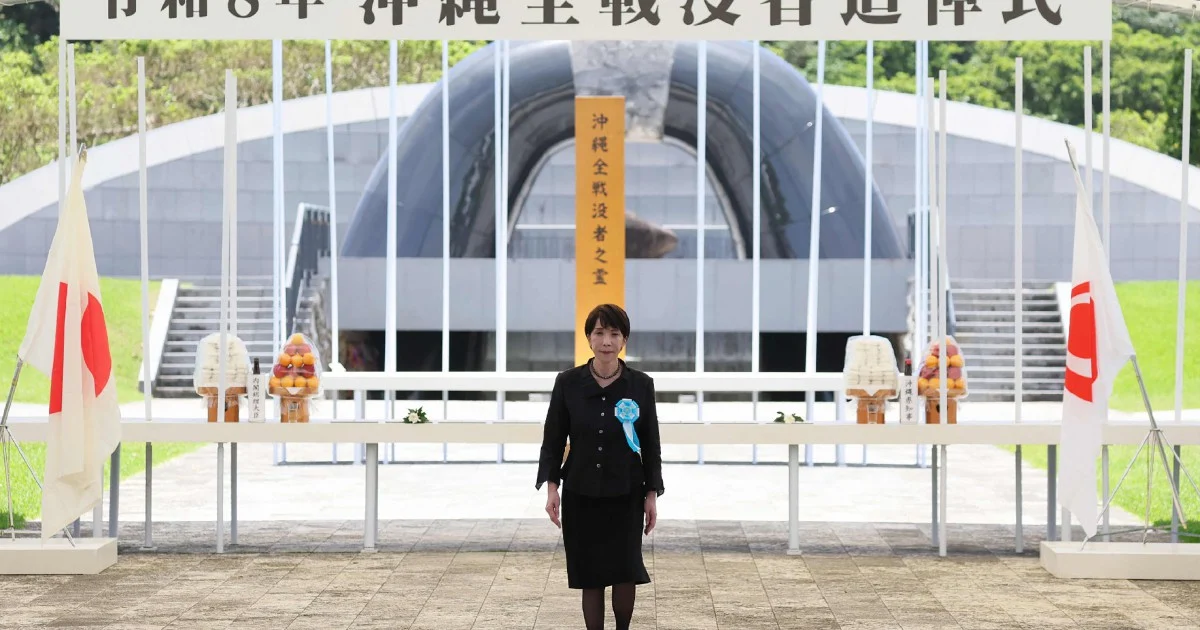
Prime Minister Sanae Takaichi encountered a vociferous challenge to her government's defence agenda during a ceremony honouring World War II victims, with television broadcasts capturing the confrontation as demonstrators voiced their opposition to Japan's strategic military reorientation. The incident underscores mounting domestic tension over whether Tokyo should maintain its post-war commitment to restraint or embrace a more assertive security posture amid deepening regional anxieties.
The memorial event served as the backdrop for what has become an increasingly visible public debate about Japan's role in regional security architecture. For more than seven decades, Japan's constitution and political culture have been shaped by Article 9, which renounces war as a means of settling disputes and strictly limits military capabilities. However, successive governments have progressively expanded the interpretation of these constraints, and Takaichi's administration appears intent on accelerating this trajectory.
Protestors gathering at the World War II memorial represented a constituency that remains deeply concerned about the implications of militarisation. Their heckling of the prime minister reflected anxieties that Japan risks abandoning a distinctive path that has defined its international identity since the nation's defeat in 1945. This constituency views the constraints embedded in Japan's post-war framework not as outdated restrictions but as valuable safeguards against a return to the militarism that led to catastrophic conflict.
Takaichi's ascent to the premiership itself signals the direction of the Liberal Democratic Party's thinking on defence matters. She is known as a hawk within Japanese politics, with long-standing views favouring stronger military capabilities and a more muscular approach to regional challenges. Her appointment therefore represents a deliberate choice by the ruling coalition to prioritise security measures over continuity with Japan's traditional pacifist positioning.
The underlying drivers of this strategic shift are multifaceted and deeply rooted in regional geopolitics. China's rapid military modernisation and assertive posture in the East and South China Seas have prompted Japanese policymakers to recalibrate their security calculations. Simultaneously, North Korea's nuclear weapons programme and ballistic missile capabilities present direct threats to Japanese territory. These external pressures have created compelling arguments within Tokyo's policy establishment for enhanced defence spending and more proactive security measures.
Yet the domestic pushback captured at the memorial event reveals that Japanese society remains fractured over these questions. Older generations with living memories of wartime devastation and younger peace activists both harbour deep reservations about militarisation. This demographic dimension is significant because Japan's ageing population means that those who directly experienced the horrors of total war still wield considerable moral authority in public discourse, even as younger generations engage with very different strategic realities.
The LDP's political calculation appears to be that external security imperatives override domestic pacifist sentiment. Rising defence budgets and expanded military capabilities have become government policy, supported by the ruling coalition and endorsed by enough of the electorate to sustain electoral dominance. However, the visible protests at high-profile events suggest that consensus on this pivot remains incomplete and that substantial portions of the public harbour unresolved concerns.
For Malaysia and other Southeast Asian nations, Japan's military trajectory carries significant implications. A more militarily capable Japan could contribute positively to regional stability by bolstering deterrence against revisionist powers and providing security reassurance to partners concerned about rising Chinese assertiveness. However, the same development could also accelerate regional militarisation, triggering security dilemmas where neighbouring states respond with their own force buildups, ultimately intensifying tensions rather than alleviating them.
The memorial setting for this political confrontation is symbolically laden. World War II memorials in Japan remain contested spaces where competing narratives about national history intersect. For some, the site represents a place to acknowledge national sacrifice and suffering; for others, it evokes unresolved questions about wartime responsibility. The prime minister's appearance therefore inevitably attracted scrutiny from those concerned that military expansion represents a failure to absorb the lessons of 1945.
Takaichi's government will need to navigate carefully between its defence agenda and domestic concerns about reverting to militarism. Public diplomacy efforts, including clarification that Japan's military expansion is defensive and not aimed at regional conquest, may help build broader consensus. Simultaneously, the administration is likely to argue that maintaining current pacifist restraints in an increasingly unstable region would itself constitute an irresponsible abdication of Japan's duty to protect its citizens.
The broader trajectory suggests that Japan's strategic debate will remain contentious for years to come. Regional developments—whether tensions escalate or ease in the Taiwan Strait, whether North Korea conducts further weapons tests, or whether China continues its assertive behaviour—will shape whether public opinion gradually accepts military expansion or hardens against it. For now, the heckling at the memorial indicates that the consensus underlying Japan's pacifist order has fractured, and the nation faces uncomfortable choices about its future security role.

