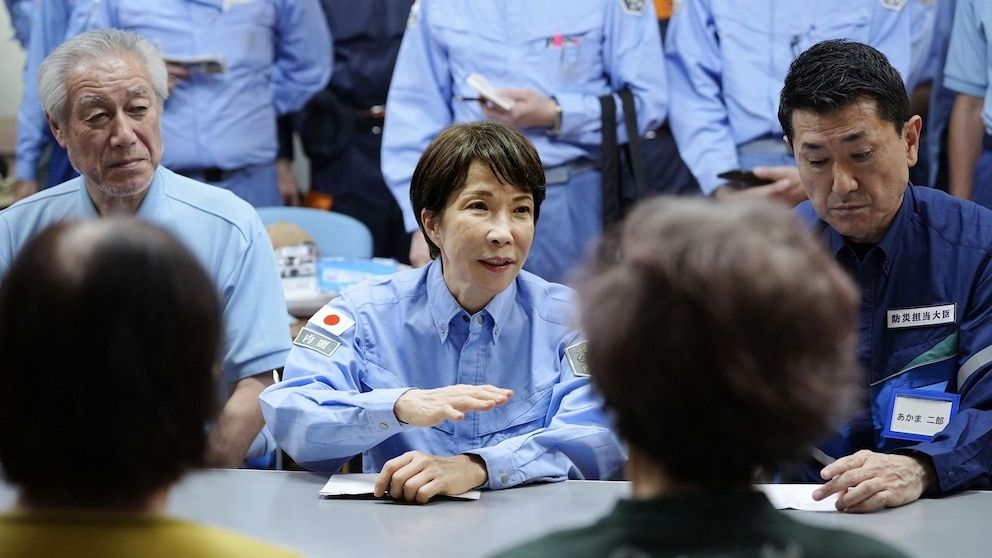
Prime Minister Sanae Takaichi visited the earthquake-devastated Kumamoto Prefecture on Monday for the first time since a magnitude 7.1 tremor struck Japan's southern island of Kyushu on Tuesday, August 4. The tour came as residents began the grim work of clearing debris from collapsed buildings and damaged homes, while simultaneously battling an emerging public health crisis brought on by scorching temperatures and dwindling essential supplies throughout the affected region.
The earthquake's toll has been severe and continues to mount. Thirty-eight people have been confirmed dead, though the circumstances surrounding some deaths underscore the complex challenges facing survivors. One victim died of apparent heat stroke while sheltering in a vehicle during the sweltering aftermath, while another death remains under investigation. More than 114 people sustained injuries across the prefecture. The disaster has destroyed approximately 700 homes outright and damaged more than 11,300 buildings, leaving entire communities facing weeks or months of reconstruction.
The combination of extreme weather and infrastructure damage has created a perfect storm for disaster survivors. More than 46,000 households remain without access to clean water, a critical concern given that Japan Meteorological Agency forecasts temperatures approaching 40 degrees Celsius (104 Fahrenheit) throughout the region. Simultaneously, fuel shortages are straining what little mobility residents retain, hampering both relief distribution and personal transportation to acquire supplies. These twin pressures have transformed what would normally be a challenging recovery scenario into an increasingly dire humanitarian situation requiring urgent intervention at multiple levels of government.
The human cost of inadequate shelter provisions has become plainly visible across Kumamoto. More than 8,500 people remain crowded into emergency shelters—hastily converted community centers, school gymnasiums, and classrooms—many of which lack air-conditioning despite the suffocating heat. Beyond these official facilities, thousands more have resorted to sleeping in parked vehicles at municipal parking lots and parks, or remaining outside their destroyed homes entirely. Disaster management experts have consistently warned that such crowded, poorly equipped shelters breed sanitation failures, disease transmission risks, and psychological strain that compounds physical injuries and loss.
Kumamoto Governor Takashi Kimura used his meeting with Takaichi to emphasize what he termed the "abnormal heat" bearing down on residents already struggling with displacement and loss. He pressed the national government for concrete support to elevate conditions at evacuation centers, highlighting critical shortfalls in clean water distribution and medical care access. The governor's appeals reflect the reality that local prefectural resources alone cannot manage a disaster of this magnitude, especially when compounded by seasonal weather extremes that would ordinarily pose minimal threat to properly housed populations.
Takaichi's response acknowledged the severity of the situation, though her visit itself sparked controversy. Before meeting with the governor, the Prime Minister flew over affected areas by military helicopter and visited one of the region's best-equipped shelters, which featured cardboard beds, privacy partitions, and air-conditioning. The selection of this particular facility for her inspection generated sharp criticism on Japanese social media, with observers arguing that the pristine conditions presented a misleading portrait of the actual shelter experience endured by the vast majority of displaced residents. The contrast between showcase facilities and the grim reality of crowded, sweltering gymnasiums illustrated how political optics can undermine public confidence in crisis response efforts.
In her formal statement, Takaichi committed to examining government options and moving "proactively" on the governor's requests, language that stopped short of announcing specific additional resources or timelines. Such measured political language, while typical of formal disaster responses, leaves unclear what concrete acceleration of aid residents might expect. Given the exponential increase in heat-related illness risk during the coming weeks, any delay in water restoration or shelter improvements could translate directly into additional casualties among an already traumatized population.
Beyond the immediate shelter crisis, questions of corporate responsibility have surfaced regarding decisions made during the disaster's earliest moments. Two young workers died in a subsequent explosion at an Aeon Mall shopping center in the town of Kashima. Habita, the local general store operator that occupied space within the mall, instructed these employees to remain inside the building to secure sales proceeds in a safe, even as thousands of shoppers evacuated following the earthquake. Two company executives subsequently attended the wake of Kurumi Otake, a 22-year-old victim, where they apologized to her parents for her death. "I wish someone had stopped her," her mother said through tears, articulating the anguish of survivors who question whether preventable decisions claimed their loved ones.
The mall operator attributed the explosion to a gas leak occurring after evacuations had been completed, though the decision to retain employees inside the building to safeguard company assets raises uncomfortable questions about disaster protocols and corporate priorities. Rescuers ultimately recovered five people alive from the collapsed structure and recovered the bodies of seven others, including Otake and a colleague. The incident has prompted broader examination of whether businesses adequately prioritize human life over property protection during natural disasters—a question resonating across Japanese society as reconstruction begins.
Temporary housing construction has commenced in the towns of Uki and Hikawa, providing a glimmer of longer-term recovery progress. Additionally, some local hotels and inns have offered rooms to evacuees, creating breathing room for at least some displaced residents to escape the crushing conditions in official shelters. However, these measures address only a fraction of the housing need, and the pace of temporary housing construction typically lags far behind the urgent displacement timeline for disaster survivors.
The Kumamoto earthquake arrives amid broader awareness in Japan about compounding climate and seismic risks. The nation sits atop multiple tectonic plates and faces increasingly severe summer heat driven by climate change. Disaster planners have long understood that combining these hazards requires robust shelter infrastructure, adequate water systems, and cooling provisions—yet prefectures across Japan continue to struggle with the financial and logistical burdens of pre-positioning such resources. Kumamoto's experience may force a reckoning with how Japan allocates disaster preparedness funding and whether current frameworks adequately account for climate-influenced intensification of post-disaster conditions.
For Malaysian observers and regional disaster management professionals, Kumamoto offers sobering lessons about the compounding vulnerabilities facing communities struck by major earthquakes in tropical and subtropical zones. While Malaysia faces different seismic risks than Japan, the intersection of natural disasters with extreme heat, water system failures, and inadequate shelter provision represents a shared regional vulnerability. The coordination challenges Kumamoto illustrates—balancing immediate rescue with medium-term recovery, managing corporate interests against public welfare, and scaling government response to match actual rather than perceived need—will resonate across Southeast Asia as communities increasingly grapple with climate-disaster intersection scenarios.

