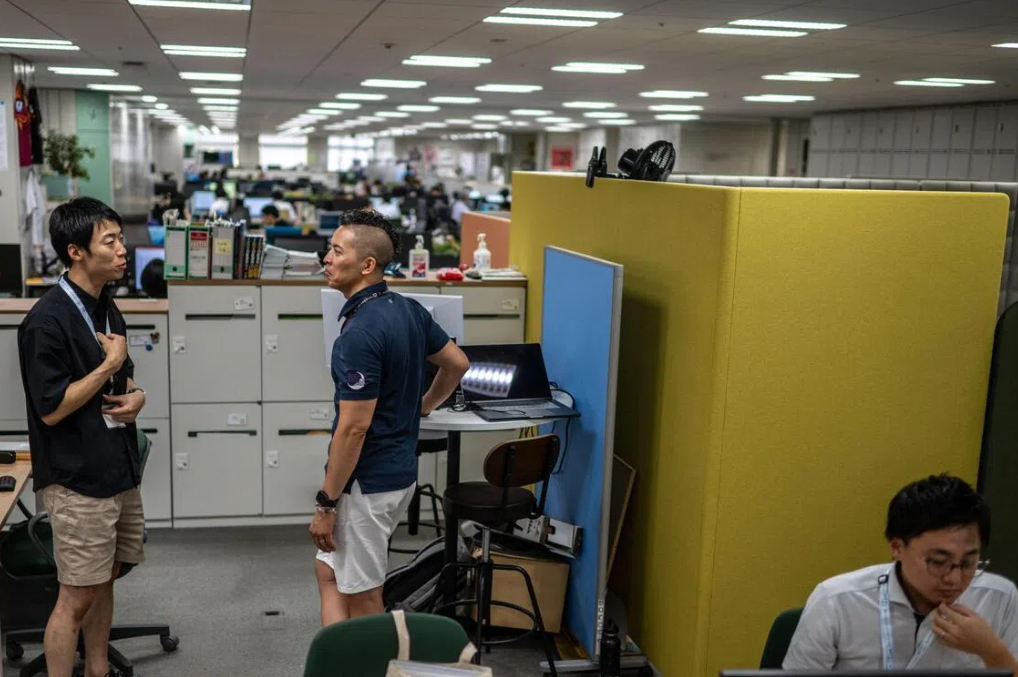
Tokyo's effort to provide relief from sweltering summer conditions through relaxed workplace dress codes has inadvertently opened a cultural fault line in Japan's traditionally formal office culture. The Tokyo metropolitan government, seeking to help workers manage extreme heat and humidity that regularly hospitalises thousands, expanded its Cool Biz initiative in April to permit casual attire including shorts, trainers, and T-shirts instead of the conventional suits and ties that have long dominated Japanese corporate environments. What officials framed as a practical measure to improve worker comfort and reduce energy consumption has instead sparked an unexpected social controversy centred on an unlikely culprit: visible male leg hair.
The phenomenon that critics have branded "leg hair harassment", or "sunehara" in Japanese, captures a peculiarly modern workplace anxiety. The term refers to the discomfort some women experience when observing male colleagues with exposed shin hair in the office setting. Tokyo environmental official Noboru Watanabe attempted to position the initiative as non-prescriptive, telling the BBC that authorities simply wanted to "give people more options in the severe heat, not tell them what to wear", and asserting that no issue should arise provided office attire remained inoffensive to colleagues. Yet determining the boundary between appropriate and inappropriate casual wear has proven considerably more nuanced than policymakers anticipated.
A June survey conducted by Gorilla Clinic, a chain specialising in men's cosmetic treatments, provides quantitative evidence of the resistance the initiative has encountered. The poll found 53.5 per cent of respondents opposed wearing shorts to work, whilst 46.5 per cent expressed support. Notably, concerns about body shape and body hair emerged as primary objections among opponents, with the clinic reporting that female respondents significantly outnumbered male respondents in the survey cohort. This gender skew suggests women may harbour greater reservations about witnessing extensive leg hair exposure in proximity to standard office fixtures like photocopiers and meeting tables. The findings reveal that acceptance of casual summer attire remains far from universal, even among workers who might hypothetically benefit from relief during Japan's brutal seasonal heat.
The controversy has extended beyond abstract debate into practical reality, creating newfound anxieties amongst male employees. Akifumi Funatsu, a director at Gorilla Clinic, reports that the clinic has experienced increased demand for laser hair removal services amongst male clients who frame the treatment not primarily as cosmetic enhancement but rather as a form of "social etiquette when wearing shorts". This shift in demand signals that some men have internalised concerns about colleague discomfort sufficiently to seek permanent hair removal solutions, viewing their natural leg hair as potentially offensive to others in the workplace. The development suggests that well-intentioned policy measures can inadvertently generate unanticipated social pressures and shape personal grooming decisions in unexpected ways.
Japan's journey toward more relaxed workplace fashion standards stretches back nearly two decades. The original Cool Biz campaign emerged in 2005 when Yuriko Koike, then serving as environment minister and now Tokyo's governor, introduced the scheme to encourage workers to abandon jackets and ties in favour of short-sleeved shirts. The initiative gained significant momentum when then Prime Minister Junichiro Koizumi publicly embraced the dress code by appearing without a tie or jacket, lending high-profile political endorsement to the cultural shift. This early campaign succeeded in normalising semi-casual business attire as an acceptable response to summer heat whilst simultaneously reducing air-conditioning consumption across Japan's office buildings.
Following the catastrophic 2011 earthquake and tsunami that severely strained Japan's power supply infrastructure, the government extended this philosophy further by launching "Super Cool Biz", which pushed dress code relaxation substantially further. Over the subsequent decade, casual workplace fashion gradually became entrenched, particularly within forward-thinking sectors such as technology and start-ups where traditional corporate formality had already begun eroding. The Tokyo metropolitan government's recent decision to explicitly permit shorts therefore represents a natural progression of this longer trend toward informality, yet it has collided with deeply embedded cultural expectations about appropriate professional appearance in ways the earlier iterations did not.
The timing of the expanded Cool Biz campaign reflects Japan's genuine struggle with extreme summer temperatures and the public health consequences they generate. The country regularly experiences dangerous heatwaves characterised by elevated humidity levels that severely impair the human body's ability to regulate core temperature through perspiration. Between July 6 and July 12 alone, Japan's Fire and Disaster Management Agency recorded seven deaths directly attributable to heatstroke and transported 4,580 individuals to hospitals for heat-related medical emergencies. These statistics underscore that workplace dress code decisions carry serious health implications, as appropriate clothing can meaningfully reduce heat stress and thermal strain on workers, particularly those without reliable air-conditioning access during extended outdoor work or in poorly ventilated facilities.
Government authorities have consequently promoted multiple heat-mitigation strategies beyond dress code relaxation. Officials continue emphasising the importance of hydration, air-conditioning usage, and gradual acclimatisation to elevated temperatures as fundamental protective measures. Concurrently, Japanese consumers have fuelled a booming market for innovative cooling technologies, including garments embedded with miniature fans, chemical cooling wipes designed for rapid temperature reduction, umbrellas manufactured with heat-blocking materials, and portable fan devices for personal use. These consumer-driven solutions illustrate the broader challenge Japan faces in adapting to climate patterns that increasingly strain established social and professional conventions.
The ongoing debate surrounding shorts in Japanese offices ultimately reflects deeper questions about how societies navigate conflicts between practical necessity and cultural convention. The leg hair harassment controversy, whilst superficially amusing to external observers, points toward genuine tensions within Japanese workplace culture between maintaining traditional standards of formal propriety and adapting to environmental conditions that increasingly make such standards physically uncomfortable and potentially hazardous. The resolution of this debate will likely determine not only what Japanese office workers wear during summer months but also signal broader acceptance of gradual cultural liberalisation in professional contexts. Whether Japanese corporate culture ultimately embraces visible leg hair or whether workers opt for permanent hair removal solutions to preserve conventional aesthetics remains an open question, one that encapsulates Japan's ongoing negotiation between tradition and practical adaptation.

