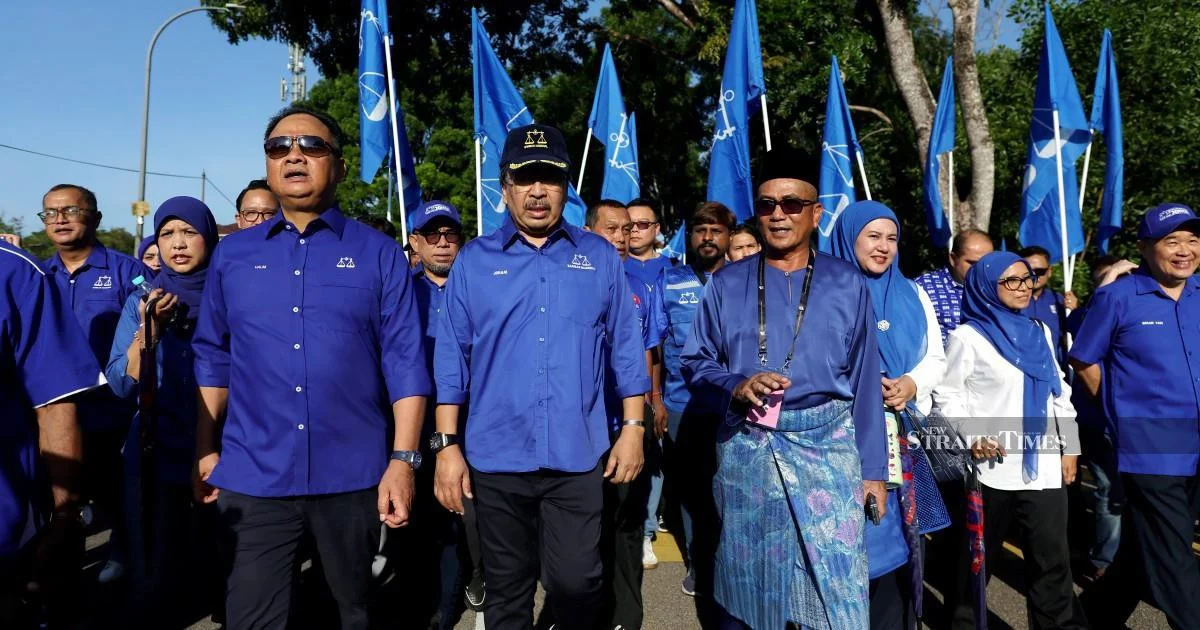
Umno vice-president Datuk Seri Johari Abdul Ghani has arrived at the Taman Pelangi Indah community hall in Johor Baru to bolster campaigning efforts for the Barisan Nasional candidate vying for the Tiram state seat. The visit signals the coalition's determination to consolidate support in this constituency as polling day approaches, with senior party leadership throwing its weight behind ground-level mobilisation.
The appearance by Johari, one of the senior-most figures in Umno's party hierarchy, reflects the strategic importance Barisan Nasional places on the Tiram division. By dispatching a vice-president to conduct direct outreach with voters, the coalition demonstrates its commitment to reclaiming or defending ground in Johor, a state that remains crucial to BN's political fortunes nationwide. Such high-level engagement also sends a message to party machinery that this particular contest warrants serious resource allocation and coordinated effort.
Johor remains a bellwether for national politics in Malaysia, given its size, demographic diversity, and historical role as either a stronghold or battleground depending on electoral circumstances. The state has witnessed significant political turbulence over recent years, with shifts in voter sentiment creating uncertainty even in traditionally safe areas. Tiram, as a state constituency, reflects the urban and semi-urban dynamics that characterise much of the Johor Baru metropolitan region, making it representative of broader voter trends affecting the coalition.
The Taman Pelangi Indah community hall serves as a focal point for grassroots mobilisation, enabling Barisan Nasional to engage directly with residents in their local setting. Such intimate campaigning venues allow political leaders to address specific community concerns—infrastructure, services, economic opportunities—that resonate most strongly with voters in residential areas. This approach contrasts with large-scale rallies and focuses instead on cultivating relationships with neighbourhood associations and local opinion leaders.
Barisan Nasional's campaign strategy in Johor appears to emphasise the coalition's track record of development and service delivery, positioning it as the experienced, establishment choice against potential challengers. By having senior figures like Johari actively visit constituencies, BN seeks to reinforce perceptions of organisational strength and active leadership investment in local matters. This personnel deployment also tests grassroots support levels and identifies areas requiring additional campaign attention.
Umno, as the backbone of Barisan Nasional, carries particular responsibility for mobilising Malay-Muslim voters who form a significant proportion of most Johor constituencies, including Tiram. Johari's participation in local campaigning demonstrates Umno's seriousness in retaining these traditional voter segments while simultaneously signalling unity within the coalition structure. The vice-president's presence also provides a platform for articulating party positions on state-level issues while reinforcing federal-level policy messaging.
The timing of such visits typically coincides with intensified campaign phases when voter attention peaks and persuadion efforts become concentrated. Johari's arrival at the community hall likely preceded or accompanied candidate speeches, meet-and-greet sessions, and distribution of campaign materials designed to crystallise voter preferences before polling. Such events also generate local media coverage and social media activity that extends the campaign message beyond immediate attendees.
For Johor residents monitoring state-level politics, the appearance of senior federal figures in local campaigns signals that their constituency matters to national leadership. This can either energise supporters of the visiting party or alert opposition candidates to competitive threat levels in their areas. The spectacle of such visits also serves a symbolic function, demonstrating party resources and internal coordination capacity to both supporters and sceptics.
Barisan Nasional's focus on methodical grassroots campaigning in venues like community halls reflects lessons learned from previous electoral disappointments. Rather than relying solely on traditional mass media or top-down messaging, the coalition appears to have embraced more localised, relationship-oriented approaches that allow for two-way dialogue with voters. This shift acknowledges that contemporary Malaysian voters increasingly expect direct engagement and responsiveness to specific community grievances rather than generic policy announcements.
The Tiram seat contest sits within the broader context of Johor state politics, where multiple constituencies present opportunities and challenges for Barisan Nasional. By concentrating leadership resources on visible local campaigning, the coalition maintains momentum while testing its organisational capabilities in real-time. Such visits also provide intelligence about voter sentiment, allowing party strategists to adjust messaging and resource allocation across other competitive seats.
For political observers across Southeast Asia, BN's approach in Johor illustrates how established coalitions adapt to evolving electoral dynamics. Rather than assuming voter loyalty or relying on historical advantages, the coalition invests in demonstrable commitment to local communities through high-level engagement. This strategy reflects understanding that modern voters reward parties perceived as attentive and responsive, particularly in urban and semi-urban areas where voter churn has increased significantly in recent years.

