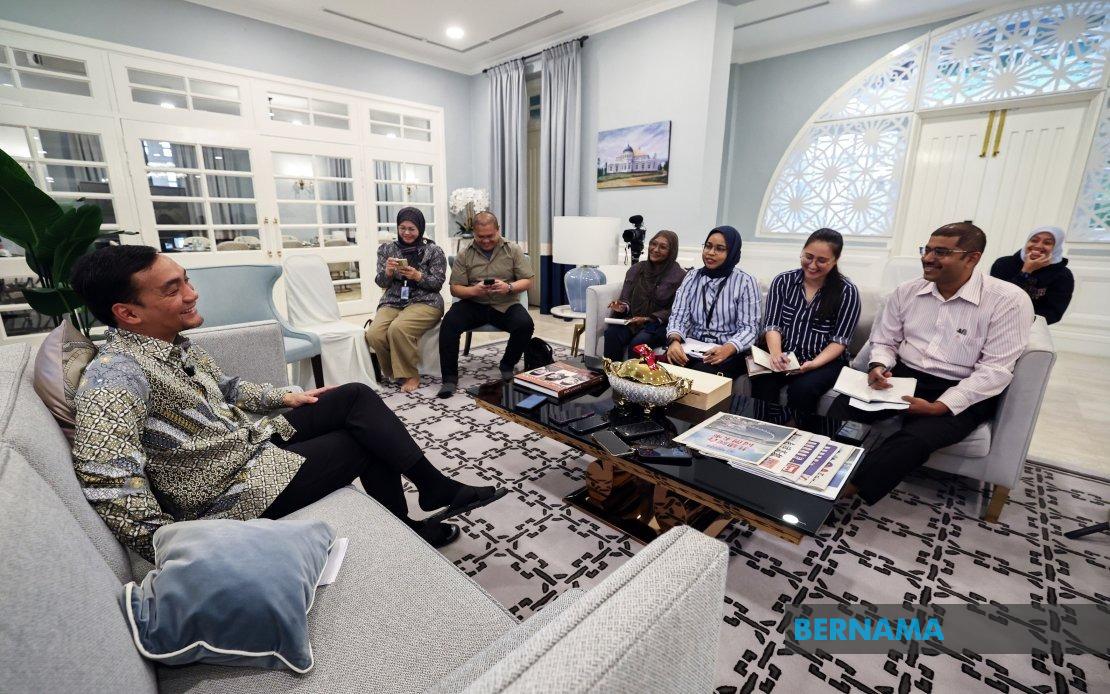
As the Johor state election approaches, Johor Barisan Nasional chairman Datuk Onn Hafiz Ghazi has delivered a message of solidarity to party members who will not be contesting as candidates in the upcoming poll scheduled for July 11. Speaking at his official residence in Saujana, the Johor Menteri Besar urged those who missed out on nomination to remain dedicated to the broader struggle of the coalition, framing rejection at this stage as merely a temporary setback rather than a career-ending blow.
The selection disappointment, Onn Hafiz explained, should not be construed as a complete closure of opportunities within the party hierarchy. He highlighted that numerous alternative avenues exist for those not chosen to stand as candidates, ranging from positions as Members of Parliament to roles within the party machinery itself. This message appears designed to maintain morale among the broader party membership during a period when only a limited number of nominations become available. The Menteri Besar's comments reflect a pragmatic understanding that every election cycle inevitably produces a cohort of ambitious individuals who will be passed over, and their continued participation remains valuable for the coalition's infrastructure and grassroots operations.
Onn Hafiz provided an update on the timeline for finalising the candidate roster, noting that the selection process had reached approximately 80 per cent completion at the time of his statement. However, he stressed that no decision becomes final or irreversible until the watikah—the official letter of appointment—physically reaches a nominated candidate. This caveat carries particular significance in Malaysian politics, where instances of withdrawals and changes have occurred even after initial selection, underscoring the fluid and sometimes unpredictable nature of candidacy determinations at the highest levels of party leadership. The Menteri Besar's emphasis on this uncertainty suggests that the selection mechanism remains subject to final approval by senior party figures, including Barisan Nasional president and UMNO president Datuk Seri Dr Ahmad Zahid Hamidi.
Regarding the criteria employed in identifying suitable candidates, Onn Hafiz outlined a framework that emphasises inclusivity across professional disciplines and age demographics. Rather than adhering to rigid templates or favouring particular career backgrounds, the selection committee has prioritized candidates with demonstrated community integration and local recognition. The successful contender must possess genuine roots within their constituency and enjoy grassroots acceptance among residents. This approach aligns with the concept of WALI candidates—an acronym representing winnable, acceptable, and likeable—a framework previously articulated by Barisan Nasional leadership to describe the ideal representative.
Age considerations, according to Onn Hafiz, deliberately occupy a secondary position in the evaluation process. Whether candidates are young, seasoned, or at intermediate stages of their careers matters far less than their capacity to effectively serve constituents. The Menteri Besar's commentary reflects a broader debate within the coalition about generational representation and the tension between cultivating fresh political talent and retaining experienced operators. His assertion that youthfulness without competence provides little value represents a more conservative position that privileges demonstrated ability over demographic characteristics, a stance that may have implications for how Johor Barisan Nasional structures its candidate pipeline.
The final determination of all candidate selections, Onn Hafiz emphasized, does not rest with individual party branches or state-level committees acting independently. Instead, major decisions require endorsement from the apex of the party structure, with Ahmad Zahid Hamidi and other senior leaders wielding decisive influence. This centralized approach ensures uniform standards across constituencies and prevents regional factions from capturing the nomination process, though it can also generate frustration among grassroots activists who feel disconnected from decision-making mechanisms.
Onn Hafiz identified young voters and first-time participants as a critical demographic for determining the outcome of the Johor contest. He noted that individuals below age 40 constitute between 20 and 40 per cent of Johor's population, a proportion that has not escaped the attention of elected representatives and party strategists. The acknowledgment that Barisan Nasional recognizes the importance of younger voters suggests a deliberate effort to engineer candidate selections and messaging that resonate with this cohort, though the actual impact of such outreach remains subject to electoral verification.
The Menteri Besar extended his appeal for voter participation to Johoreans employed across the causeway in Singapore, a population that represents a meaningful constituency with particular economic and social interests. By explicitly encouraging these voters to exercise their franchise, Onn Hafiz signalled recognition of the economic interdependence between Johor and Singapore and the legitimate stake that cross-border workers possess in regional governance. The emphasis on turnout reflects a broader understanding that democratic legitimacy derives partly from the breadth of participation, with higher engagement producing governments with stronger claims to represent community sentiment.
Onn Hafiz articulated a defence of the Johor state government's record under his leadership, claiming consistent effort to deliver services and benefits to residents. His statement that the administration stands ready to continue such service should it receive renewed electoral endorsement casts the upcoming election as a referendum on performance rather than a contest between radically different visions. This framing is standard for incumbent administrations, which typically emphasize continuity and demonstrated competence over revolutionary transformation.
The electoral timeline establishes clear parameters for the selection drama's resolution. Nomination day on June 27 will definitively confirm which individuals have received their watikahs and will contest the election, with early voting scheduled for July 7 and main polling day on July 11. These dates create a compressed window during which the party must settle remaining selections, campaign intensively, and prepare voters for a significant democratic exercise. For Johor Barisan Nasional members awaiting final decisions, the June 27 deadline represents a moment of truth when tentative hopes become either confirmed realities or definitive disappointments, making Onn Hafiz's exhortation to maintain steadfast commitment all the more pressing.