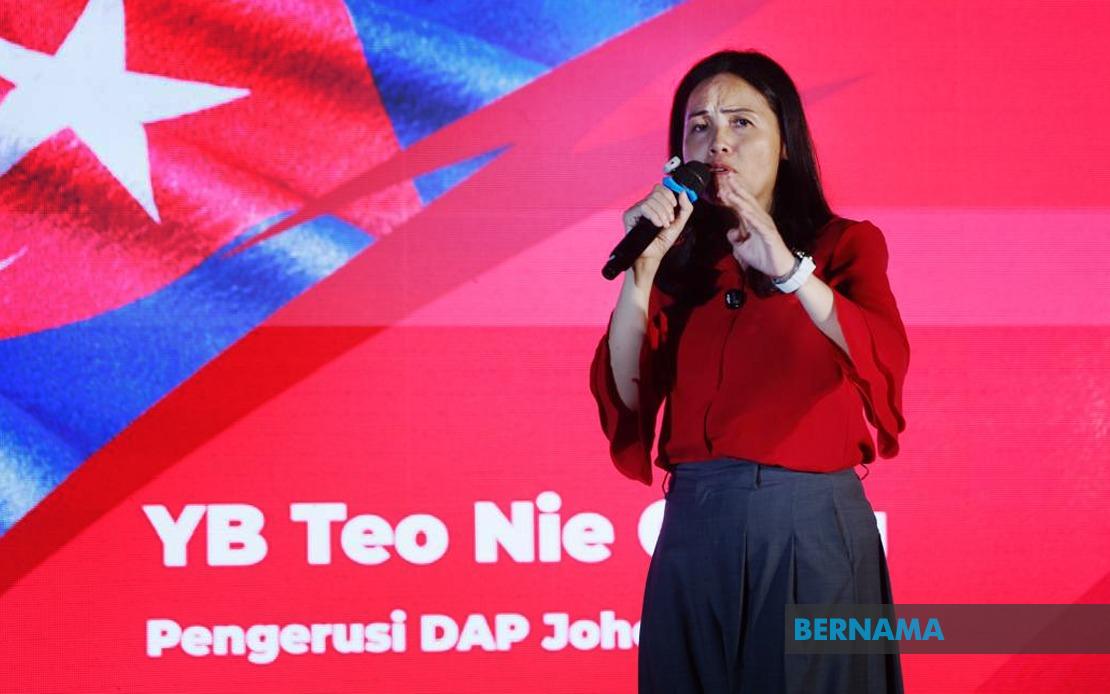
Johor DAP chairman Teo Nie Ching has raised sharp questions about the underlying motives behind the Johor state government's decision to introduce appointed state assemblymen positions, suggesting the mechanism lacks democratic legitimacy and could erode public trust in the legislative process. Speaking at a Pakatan Harapan rally in Paloh on July 9, Teo, who also chairs the DAP Women's wing, argued that allowing unelected representatives to sit in the state assembly bypasses a fundamental principle of representative democracy—the requirement that those holding power must first earn a mandate from voters.
The controversy centres on legislation passed by the Johor State Legislative Assembly on May 7, which amended the state enactment to permit the appointment of up to five assemblymen. The government framed this move as necessary to strengthen the assembly's functional capacity and diversify its composition. However, Teo's intervention suggests this justification has not persuaded the opposition, particularly regarding who will actually benefit from these appointments and under what criteria. Her pointed questioning—"If the appointed assemblymen positions are not meant for those who lost in the state election, then who are they really for?"—implies suspicions that the mechanism might serve partisan purposes.
Teo's concern touches on a broader tension within Malaysian politics: the proper balance between appointed and elected representation. While the federal level has long utilised appointed senators to bring in expertise and ensure geographic representation, state-level assemblies have traditionally comprised exclusively elected members. The Johor innovation represents a departure from this convention, and critics worry it could set a precedent that weakens state legislatures' democratic character. Teo particularly questioned whether these appointments might reward political allies or those from parties like PAS, which she noted had provided significant support to the government in the recent election cycle.
Her remarks carry additional weight because they come from within the Unity Government itself, the federal coalition that includes DAP alongside UMNO, Amanah, and other parties. This internal criticism underscores legitimate questions about governance standards that transcend partisan divisions. A deputy communications minister raising transparency concerns suggests these are not merely opposition talking points but reflect genuine divisions within the coalition about how far institutional innovation should extend. The fact that Teo's comments occurred at a campaign event ahead of Saturday's election also indicates that the appointed assemblymen issue has become a live political question for voters considering which parties merit their support.
Despite her criticisms of the appointee mechanism, Teo defended the Unity Government's broader reform agenda, attempting to separate concerns about democratic process from her party's broader achievement record. She pointed to concrete educational improvements implemented during the current administration's tenure, including the policy guaranteeing matriculation placement for all SPM students achieving 10A grades, regardless of socioeconomic background. This represents a significant equity reform, as previously such placements could be constrained by quotas or other limiting factors. Similarly, she highlighted the government's expansion of educational access for students holding the Unified Examination Certificate, an important step for the significant portion of Malaysian students enrolled in Chinese independent schools.
Financial allocation increases for Chinese independent schools further illustrate the government's policy direction. Funding rose to RM20.16 million in the current year from RM12 million in 2019—a 68 percent increase that signals genuine commitment to non-vernacular education institutions, an issue traditionally important to DAP's base. These reforms signal the Unity Government's attempt to translate its multitethnic coalition composition into tangible policy outputs that benefit diverse communities. For Malaysian voters assessing political performance, such specifics matter more than rhetorical claims, as they indicate whether parties in power actually deliver on equitable administration promises.
Teo's framing of these achievements as "systemic reforms aimed at leaving Malaysia and future generations with a stronger system" emphasises that the Unity Government views its work as foundational rather than superficial. However, her simultaneous acknowledgement that the government "does not score 100 percent" and "has plenty of room for improvement" introduces an important note of candour often absent from political messaging. This balancing act—defending substantive achievements while acknowledging limitations—reflects the political reality that voters in competitive democracies expect both accomplishment and humility from leaders.
The timing of these comments, with approximately 2.7 million voters preparing to elect 56 state representatives on Saturday, gives these remarks electoral significance. The Johor state election represents a crucial test for the Unity Government's ability to maintain its coalition while delivering on reform promises. For DAP, which contests the election as part of Pakatan Harapan, the Paloh campaign event provided an opportunity to make its particular contribution to the coalition's agenda visible to voters—namely, focusing on educational equity and institutional reform while maintaining pressure for democratic standards.
Teo's comments about the appointed assemblymen controversy also touch on a deeper concern within Malaysian democracy: the tendency for governments to accumulate power tools that, while perhaps justified in specific contexts, could be misused by future administrations with less benign intentions. Once such mechanisms exist, they remain available to whoever holds office next. This forward-looking concern about institutional precedent, rather than just immediate partisan advantage, likely motivates some of the criticism from within the coalition itself.
The Johor state election outcome will partly reflect how voters weigh these competing considerations: appreciation for concrete policy improvements against concerns about democratic process integrity. For parties like DAP and Pakatan Harapan, the challenge lies in maintaining coalition unity while remaining willing to critique specific policies—a balancing act that becomes harder when election day approaches and party discipline usually tightens. Teo's Paloh remarks suggest that even as the election nears, some senior figures within the coalition remain committed to public accountability conversations, whether that serves their political interests or not.

