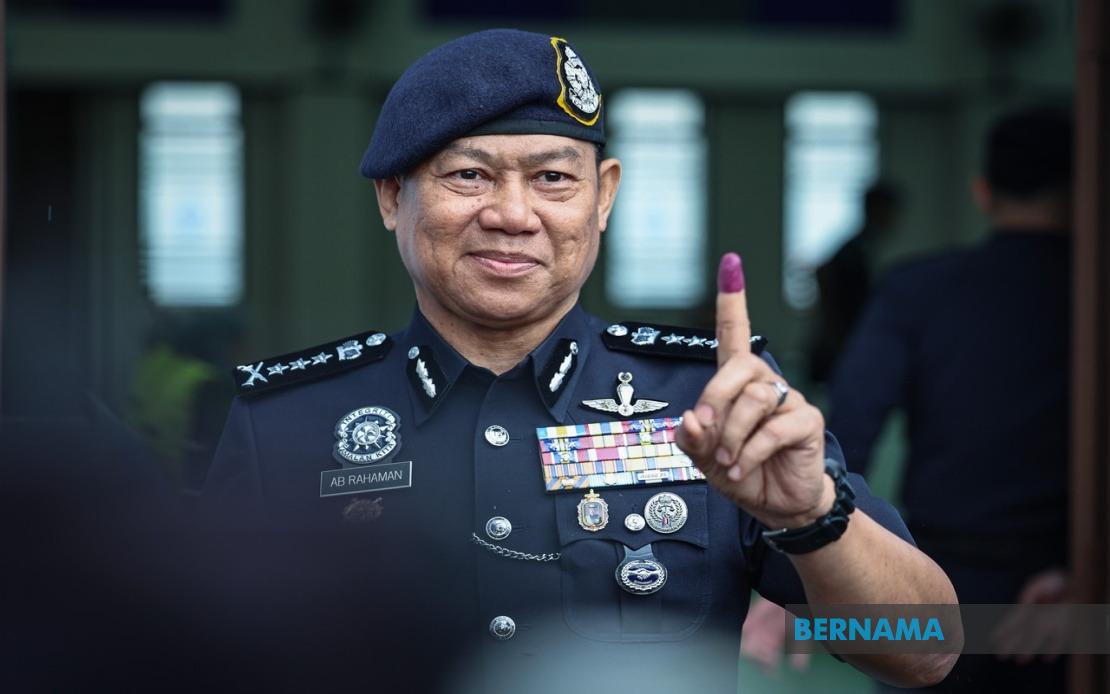
The 16th Johor state election saw steady participation among security personnel during early voting on July 7, with 4,257 police officers—representing 36.3 per cent of those eligible—casting their ballots by 10.30 am. The early voting arrangement for law enforcement and military personnel ensures that officers who may be on duty during the main polling day on Saturday can still exercise their democratic right. This mechanism has become standard practice in Malaysian elections, recognising the operational demands placed on security forces during electoral events.
Johor police chief Datuk Ab Rahaman Arsad reported that voting operations across all 53 early polling centres statewide proceeded without disruption or irregularity. The absence of reported incidents underscores the methodical preparations undertaken by election authorities and police in managing the early voting process. Speaking at the Johor Police Contingent Headquarters where he himself voted, Ab Rahaman stressed that the integrity of the voting process remained paramount, with officials monitoring each centre to ensure compliance with electoral procedures and voter conduct.
Early voting facilities accommodated 20,607 registered personnel across 64 polling centres that opened at 8 am. The staggered closure times—between noon and 6 pm depending on location and voter numbers—reflected efforts to manage crowd flow and administrative efficiency. Unlike a single voting day, the extended early voting schedule allowed authorities to manage capacity constraints while maintaining order. This phased approach has historically reduced congestion and potential complications that can arise when large numbers of voters converge simultaneously.
The broader context of this state election involves 172 candidates competing for 56 seats, with more than 2.7 million registered voters eligible to participate in Saturday's polling. The Johor election carries significance beyond state politics, given the state's size, economic importance, and traditionally decisive electoral outcomes. Results here often signal broader political trends affecting Malaysian politics and coalition dynamics at both state and federal levels. The election also reflects ongoing competition between Barisan Nasional and opposition coalitions for control of state government.
Campaign-related incidents have drawn police attention during the pre-election period, with law enforcement recording numerous reports centering on vandalism of campaign materials. Party flags, billboards, and other promotional items became focal points of property damage complaints filed during the campaign. While such incidents are relatively minor compared to serious electoral violations, they nonetheless indicate the heated political atmosphere and reflect tensions between competing political organisations vying for voter attention and support.
A significant development involved police investigations into statements made by former Johor State Assembly Speaker Datuk Dr Mohd Puad Zarkashi regarding alleged interference by the Johor Palace in the dissolution of the state legislative assembly. Police had recorded 153 reports nationwide concerning these claims as of the afternoon of July 7. The investigation into Mohd Puad's allegations remained ongoing at the time of the early voting, highlighting sensitivities around the constitutional and institutional dimensions of state governance. Such allegations carry implications for understanding the relationship between hereditary rulers, state executives, and constitutional procedures in Malaysian federalism.
The smooth conduct of early voting reflects established protocols for managing security personnel participation in elections. Malaysian authorities have developed systematic procedures governing early voting to accommodate workers in essential services—including police, military, and healthcare personnel—who cannot attend regular polling stations. These arrangements strengthen electoral legitimacy by ensuring comprehensive participation across all demographic and occupational categories, preventing scenarios where eligible voters face practical impediments to casting ballots.
Johor's electoral process represents a microcosm of Malaysia's sophisticated electoral administration. Despite periodic controversies surrounding electoral boundaries, campaign conduct, and political allegations, the mechanics of voting—including early voting arrangements—generally function smoothly. The July 7 early voting day demonstrated this operational competence, with authorities managing logistics across a geographically dispersed state without major complications. Such consistency matters for maintaining public confidence in electoral processes and democratic institutions.
The 2.7 million eligible voters in Johor represent approximately ten per cent of Malaysia's total registered electorate, underscoring the state's political weight. A state election here typically attracts national attention from political parties, media, and analysts seeking insights into voter sentiment and coalition performance. Results often receive interpretation as bellwethers for potential federal-level political developments, making Johor elections consequential beyond state-level governance concerns.
As authorities prepared for Saturday's main polling day, the early voting results provided preliminary indicators of participation rates and operational readiness. The 36.3 per cent turnout among police personnel suggested reasonably high engagement, though final aggregate turnout figures would only emerge after all centres completed voting and officials compiled comprehensive statistics. These early voting mechanics ultimately serve to facilitate democratic participation while maintaining the operational capacity of security and essential service personnel to perform their duties during the election itself.

