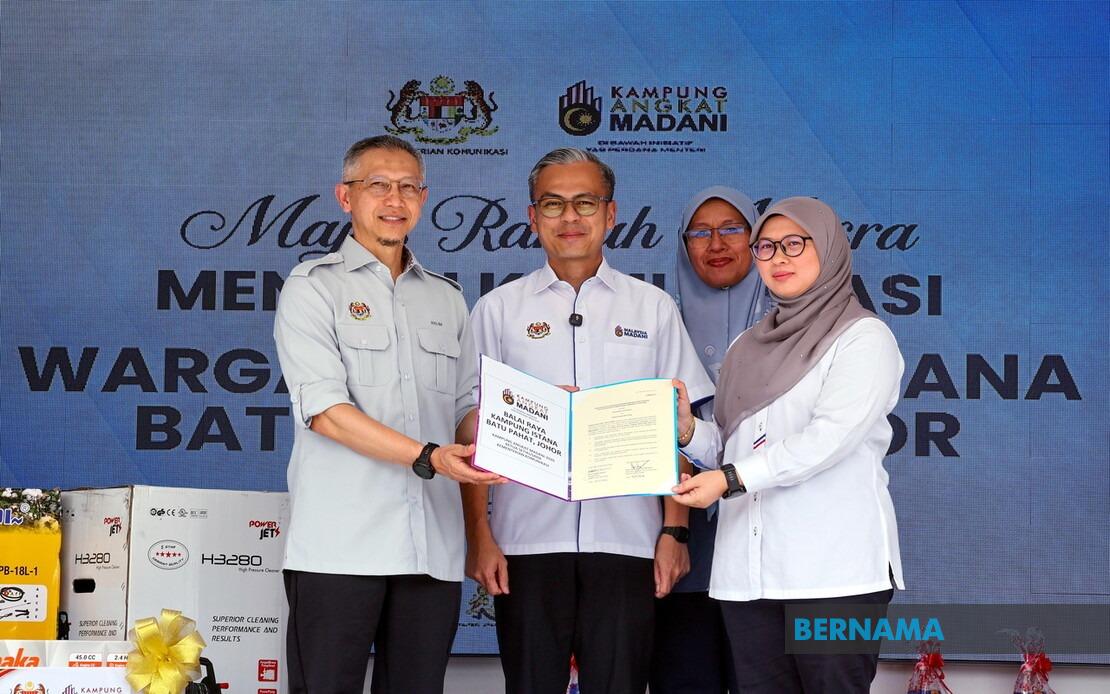
The upcoming Johor state election should be viewed as a critical juncture for voters to select leaders who can genuinely improve the state's prospects, not as a personal endorsement of any single figure, according to Pakatan Harapan Communications Director Datuk Fahmi Fadzil. Speaking to reporters in Batu Pahat on July 4, Fahmi distanced the coalition from what he characterised as misleading narratives that attempt to interpret electoral outcomes as proxy votes for particular individuals, calling such framings a disservice to the democratic process and voter intelligence.
Fahmi's remarks came in direct response to statements by Datuk Nazifuddin Mohd Najib, who had suggested that a Barisan Nasional victory in the July 11 election would constitute public backing for his father, former Prime Minister Datuk Seri Najib Razak, to receive a pardon. Such claims, Fahmi indicated, represent exactly the kind of personalised political narrative that should alarm Malaysian voters who understand their ballots carry far greater significance than individual aspirations. The Communications Minister stressed that electoral choices must be anchored in substantive governance concerns rather than personality-driven considerations, particularly when state development and national stability hang in the balance.
The broader implication of Fahmi's position reflects growing concern within Pakatan Harapan that opposition parties—specifically Barisan Nasional—may be attempting to leverage the Johor election as a vehicle for rehabilitating controversial political figures. By reframing the contest as purely about state welfare and capable administration, Fahmi sought to redirect voter attention toward evaluating each party's policy platforms, track records in governance, and vision for Johor's economic and social development over the next five years. This rhetorical shift acknowledges the sensitivity surrounding criminal convictions and the pardon question while refusing to allow those issues to dominate campaign discourse.
Fahmi also addressed the fracturing of what was once considered unshakeable political support bases in Malaysian elections. He contended that no political party should assume public backing is permanent or automatic, emphasising that voter allegiance must be continuously earned through demonstrable results and responsive leadership. This observation directly challenges the concept of "fixed deposits"—traditionally reliable voter blocs that parties could count on regardless of performance. Fahmi cited the defection of former Rengit assemblyman Datuk Dr Mohd Puad Zarkashi from Umno's assumed orbit as evidence that even long-established political alignments are now vulnerable to erosion when voters perceive superior alternatives.
The phenomenon of cross-party endorsements that Fahmi highlighted underscores significant shifts in Johor's political landscape. His reference to Bersatu members publicly supporting the Pakatan Harapan candidate in Sri Medan, Hishamuddin @ Misrin Ishak, combined with Datuk Puad Zarkashi's endorsement of the PH Rengit candidate, suggests that factional divisions within the opposition coalition remain unhealed and may benefit the ruling bloc. These individual defections, while potentially small in numerical terms, carry symbolic weight in signalling that Pakatan Harapan is successfully attracting figures with established political credentials and community influence who previously aligned with Barisan Nasional or Bersatu. Such developments complicate the traditional opposition-government binary that characterised Malaysian politics for decades.
Fahmi's confidence in Pakatan Harapan's expanding appeal rested partly on his assertion that Prime Minister Anwar Ibrahim's leadership has strengthened national economic recovery, with positive spillover effects for Johor's economy. This argument attempts to link macroeconomic performance—a tangible benefit affecting voters' daily lives and livelihoods—to the coalition's governance record, making the case that supporting PH represents enlightened self-interest rather than partisan tribalism. For Johor voters, particularly those in urban centres and commercial hubs, the nexus between stable governance, investor confidence, and employment opportunities provides concrete reasoning to evaluate Pakatan Harapan's claims seriously rather than reflexively supporting traditional power structures.
The election itself represents a substantial undertaking, with 172 candidates vying for 56 state assembly seats across Johor's diverse constituencies spanning urban, suburban, and rural areas. The sheer scale of contestation ensures that voters face genuine meaningful choices rather than predetermined outcomes, and individual personalities and local issues will likely weigh heavily in determining electoral results. Early voting scheduled for July 7 preceding the main polling day on July 11 provides additional scheduling flexibility that may influence voter turnout patterns and campaign dynamics in the final week.
Fahmi's intervention in the campaign carried additional symbolic significance given his position as Communications Minister, suggesting that the federal government views the Johor election as consequential for national political trajectories beyond the state itself. His presence at a meet-and-greet session in Kampung Istana alongside PH candidate for Penggaram Felicia Poh Rui Ling and Communications Ministry Secretary-General Datuk Abdul Halim Hamzah underscored the coalition's investment of resources and high-level attention in securing victory. The focus on grassroots engagement and direct voter interaction reflects recognition that modern campaigns cannot rely solely on traditional media channels or top-down messaging but require sustained contact with constituents addressing their specific concerns and priorities.
The evolution of voter behaviour that Fahmi implicitly acknowledged—the weakening of predictable voting blocs and the emergence of more volatile, issue-responsive electorates—suggests that Malaysian politics is undergoing deeper structural realignment than surface-level coalition mathematics might indicate. Voters increasingly evaluate parties based on perceived competence, anti-corruption credentials, and capacity to deliver tangible improvements in living standards, service quality, and economic opportunity. This shift, while still incomplete and uneven across regions, creates openings for political forces willing to engage authentically with voter concerns and demonstrate genuine commitment to addressing them. Pakatan Harapan's strategy in Johor appears premised on the calculation that emphasising governance capability over personality cults and responding to evidence of electoral volatility represents the most promising path to consolidating support across diverse communities and demographic groups.

