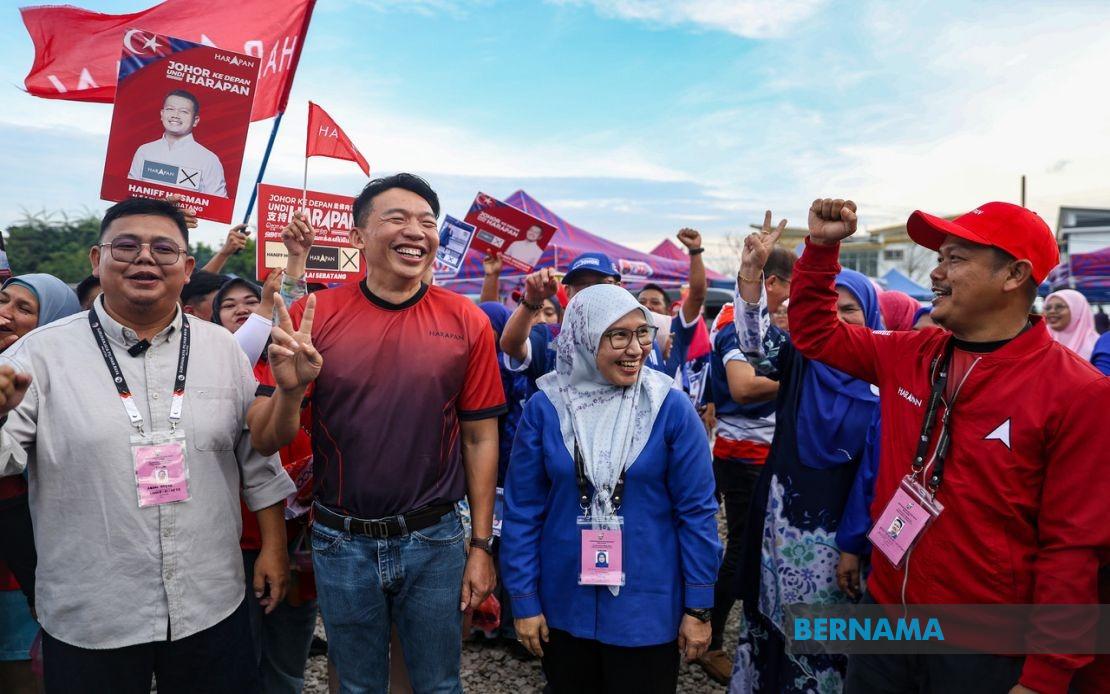
The Johor state election campaign took on a notably civil tone this week when four candidates representing rival political alliances crossed paths at the Taman Megah night market in Pontian, offering a refreshing reminder of how electoral competition can coexist with personal respect and neighbourly conduct. The encounter brought together three Pakatan Harapan representatives—Haniff @ Ghazali Hosman contesting the Pulai Sebatang seat, Abd Razak Ismail standing in Benut, and Cheah Chee Hong competing for Kukup—who were conducting joint campaigning activities when they encountered Barisan Nasional's Hasrunizah Hassan, also campaigning for the Pulai Sebatang constituency at the same venue.
What could have developed into an awkward confrontation between campaign teams flying opposing red and blue colours instead unfolded as a genuinely warm exchange. The candidates greeted each other at a junction within the bustling night market, their interaction soon drawing the curious gaze of shoppers and traders who momentarily paused their activities to observe this unusual scene of political opponents demonstrating camaraderie. Rather than retreating or maintaining frosty distance, both camps proceeded to continue their respective campaign efforts, engaging with the local community in a professional and cordial manner.
The incident underscores a broader narrative about the conduct of the Johor state election, now less than two weeks away. Speaking to media representatives after the encounter, Haniff emphasised that the peaceful nature of the campaign reflected democratic ideals being upheld across the state. He characterised the meeting with his direct opponent as entirely natural and welcomed, noting that personal relationships between political adversaries need not be adversarial simply because they represent different coalitions. His comments highlighted that Pontian's campaign environment has remained free from disruptions or hostile confrontations, maintaining a tone of respectful competition.
Cheah reinforced this sentiment while simultaneously pushing his coalition's electoral message, expressing pride at campaigning alongside his Pakatan Harapan colleagues across the three constituencies. He seized the platform to appeal directly to voters in Pulai Sebatang, Benut, and Kukup, urging them to continue their support for the opposition coalition's vision for Johor. His appeal represented the balance many candidates now attempt to strike—maintaining competitive vigour while refusing to descend into personal animosity or character attacks.
From the Barisan Nasional perspective, Hasrunizah similarly characterised such encounters as routine occurrences within mature electoral systems, rather than exceptional or problematic events. Her framing reflected an important shift in how some Malaysian political figures are approaching state and national campaigns, moving away from the toxic polarisation that has occasionally marked recent electoral cycles. She explicitly stated that despite the intensifying campaign activities and heightened political messaging, Johor has maintained an orderly environment without significant incidents or violations of electoral conduct standards.
Hasrunizah's statement carries particular weight given that Barisan Nasional and its allied Maju Johor coalition represent the incumbent state government facing serious electoral challenge. Rather than adopting a defensive posture or attempting to delegitimise opposition campaigning, her response demonstrates confidence in the coalition's electoral prospects while acknowledging the legitimacy of competitive politics. Her observation that such meetings actually energised her team's campaign efforts suggested that confrontation-free competition paradoxically strengthens rather than weakens electoral enthusiasm.
The Pontian encounter occurs within the context of a state election scheduled for July 11, with early voting commencing on July 7. This timeline places the incident roughly midway through the formal campaign period, a moment when electoral temperature typically rises as polling day approaches. That the candidates chose civility rather than conflict at this crucial juncture suggests either confidence in their respective positions or genuine commitment to maintaining democratic standards regardless of electoral stakes. Either way, the scene provides a counternarrative to the increasingly acrimonious tone characterising politics elsewhere in Malaysia and regionally.
Johor's relative calm during this election cycle stands in contrast to electoral campaigns in other Malaysian states, where candidates have occasionally engaged in heated confrontations, social media attacks, and public questioning of opponents' character or loyalty. The state's apparent commitment to what might be termed competitive civility offers lessons for political culture more broadly in Southeast Asia, where rising democratic participation sometimes accompanies rising incivility. Malaysia particularly, as a diverse multiethnic and multireligious democracy navigating complex political transitions, benefits from examples of opponents disagreeing without becoming disagreeable.
The night market setting itself carries symbolic significance. Night markets represent spaces where Malaysians from all backgrounds and political persuasions gather for commerce, socialisation, and community connection. That candidates recognised these venues as spaces for respectful engagement rather than territorial confrontation suggests evolving understanding of how to conduct electoral politics in shared public spaces. For voters observing these interactions firsthand, such scenes may reinforce democratic principles and voter agency—the sense that electoral choices carry genuine weight while remaining rooted in respect for fellow citizens.
For Johor voters, the stakes of this election remain substantial, as the state government controls significant resources and determines policy direction on numerous local issues affecting daily life. Yet the apparent decoupling of competitive intensity from personal hostility means voters can engage with electoral choices on substantive grounds rather than reacting to inflammatory rhetoric or staged controversies. The conduct demonstrated at Taman Megah suggests that even within closely fought electoral contests involving multiple constituencies and competing visions for governance, candidates can maintain professional relationships that ultimately serve democratic institutions.
The July 11 election will determine whether Barisan Nasional and Maju Johor retain control of the state government or whether Pakatan Harapan can execute an electoral breakthrough in a state the opposition coalition has not controlled in recent decades. The campaign encounters like the one in Pontian will likely remain largely symbolic, with electoral outcomes ultimately determined by voter choices on policy, performance, and political direction. Nevertheless, the tone established during this campaign period—emphasising peaceful competition and mutual respect—sets an important precedent for how Malaysian elections can be contested without sacrificing democratic civility or social cohesion.

