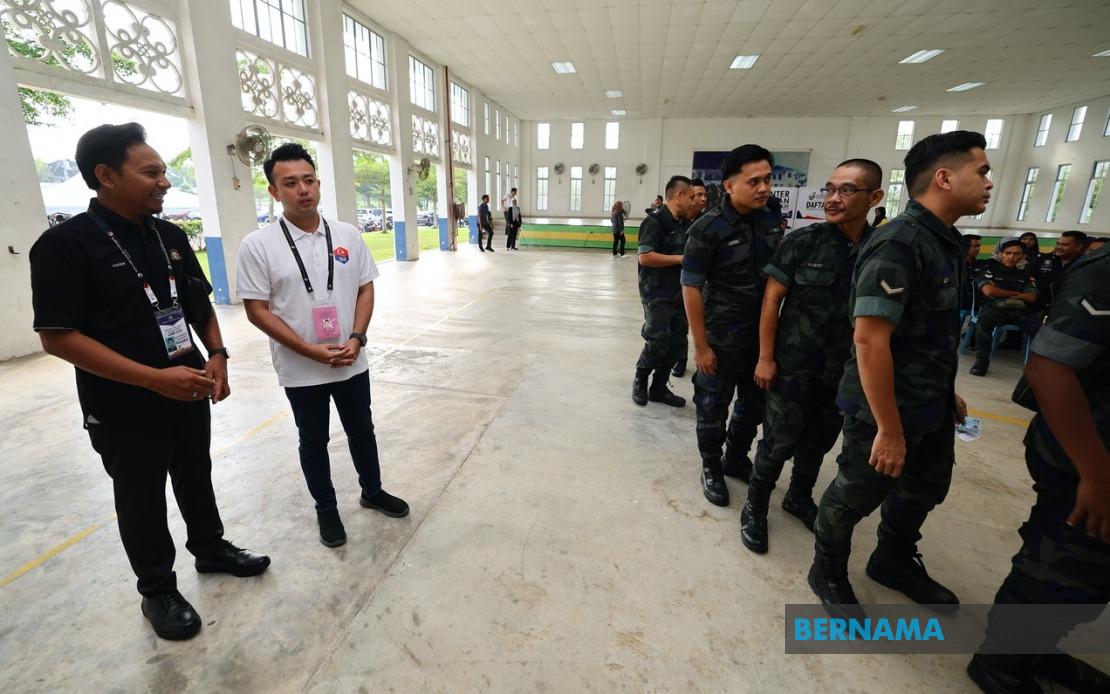
The Johor state election entered its crucial final stretch on Friday as candidates across the political spectrum paused their campaign activities to witness the early voting process for military and police personnel. The move reflected both the regulatory requirements and political importance of ensuring transparent elections, with representatives from Pakatan Harapan, Barisan Nasional and Perikatan Nasional making appearances at designated polling centres throughout the day. The early voting mechanism serves an essential function in Malaysian electoral cycles, allowing security force members whose operational duties may conflict with Saturday's polling day to exercise their democratic rights beforehand.
In the Layang-Layang constituency, all three contenders demonstrated their commitment to electoral integrity by converging at the 5th Battalion General Operations Force Camp in Simpang Renggam to observe proceedings. Guna Balakrishnan representing the opposition Pakatan Harapan coalition was joined by Barisan Nasional's Chua Jian Boon and Perikatan Nasional's Abd Mutalip Abd Rahim, creating a rare moment of political cooperation centred on the sanctity of the voting process. This convergence of rival candidates at a single location underscored the shared recognition that transparent elections strengthen democratic institutions regardless of partisan outcome.
Similarly, the Tenggaroh constituency's three candidates — Muhamad Amerul Muhamad of Perikatan Nasional, Mohd Youzaimi Yusof from Barisan Nasional and Md Yusof Dawam representing Pakatan Harapan — assembled at the Iskandar Camp polling centre in Mersing to monitor voting operations. These coordinated observations across multiple constituencies demonstrated a systematic approach by the contending parties to verify that electoral procedures met established standards. The presence of multiple candidates simultaneously allowed for collective verification and reduced opportunities for allegations of irregularities that might emerge from unilateral monitoring.
Higher-profile candidates also participated in the oversight exercise, with Lim Chin Eng, the election's oldest contender standing for Perikatan Nasional, attending the Johor Contingent Police Headquarters location. Muhammad Faezuddin Mohd Puad, the Pakatan Harapan candidate for Kempas, observed voting at Kempas Police Station, while Datuk Jafni Md Shukor, Barisan Nasional's representative in the Bukit Permai seat, was present at Kulai District Police Headquarters. The geographical spread of candidate observations across different districts reflected the statewide nature of these elections and the importance of ensuring procedural consistency throughout Johor.
Military and police leadership also maintained visible presence at early voting locations, reinforcing institutional commitment to electoral processes. Army Chief General Tan Sri Azhan Md Othman and 21st Special Service Group commander Major General Datuk Ahmad Shuhaimi Mat Wajab jointly visited the Iskandar Camp facility, signalling the armed forces' institutional backing for transparent voting procedures. Meanwhile, Johor police chief Datuk Ab Rahaman Arsad cast his own ballot at Dewan Dato Onn within the Johor IPK complex, demonstrating that security leadership participated directly in the democratic process they were tasked with protecting.
Despite logistical challenges, the early voting process proceeded without disruption throughout Friday. Brief rainfall at several centres failed to impede the orderly flow of security personnel who arrived in scheduled batches to fulfil their voting responsibilities. Election Commission officers maintained strict adherence to procedural protocols, with voting commencing as early as 8 am and continuing through staggered closing times between noon and 6 pm depending on individual centre capacity and registered voter numbers. This methodical approach ensured that all eligible personnel could participate regardless of operational scheduling constraints.
The scale of early voting reflected the substantial security force presence throughout Johor. A combined total of 20,607 registered early voters comprised 8,544 Malaysian Armed Forces members and their spouses alongside 12,063 police personnel and their spouses. These figures underscore both the size of Johor's security establishment and the logistical complexity of accommodating military and police voting requirements separately from general election day procedures. The substantial numbers made early voting not merely a convenience but an operational necessity for maintaining security force readiness.
To facilitate these early voters, the Election Commission established 64 dedicated polling centres operating under standardised conditions and procedures. The infrastructure investment in separate early voting facilities demonstrated institutional recognition that security personnel's availability for general election day could not be assured due to operational commitments. This separation allowed both security forces and civilian voters to participate fully without creating bottlenecks or conflicts at general polling stations scheduled for Saturday.
The broader electoral context involves 172 candidates competing across 56 seats in the Johor State Legislative Assembly, making this a significant contest within Malaysia's devolved political structure. State elections, while often overshadowed by federal politics, wield substantial influence over local development priorities, land administration and state-level economic policy. Johor's geographic size, economic importance and historical political significance made its state assembly composition consequential for the broader political trajectory of peninsular Malaysia. The competitive nature of the three-way contest between Pakatan Harapan, Barisan Nasional and Perikatan Nasional reflected the fluidity of Malaysian coalition politics in the post-2018 era.
The systematic candidate observation of early voting procedures served multiple purposes beyond simple regulatory compliance. Such visible presence reassured respective party supporters that electoral processes were being monitored by their representatives, potentially reducing post-election contestation over results legitimacy. Simultaneously, the participation of opposition and ruling coalition candidates at identical locations modeled democratic norms of accepting shared institutional frameworks. For Malaysian voters accustomed to electoral controversies and polarised political narratives, Friday's coordinated candidate observations offered a valuable counternarrative of political maturity and institutional respect.
Saturday's polling would ultimately determine which coalition achieved dominance in Johor's state assembly, with potential implications for national political calculations given Johor's size and strategic location. However, the preceding day's orderly early voting process, monitored transparently by competing candidates and verified by security leadership, demonstrated that Malaysia's electoral institutions retained capacity for procedural integrity and political cooperation despite contemporary partisan tensions. The peaceful observation of voting mechanics suggested that whatever outcome emerged on Saturday would rest on institutional legitimacy that all major players had visibly endorsed.

