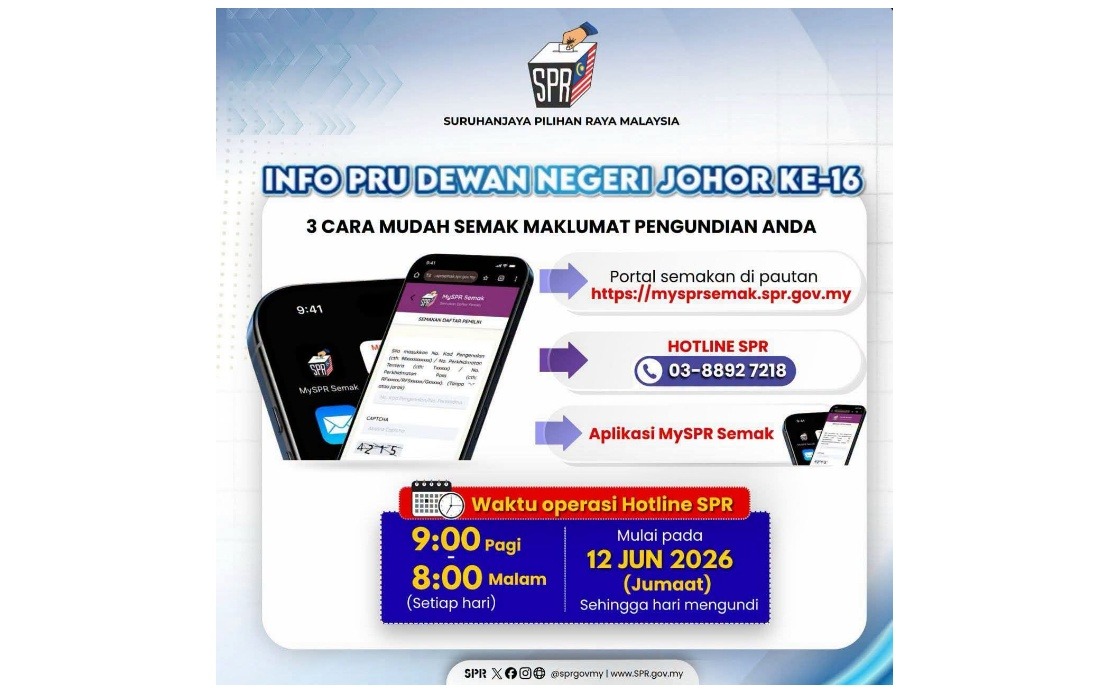
The Election Commission has issued a formal reminder to voters in Johor ahead of this Saturday's state election, encouraging the 2.7 million registered voters expected to participate to verify their assigned polling locations and voting information beforehand. The advisory, issued on Friday, represents a standard pre-election step aimed at reducing confusion and delays on polling day itself, which falls on July 11.
Voters seeking to confirm their details have two convenient options available through the EC's official infrastructure. The MySPR Semak portal and its associated mobile application both provide instant access to individual polling centre assignments and relevant voting stream information. This digital approach reflects Malaysia's ongoing modernisation of electoral administration, enabling citizens to complete verification checks from their homes or mobile devices rather than making in-person inquiries at local authorities.
The 16th Johor state election represents a significant contest within Malaysia's political landscape, involving a diverse field of contenders vying for representation in the state assembly. A total of 172 candidates are competing across 56 state seats, demonstrating considerable competition within the democratic process. This candidate-to-seat ratio illustrates the intensity of the contest and the range of political options available to voters in the state.
The major political coalitions have fielded comprehensive slates of representatives. Pakatan Harapan and Barisan Nasional each nominated 56 candidates, effectively contesting all available seats and reflecting their status as Malaysia's two largest political groupings. Perikatan Nasional, which has gained traction in recent electoral cycles, put forward 33 candidates, while Parti Bersama Malaysia nominated 15 hopefuls. The Malaysian United Democratic Alliance fielded four candidates, alongside smaller representation from Parti Orang Asli Malaysia and Parti Sosialis Malaysia, with six Independent candidates also seeking election.
Early voting procedures have already commenced, with military and police personnel given the opportunity to cast ballots in advance of the main polling day. Last Tuesday saw 19,471 early voters participate in the democratic process, comprising 7,960 military personnel and their spouses, as well as 11,511 police officers from various branches including the General Operations Force and their families. This advance voting arrangement acknowledges the operational requirements of security personnel who may be on duty or deployed during the main election period.
The EC's reminder forms part of its broader voter education campaign designed to ensure smooth electoral conduct. By encouraging citizens to proactively check their polling information, the commission aims to minimise queuing times, reduce administrative errors, and facilitate a more orderly voting process. This preventative approach has become standard practice in Malaysian elections, recognising that informed voters contribute to more efficient polling operations.
For Johor residents unfamiliar with their assigned polling centres, the process is straightforward. Accessing either the MySPR Semak website or downloading the mobile application requires only basic identification information. The system immediately displays the voter's designated polling location, address, opening hours, and relevant voting stream details. This transparency allows voters to plan their participation accordingly, whether by arranging transport to their assigned centre or scheduling their voting time around other commitments.
The state election holds particular significance for Johor's political future and Malaysia's broader governance landscape. As the nation's second-largest state by population and a crucial economic hub in the southern region, Johor's election outcomes often carry implications extending beyond state-level administration. The composition of the state assembly will influence policy direction on education, infrastructure development, economic zones, and local governance priorities that affect millions of residents and businesses operating within the state.
Voter participation rates in state elections typically reflect levels of civic engagement and political interest within the jurisdiction. The EC's proactive messaging encouraging voters to verify their details suggests an institutional commitment to maximising legitimate participation while maintaining procedural integrity. By removing practical barriers to voting, such as confusion regarding polling locations, the commission enables voters to focus on their democratic choice rather than administrative inconvenience.
The diversity of political representation in this election reflects Malaysia's competitive democratic system, where multiple coalitions and independent voices contribute to the political marketplace. The substantial number of candidates competing across relatively few seats indicates competitive races in numerous constituencies, potentially creating interesting contests that may engage voter interest and drive turnout levels. Such competition strengthens democratic legitimacy by ensuring voters face genuine choices among distinct political platforms and personalities.
As polling day approaches, the EC's call for voters to fulfil their democratic responsibility serves as both a practical administrative reminder and a broader civic appeal. The framing of voting as a voter responsibility rather than merely a right emphasises the reciprocal nature of democratic citizenship. In the Malaysian context, where electoral participation has historically been significant, such messaging reinforces cultural expectations around civic engagement while acknowledging that informed participation enhances both individual voting experiences and the legitimacy of electoral outcomes.

