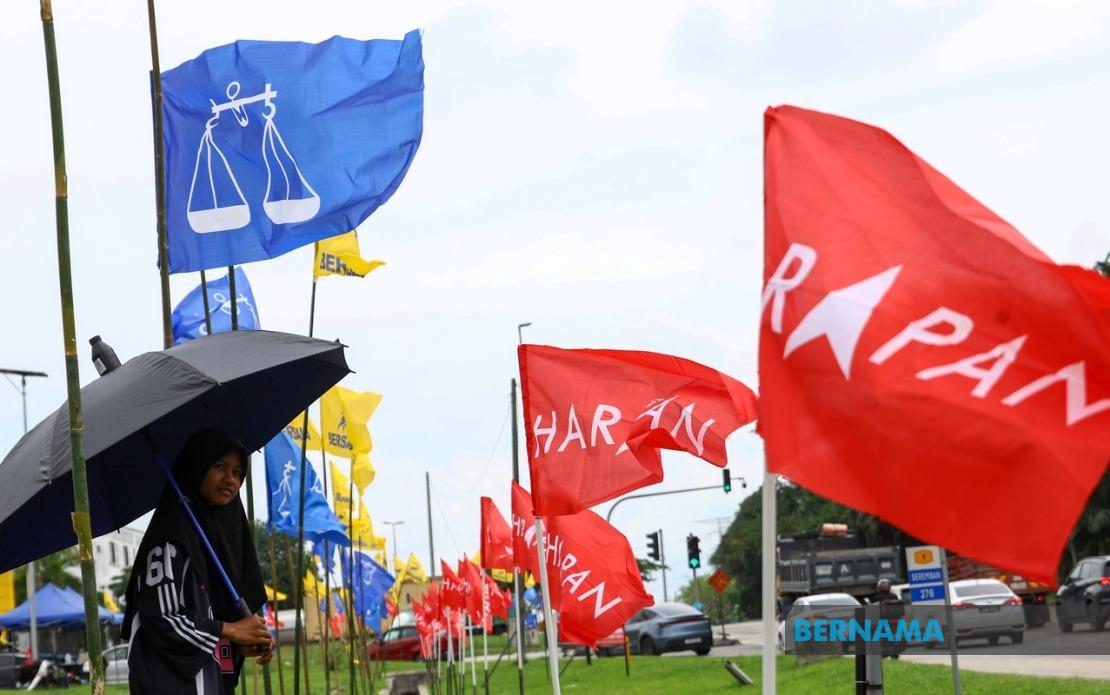
The second week of campaigning for Johor's 16th state election has crystallized a fundamental divide in how the two major political coalitions are seeking to convince voters. Pakatan Harapan and Barisan Nasional, both contesting all 56 seats, have adopted markedly different strategies that reflect their respective organizational assets and perceived electoral advantages ahead of voting on Saturday, July 11. With 172 candidates in play and early voting scheduled for July 7, the campaign has intensified considerably as both camps race to shape the narrative around what kind of government Johor needs.
Pakatan Harapan's core campaign message centres on addressing the material concerns that weigh most heavily on ordinary Johor households. Rather than abstract appeals to growth or progress, PH is positioning itself as a coalition committed to tackling the cost of living, raising incomes, expanding access to affordable housing, and building human capital through genuine economic opportunity. This strategy reflects a deliberate calculation that voters are increasingly pragmatic and sceptical of grand claims disconnected from their daily lived experience. The coalition has launched a manifesto titled "Johor For All" that attempts to operationalize these commitments through concrete policy proposals, particularly initiatives designed to boost domestic wage levels and ensure that foreign investment actually translates into improved living standards for ordinary Johorians rather than concentrating wealth among elites.
This approach reveals something important about how PH perceives the political moment in Johor. The coalition is arguing, in effect, that economic development divorced from shared prosperity is ultimately hollow—that measuring Johor's progress purely through foreign direct investment figures or headline GDP growth rates obscures whether ordinary people are genuinely better off. Dr Mohammad Tawfik Yaakub of Universiti Malaya elaborates that PH is essentially challenging the framework through which development success has traditionally been evaluated in Malaysian politics, insisting instead that tangible improvements in employment quality, housing affordability, and welfare provision should be the true measures of governmental effectiveness.
Barisan Nasional, by contrast, is deploying a dual-pronged approach that leverages both its institutional machinery and carefully cultivated personality politics. The coalition has made considerable strategic capital from the return of two prominent figures through UMNO's "Rumah Bangsa" reconciliation initiative: former UMNO vice-president Datuk Seri Hishammuddin Tun Hussein and former UMNO Youth chief Khairy Jamaluddin. By positioning these politically experienced figures prominently in campaign events, BN is signalling organizational continuity and attempting to project an image of institutional competence backed by recognizable leadership.
Hishammuddin's reactivation in particular carries psychological significance for UMNO. According to Assoc Prof Dr Mohd Yusry Ibrahim of Universiti Malaysia Terengganu and the Ilham Centre, the former vice-president retains substantial personal influence within Johor and potentially appeals to segments of the UMNO base that have drifted away from the party in recent years due to internal conflicts or broader disenchantment with coalition politics. His visible presence on campaign platforms functions as a reassurance mechanism—a signal that UMNO's leadership class remains coherent and committed to competing seriously for power.
Khairy's participation addresses a different electoral vulnerability for BN. The younger political figure has consistently demonstrated stronger appeal among voters under forty, a demographic where traditional party loyalty has eroded considerably. Dr Mohd Yusry notes that voting behaviour among young people has become increasingly volatile and personality-driven rather than inherited. Younger voters, lacking the generational attachment to BN that characterized their parents' electoral choices, respond more to individual political figures they recognize and feel personally connected to rather than abstract party identity. In this context, Khairy functions as a bridge—a recognizable public figure whose personal political brand might generate sufficient interest to move younger voters toward BN despite their general lack of strong partisan commitment.
Yet both analysts caution that these personality-centred strategies encounter a more sophisticated electorate than in previous political eras. Dr Mohammad Tawfik emphasizes that contemporary voters are considerably more discerning than they were even a decade ago. The mere presence of prominent speakers at campaign ceramah no longer automatically translates into electoral advantage. Instead, voters increasingly evaluate whether parties can articulate clear, coherent policy offerings, nominate credible candidates capable of delivering on promises, and demonstrate that their proposals genuinely address the issues voters care about. This shift represents a fundamental challenge to personality-dependent campaign models that assume voter receptivity to charisma or political celebrity status.
The distinction between PH's policy-focused approach and BN's hybrid strategy of institutional strength plus personality politics also reflects different assessments of what has changed in Johor's electorate over the past decade. PH's emphasis on redistributive economic policies and cost-of-living relief implicitly assumes that material anxiety dominates voter calculations. The coalition is banking on the proposition that comprehensive, well-articulated policy solutions that directly address household economic pressures will prove more persuasive than either personality-driven campaigns or abstract invocations of stability and experience. This represents a calculated bet that Johorians have become weary of symbolic politics and are hungry for substantive commitments backed by detailed implementation plans.
Barisan Nasional's strategy, meanwhile, appears to combine confidence in UMNO's organizational reach—the party machine's ability to mobilize voters through established networks—with a recognition that the coalition needs to address specific demographic and political vulnerabilities. By deploying Hishammuddin to shore up the traditional heartland and Khairy to penetrate the younger vote, BN is attempting a targeted approach that acknowledges different segments of the electorate respond to different political stimuli. The strategy assumes that institutional strength remains valuable but insufficient without fresh faces and recognizable personalities.
These contrasting approaches will be tested rigorously on July 11. The outcome will likely reveal which analysis of the Johor electorate proves more accurate—whether voters prioritize policy substance and concrete economic commitments, or whether traditional UMNO organizational networks combined with renewed leadership figures remain decisive. The result will carry implications beyond Johor itself, signalling to both coalitions what campaign strategies prove effective in an era when party loyalty has weakened, voters have become more materially anxious, and personality politics coexist uneasily with demands for substantive governance solutions. For Southeast Asia more broadly, the Johor election offers a case study in how established political machines adapt when confronted with changing voter expectations and demographic shifts that have fundamentally altered electoral dynamics.

