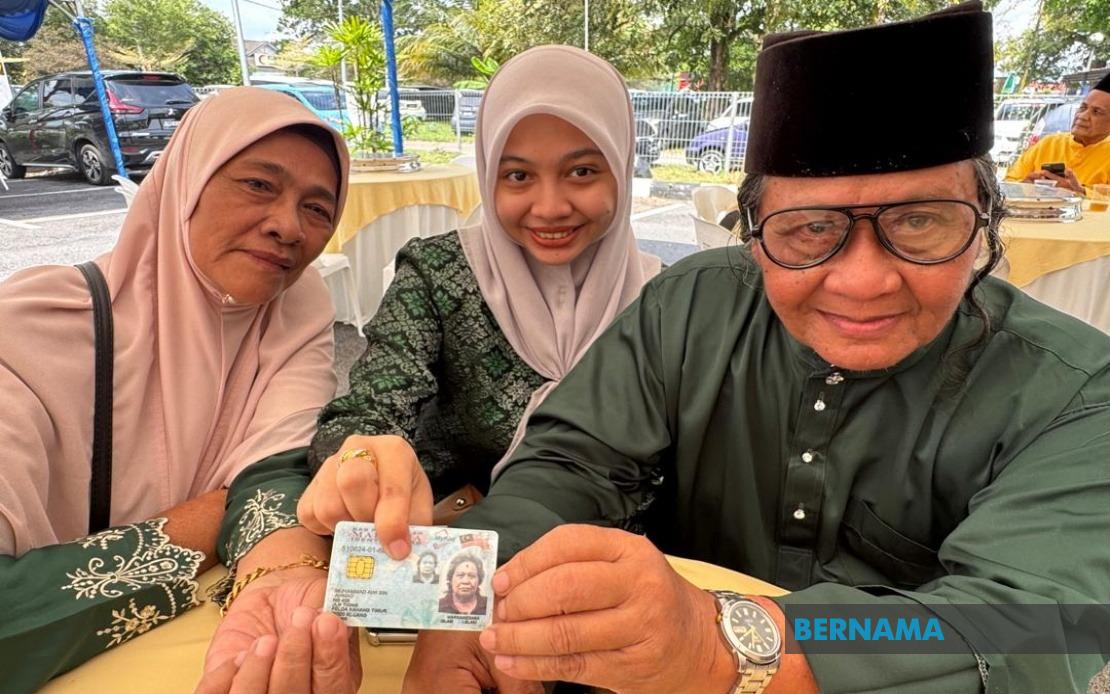
Nearly four decades of uncertainty came to an end for Muhammad Awi Ahmad on his 75th birthday when he received the official title to his 4.2-hectare plantation and home in Felda Kahang Timur, Kluang. The moment represented far more than a bureaucratic formality—it marked the conclusion of an exhausting personal journey that had seen him submit three separate applications over a 30-year span, with the first two attempts in 1990 and 2000 ending in rejection. For this Felda settler and father of four, the approval that finally came through this year, just months into his application, dissolved years of accumulated worry about whether the land he had nurtured since 1986 would ever legally belong to him.
The breakthrough for Muhammad Awi and hundreds of others like him became possible through the Johor state government's determined push to resolve what had become one of the most persistent grievances within the Felda community. The Johor Felda Settlers Land Title Handover Ceremony, held at Dewan Dato' Onn in Kluang and presided over by Menteri Besar Datuk Onn Hafiz Ghazi, formally transferred ownership documents to 210 beneficiaries drawn from three districts—Kluang, Kota Tinggi, and Mersing. The event underscored a visible commitment to untangling property rights that had remained contested or ambiguous for far too long, affecting multiple generations of farming families whose livelihoods depended entirely on land they could not legally claim.
The scale of the achievement becomes apparent when examining the broader statistics. To date, approximately 99.9 percent of all Felda settlers in Johor who filed applications—totalling 27,639 out of 27,642—have now received formal ownership titles. This near-complete resolution of the land title issue represents a watershed moment for an organisation founded in 1956 to resettle rural populations and develop agricultural land, yet which had unwittingly created a parallel problem by failing to expedite property ownership documentation for its beneficiaries. The slim margin of outstanding cases suggests that the end point of this long-running administrative saga may finally be within reach.
Beyond the statistical success, however, lies a deeper intergenerational anxiety that has preoccupied settler families. Norliyani, 25, the daughter of Muhammad Awi and herself part of the second generation of Felda settlers, articulated a concern that resonates throughout the farming communities affected by decades-long title delays. She highlighted that while the first generation of settlers maintained cultural and family ties to their original villages—meaning they theoretically had somewhere to retreat if they lost their Felda land—subsequent generations had known only their Felda plots as home. For them, the absence of clear property ownership created an existential threat. Without secure titles, the accumulated labour of their parents risked passing to others, leaving younger members of settler families without either inheritance or security.
The emotional and practical dimensions of this problem are illustrated through the experience of Mohd Farhan Mohamad, a 43-year-old resident of Felda Pasak in Kota Tinggi. His father, Mohamad Masek, had been cultivating land since the 1980s but lacked the legal documentation to prove ownership. When Mohd Farhan first lodged an application in 2006 to secure his father's position, the process seemed to stretch indefinitely. Only after resubmitting the application last year did approval finally arrive—a 17-year interval that encapsulated the broader system's dysfunction. For Mohd Farhan and his aging father, the title represented the fulfilment of a wish that had seemed increasingly unlikely to be granted.
The origins of this title problem trace back to the foundational structure of Felda schemes themselves. When the Federal Land Development Authority established its settlements, the administrative machinery for converting land use rights into absolute ownership titles proved sluggish and poorly coordinated. Settlers received parcels to work but faced bureaucratic obstacles when attempting to transition those usufruct rights into freehold ownership, a disconnect that persisted across decades regardless of which administration held power. The accumulation of rejected and delayed applications created a backlog that eventually became a political liability, particularly as settlers aged and passed away without resolving their estate issues.
Menteri Besar Datuk Onn Hafiz Ghazi's administration appears to have prioritised clearing this backlog as part of a broader effort to address longstanding grievances within the agricultural sector. The acceleration of processing—where applications like that of Muhammad Awi and Mohd Farhan that might previously have languished for years were resolved within months or a year—suggests either a policy shift toward prioritisation or an injection of administrative resources previously unavailable. For a state government seeking to strengthen its connection to rural constituencies, resolving such concrete property disputes delivers tangible results that resonate far more powerfully than policy announcements.
The implications of this achievement extend beyond individual settler families to affect regional economic development and rural stability. When farming communities lack secure property tenure, they become reluctant to invest substantially in improvements, equipment upgrades, or long-term planning. Banks hesitate to extend credit secured against uncertain titles. Young people are more inclined to migrate toward urban employment rather than inherit land they cannot confidently call their own. By finally establishing clear ownership for the overwhelming majority of Johor's Felda settlers, the state government has removed a significant psychological and legal barrier to agricultural productivity and investment in these rural communities.
For other states with significant Felda populations—particularly in Peninsular Malaysia's eastern and southern regions—the Johor resolution offers both a model and an implicit challenge. Perak, Pahang, and other states with substantial Felda settlements have comparable backlogs of unresolved title applications. The visibility of Johor's success, particularly the symbolic timing of Muhammad Awi's approval on his 75th birthday, demonstrates that rapid resolution is administratively feasible and politically rewarding. It also signals to settler communities in other states that their long waits may soon face similar resolution efforts, creating pressure on their respective state governments to accelerate their own land title distribution programmes.
Looking forward, the near-completion of Johor's land title handover still leaves unresolved the question of how such administrative failures are prevented in future policy implementation. The fact that settlers waited three decades for documentation that should have accompanied their initial settlement raises important questions about institutional design and oversight. As Malaysia contemplates new rural development initiatives and land allocation schemes, the Felda experience suggests the necessity of embedding property registration and title transfer mechanisms into the initial framework rather than leaving them as afterthoughts to be resolved decades later. The settlers' long struggle to claim what they had already earned through decades of labour serves as a cautionary tale for policymakers.
The ceremonies in Kluang represent a moment of closure for thousands of families and a reaffirmation of the state government's commitment to settling outstanding disputes within its agricultural heartland. Yet they also mark the culmination of a chapter that should never have extended so long. Muhammad Awi Ahmad's 75th birthday gift—finally secured after twenty-five years of waiting—carries the weight of all those delayed applications, rejected submissions, and years of uncertainty that characterised the Felda settlement experience. His receipt of the title, alongside 209 others that day and thousands more before them, confirms that even long-abandoned administrative obligations can eventually be discharged, though the cost to those who waited is measured in decades of unnecessary anxiety.

