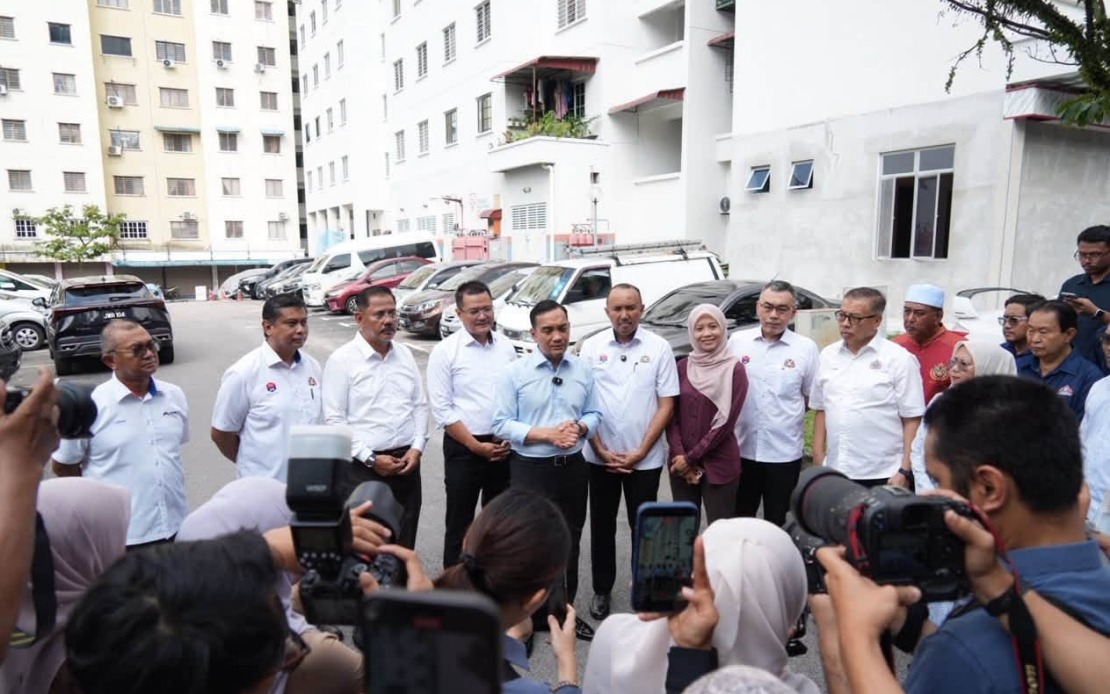
The Johor state government is undertaking an ambitious RM50 million initiative to refresh the appearance and morale of its public and low-cost housing estates, a decision that reflects the administration's commitment to quality-of-life improvements for working-class residents. The comprehensive painting programme will encompass 170 housing blocks containing 11,693 units distributed across 26 locations throughout the state, directly impacting approximately 46,772 households whose living environments have deteriorated over time from weather exposure and age.
Datuk Mohd Jafni Md Shukor, chairman of the Johor Housing and Local Government Committee, emphasised that while external observers might dismiss such work as merely cosmetic maintenance, the psychological and social dimensions of well-maintained surroundings significantly exceed surface-level aesthetics. Enhanced visual environments cultivate a sense of dignity among residents, reinforce communal bonds, and signal governmental responsiveness to the daily concerns of ordinary families. The initiative thus carries symbolic weight alongside its practical benefits, communicating that state leadership regards the welfare and dignity of lower-income communities as a genuine priority rather than a rhetorical commitment.
The programme's scope demonstrates coordination across multiple administrative tiers and agencies, with implementation responsibility distributed among the Johor State Housing Development Corporation, the state secretary's housing division, and four major municipal authorities covering Johor Bahru, Iskandar Puteri, Pasir Gudang, and Kulai. This multi-agency approach suggests sophisticated project management recognising that successful execution requires seamless cooperation between state-level policy entities and local councils responsible for ground-level service delivery. Such institutional coordination remains critical for infrastructure projects in Malaysia, where fragmented administrative structures frequently complicate execution timelines and quality standards.
Mohd Jafni and Menteri Besar Datuk Onn Hafiz Ghazi conducted site inspections at the Desa Muafakat Apartments complex, one of the programme's pilot locations, where the repainting initiative is underway alongside concurrent infrastructure projects. Beyond the painting work itself, officials identified and are addressing subsidiary maintenance issues affecting residential quality, including slope subsidence problems near parking facilities and deteriorating internal road conditions. This integrated approach suggests that the state recognises housing complexes as interconnected systems requiring holistic intervention rather than isolated cosmetic fixes.
The repainting programme must be understood within Malaysia's broader context of ageing public housing stock and limited maintenance budgets affecting hundreds of thousands of families nationwide. Many state-built apartments and low-cost housing schemes constructed during the 1980s and 1990s now display visible signs of weathering, with faded paintwork, mould accumulation, and structural blemishes that compound residents' psychological stress and sense of abandonment. When governments delay such maintenance, residents often interpret inaction as indifference to their circumstances, potentially eroding political trust and social cohesion in communities already experiencing economic pressures.
Johor's decision to allocate this substantial sum reflects political calculations about voter sentiment and community expectations in a state where low-cost housing accommodates a significant electoral bloc. The timing and scale of investment also indicate state-level confidence in revenue generation, allowing the administration to fund quality-of-life initiatives beyond bare-minimum service provision. For Malaysian policymakers elsewhere, the Johor initiative offers a demonstration that relatively modest per-unit investments in environmental improvement can yield substantial returns in resident satisfaction and community morale when implemented comprehensively across multiple locations simultaneously.
Quality assurance mechanisms are embedded within the programme's structure, with Mohd Jafni specifically cautioning contractors and implementing agencies against producing superficially satisfactory work that deteriorates rapidly post-completion. This emphasis on durability and standards reflects hard-learned lessons from previous government projects where cutting corners on materials or workmanship resulted in premature degradation and renewed resident dissatisfaction. The chairman's public statement reinforcing these expectations serves both as motivation for contractors and as transparent communication to residents that their tax contributions are being spent with appropriate oversight.
For residents in these housing complexes, particularly families with limited disposable income, the programme represents tangible evidence of governmental responsiveness to their immediate environment. Fresh paint, enhanced aesthetics, and visible maintenance work communicate that these communities retain value within state priorities, countering the marginalisation that often characterises perceptions within low-income housing settlements. Such psychological and social benefits frequently exceed the actual financial value of the intervention, as residents experience renewed sense of belonging and civic dignity.
The programme's implementation timeline and contractor performance will determine whether this initiative becomes a template for subsequent state-level housing maintenance or remains an isolated gesture. If successfully delivered across all 26 locations within projected schedules and budget parameters, Johor may establish a replicable model for other states managing deteriorating public housing stock. Conversely, delays or quality shortfalls would reinforce scepticism about government project execution capabilities, potentially undermining resident confidence in future state-initiated improvements.
Beyond immediate housing concerns, this initiative reflects evolving state governance philosophy recognising that social stability and political legitimacy depend partly on environmental dignity and visible governmental presence in lower-income communities. As Malaysia's middle class expands and living standards expectations rise across income strata, governments face increased pressure to maintain infrastructure quality even for lower-cost segments. The RM50 million investment thus serves broader state interests in social cohesion and political stability alongside its direct benefits to nearly 47,000 households, establishing a precedent for proactive rather than reactive housing maintenance policy.

